
If you own a home anywhere in Cuyahoga County, whether it’s a bungalow in Cleveland, a colonial in Parma, or a century home in Lakewood, you’re paying property taxes. But do you really know how those numbers are calculated? For many homeowners considering selling or just trying to manage their budget, the process can feel overwhelming, especially with terms like market value, assessed value, and millage rates being thrown around. It’s easy to get lost and feel stressed.
We understand. Navigating this system, especially when you're facing financial pressure or a major life change, is tough. This guide is your flashlight in the dark. We’re going to provide a complete, plain-English breakdown of how the property tax system works in Cuyahoga County, what affects your bill, and what you can do to manage it.
And if you find that rising taxes are making your home unaffordable, know that you have options. At Home Sweet Home Offers, we help homeowners in situations just like yours by providing a fast, simple way to sell your house as-is, giving you a fresh start.
Understanding the Basics of Property Taxes
For most of us, the property tax bill is one of the biggest costs of owning a home. The best way to think of it is as your home’s annual membership fee for all the local services we rely on—from our schools and libraries to our police and fire departments. It’s not an arbitrary number; it’s a calculated amount that keeps our communities in Cleveland, Euclid, and Garfield Heights running.
Property taxes are paid by the owners of real property, and they are the financial engine for everything that makes Cuyahoga County a great place to live. These funds support our schools, parks, public safety, and infrastructure.
In Ohio, state law requires a predictable cycle for property valuations to ensure fairness. Every property is reassessed every three years, with a full, in-depth reappraisal every six years. This is why you might see your tax bill change even if you haven’t done a thing to your house.
Who Manages Property Taxes in Cuyahoga County
A few key government offices work together to manage this complex system. As a homeowner, knowing who does what is the first step to feeling in control.
- Fiscal Officer (Auditor): This office is responsible for determining the fair market value of every single property in the county. They also handle applications for tax credits like the Homestead Exemption. You can find more information on their official website: Fiscal Officer.
- Treasurer’s Office: Once the values are set, the Treasurer's job is to create and mail the tax bills, collect the payments, and manage payment plans. Their website is your go-to for payment options and deadlines: Treasurer.
- Board of Revision (BOR): If you look at your valuation and think, "Wait, that's not right," this is the board you talk to. They are an independent body that handles appeals and disputes to keep the assessment process fair for everyone. You can learn about the appeals process here: Board of Revision.
This online portal is where you can manage payments, check your bill, and find other critical tax info without having to leave your couch.
How Your Property Tax Bill Is Calculated
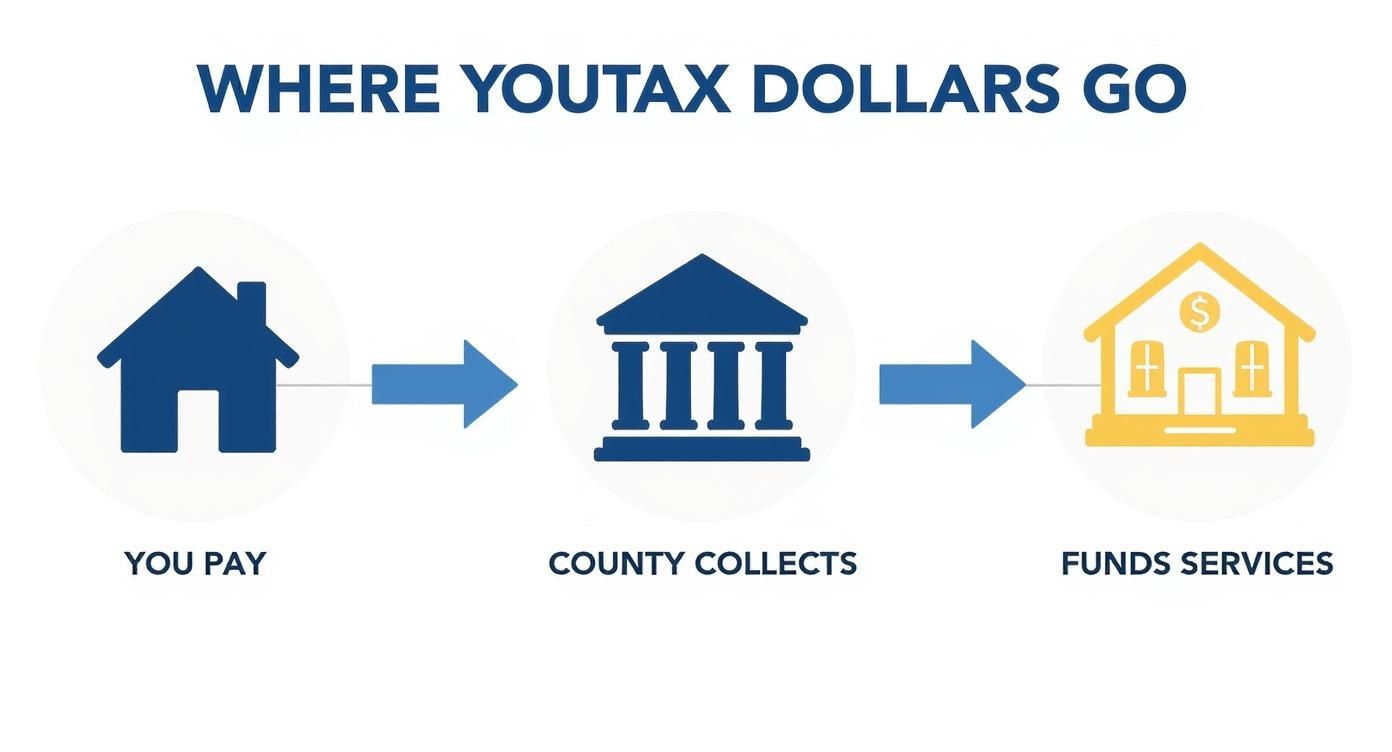
Figuring out the math behind your Cuyahoga County property tax bill is the best way to understand where your money is going. It all boils down to a simple, four-step formula that takes your home's market value and turns it into your final tax payment. Let’s walk through it with a clear example.
Step 1: The Fiscal Officer Sets Your Home’s Market Value
Everything starts with your home's market value. This isn't a random guess; it's the amount the Cuyahoga County Fiscal Officer estimates your property would realistically sell for on the open market. They look at recent sales of similar homes in your neighborhood, local market trends, and details about your property, like its size and condition.
Example: A home in Parma has a market value of $200,000.
Step 2: Determine Your Assessed Value
Here’s a key detail: you are not taxed on the full market value of your home. Ohio law mandates that property taxes are calculated using the assessed value, which is a fixed 35% of the market value. This is a big deal because it significantly lowers the amount you're actually taxed on.
For our example:
$200,000 (Market Value) × 0.35 = $70,000 (Assessed Value)
This $70,000 is the number that really matters for the next step.
Step 3: Apply Your Local Millage Rate
Next up is the millage rate. A "mill" is a tax unit that equals $1 for every $1,000 of your assessed value. These rates are decided by voters in your specific city, township, and school district to fund local services. It’s why tax bills can be so different between neighboring communities. For instance, Cleveland Heights and Shaker Heights often have some of the highest millage rates due to strong support for their school levies.
- 1 mill = $1 in tax per $1,000 of assessed value.
- A rate of 100 mills means you pay $100 for every $1,000 of assessed value.
Using our example with a sample rate of 100 mills, the initial tax calculation looks like this:
$70,000 (Assessed Value) ÷ 1,000 × 100 (Mills) = $7,000 (Gross Annual Tax)
Step 4: Subtract Credits and Reductions
Finally, we subtract any tax credits you’re eligible for. The two most common are the Owner-Occupancy Credit (a 2.5% rollback) and the Homestead Exemption for seniors. These credits can reduce your final bill.
Let’s apply the Owner-Occupancy Credit to our example, which would lower the bill by $175. If other credits apply, the final bill could drop even further. For instance, the final bill may drop to around $5,800/year after all applicable credits.
Seeing it step-by-step makes it clear how each part of the formula impacts your final bill. For a more detailed look with other local examples, check out our guide on how property taxes are calculated in Cuyahoga County.
Understanding Millage Rates Across Cuyahoga County
The "assessed value" is only half of the property tax puzzle. The other critical piece is the millage rate—and it explains why two homes with the same market value in Shaker Heights and Bedford can have wildly different tax bills.
A mill is simply 1/10th of a cent, or $1 in tax for every $1,000 of assessed value. Each city, township, and school district sets its own rates based on voter-approved levies. When voters pass a new school levy, for example, the millage rate goes up for everyone in that district. This is why areas known for excellent school systems often have higher property taxes.
Here’s a quick comparison to show you how much these rates can swing your annual tax bill for a home with a $200,000 market value (assessed value of $70,000):
| City / Area | Approx. Millage Rate | Est. Annual Tax on $200K Home (before credits) |
|---|---|---|
| Cleveland | 97 mills | ~$6,790 |
| Parma | 90 mills | ~$6,300 |
| Shaker Heights | 120 mills | ~$8,400 |
| Lakewood | 102 mills | ~$7,140 |
| Maple Heights | 115 mills | ~$8,050 |
(Note: These are sample approximations for illustration. Your exact rate depends on your specific tax district. Source: Cuyahoga County Fiscal Officer data.)
Property Value Reassessments and Updates
Your property's value isn't static. To keep things fair and aligned with the current real estate market, Ohio law requires Cuyahoga County to re-evaluate every property on a predictable schedule.
The county’s website has a fantastic tool for this. The Real Property Information search lets any homeowner look up their property's current valuation and tax details in seconds.
The reassessment cycle has two key events:
- Full Reappraisal (Every 6 years): A comprehensive appraisal of every property, sometimes involving physical inspections.
- Triennial Update (Every 3 years): A statistical update using recent sales data to adjust values.
The most recent triennial update was in 2024, and many homeowners saw a sharp increase in their property's market value. This was especially true in appreciating neighborhoods like Old Brooklyn or West Park. When your home's value shoots up, your tax bill usually follows. If your assessed value seems too high, you can appeal it—we’ll explain how later. For homeowners on a fixed income, these sudden increases can be a huge source of stress.
Tax Credits, Reductions, and Exemptions
Thankfully, both the State of Ohio and Cuyahoga County offer programs designed to lower your tax bill. These aren't loopholes; they're established credits meant to ease the financial burden.
Here are the main programs available to homeowners in Cleveland and surrounding suburbs:
- Owner-Occupancy Credit (Rollback): This is a 2.5% reduction on the tax bill for your principal residence. Most homeowners automatically receive this credit when they purchase their home.
- Homestead Exemption: This is a significant benefit for seniors (65+) or individuals who are permanently and totally disabled. It exempts the first $25,000 of your home's market value from taxation, which can save hundreds of dollars annually. To qualify, you must meet certain age/disability and income requirements. You can find more information and apply here: Homestead Exemption Info.
- Special Assessments: These are not credits, but rather extra charges that may appear on your tax bill for specific local improvements like new sidewalks, sewers, or street lighting in your immediate area.
Property Tax Payment Schedule and Options
In Cuyahoga County, property taxes are billed twice a year (semi-annually). Keeping track of these deadlines is crucial to avoid penalties.
- First Half Due: Typically in January.
- Second Half Due: Typically in July.
The Treasurer’s Office offers several convenient ways to pay your bill:
- Online: Through the official Pay Property Taxes Online portal.
- By Mail: Sending a check to the address listed on your bill.
- Via Mortgage Escrow: Most homeowners with a mortgage pay their taxes this way. Your lender collects a portion each month with your mortgage payment and pays the bill on your behalf.
- In Person: At the Cuyahoga County Administrative Headquarters.
Be aware that if you miss the deadline, a 10% penalty is added to your bill for delinquent taxes.
How to Appeal Your Property Tax Valuation
When you get your valuation notice and the number seems way too high, you don't have to just accept it. Every homeowner has the right to challenge their property's official valuation through the Cuyahoga County Board of Revision (BOR). A successful appeal can lower your assessed value and reduce your annual tax bill.
Here’s the step-by-step process:
- Gather Evidence: The BOR needs proof that your home's value is inaccurate. Strong evidence includes recent sales of comparable homes in your neighborhood that sold for less, a professional appraisal, or documentation of significant condition issues (like a failing foundation or major damage).
- File Your Complaint: You must complete the official complaint form, which you can find on the BOR's website. The filing window is from January 1st to March 31st each year. You can download the form here: BOR Appeal Application.
- Attend Your Hearing: After filing, you'll be scheduled for a short hearing (in person or virtual) where you can present your evidence to a panel.
The board will review your case and mail you a decision. They could reduce your value, leave it unchanged, or, in rare cases, even increase it if they find evidence to support a higher valuation.
What Happens If You Don’t Pay Property Taxes
Falling behind on property taxes can lead to serious consequences. The county will add penalties and interest, causing the amount you owe to grow quickly.
If the taxes remain unpaid for a long period, the county can place a tax lien on your property. This can eventually lead to a tax lien sale or even foreclosure, where you could lose your home entirely. Many of these properties are eventually acquired by the Cuyahoga County Land Bank.
For some owners, especially those facing financial hardship, job loss, or divorce, selling the property before delinquency becomes a major issue is the smartest way to protect their equity and financial future.
When Selling Makes More Sense Than Paying Rising Property Taxes
For many long-time homeowners in Cuyahoga County, especially retirees on a fixed income, rising property taxes can turn a cherished home into an unsustainable financial burden. If you bought your house in Bedford for $60,000 in 2005 and your annual taxes are now approaching $6,000, it may be time to cash out your equity and simplify your life.
When the cost of ownership—taxes, insurance, and constant repairs—outweighs the benefits, selling your home as-is can provide immediate relief. This is particularly true if you are tired of being a landlord, inherited a property you can't manage, or are relocating for a new job.
At Home Sweet Home Offers, we provide a stress-free solution. As cash home buyers in Cuyahoga County, we can help you avoid high property taxes and the hassles of a traditional sale. We buy houses in any condition, so you don’t have to worry about repairs or updates. If you need to sell your house as-is in Cleveland, we can provide a fair cash offer and close on your timeline.
FAQ Section
How often does Cuyahoga County reassess property values?
The county conducts a full reappraisal every six years and a statistical "triennial update" every three years in between. The most recent update was in 2024.
Why did my taxes go up if my home didn’t change?
Your taxes can increase for two main reasons: 1) The county reassessed your property's market value based on rising home prices in your area, or 2) Voters in your city or school district approved new tax levies, which increased the millage rate.
Can I appeal my tax bill every year?
Yes, you have the right to file an appeal with the Board of Revision every year between January 1 and March 31 if you believe your property's valuation is incorrect.
What’s the average property tax rate in Cuyahoga County?
There is no single "average" rate, as it varies significantly by city and school district. Rates can range from around 90 mills to over 120 mills, depending on local levies.
Can I sell a home with delinquent taxes?
Yes. When you sell, any overdue taxes, penalties, and interest are simply paid from the sale proceeds at closing. The title company ensures the county is paid before you receive the remaining funds, making it a smooth process.
Your Partner in Navigating Real Estate Challenges
Understanding your property taxes empowers you to plan smarter and protect your investment. It’s a complex system, but knowing the key players, formulas, and deadlines gives you the control you need as a homeowner in Cuyahoga County.
If rising taxes, costly upkeep, or a difficult life situation have made your home unaffordable or a source of stress, Home Sweet Home Offers can help. We are local experts who understand the challenges Cleveland-area homeowners face. We buy homes across Cuyahoga County as-is—no commissions, no repairs, and no waiting. You can get a fast, fair cash offer and move forward with peace of mind.
Call us at 702-281-9498 or request your free cash offer today.
Sources
- Cuyahoga County Fiscal Officer – Real Property Information
- Cuyahoga County Treasurer’s Office
- Cuyahoga County Board of Revision
- Ohio Department of Taxation – Property Tax Division
- Cleveland.com – Property Tax Rate Analysis