

Property taxes in Portage County can feel like a maze, especially for homeowners trying to make sense of their budget. With a diverse mix of cities, suburbs, college areas like Kent, and rural townships, the rules and rates seem to shift depending on where you live. For many of us, seeing home values go up has been great, but it's also brought confusing—and frankly, stressful—hikes in our tax bills. If you're a homeowner in Cleveland or a nearby suburb like Parma or Euclid considering selling, you know that understanding these costs is critical.
The goal of this guide is to give you a simple, trustworthy roadmap. We understand that for many sellers, especially those facing financial pressure, a rising tax bill can be the final straw. We’ll walk through exactly what your taxes are paying for, how they’re calculated, and what you can do if that bill starts to feel like too much to handle. We'll show you how Home Sweet Home Offers can provide a clear solution.
What Property Taxes Pay For in Portage County
For homeowners across Portage County—from the busy streets near Kent State to the quiet, sprawling lots in Rootstown—that property tax bill can unleash a wave of questions. It's natural to wonder where all that money is actually going.
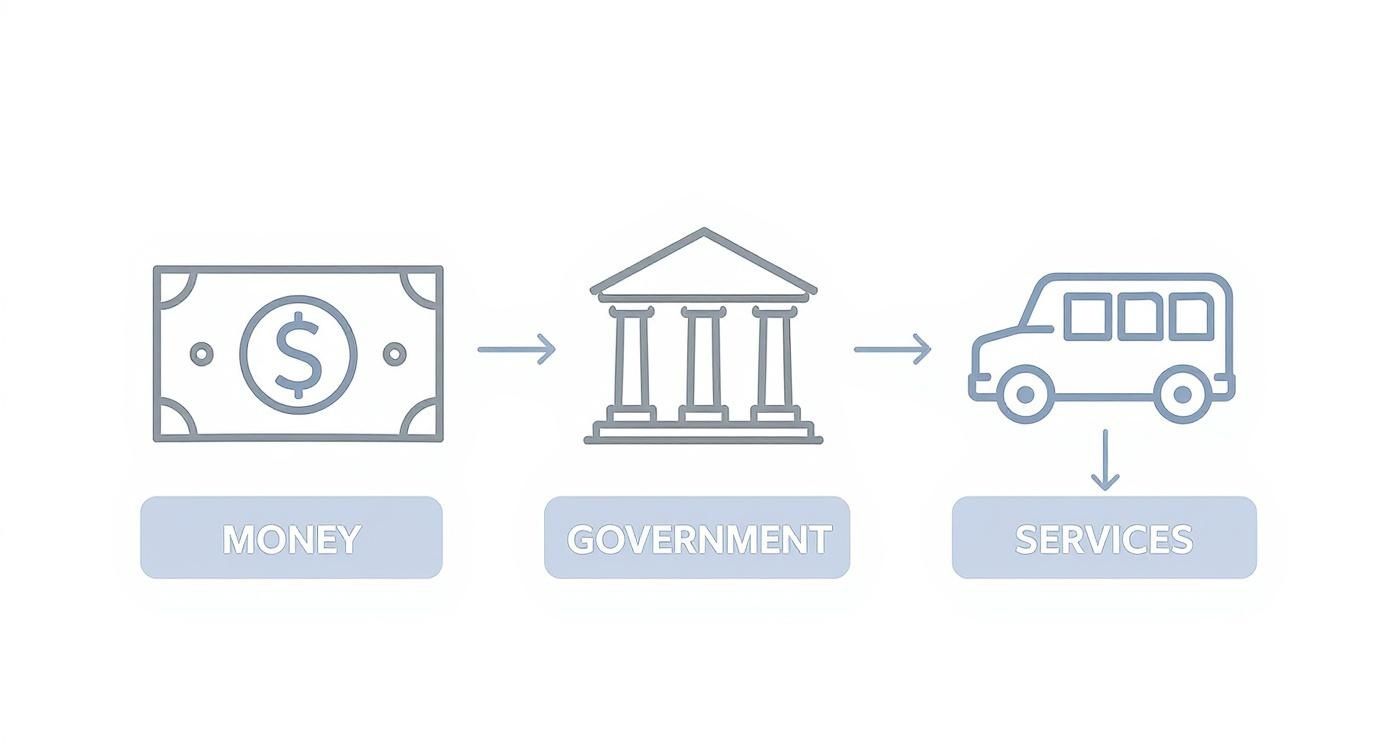
Think of your property tax payment as an investment in the community you live in. The funds collected are the primary source of revenue for essential local services that keep our neighborhoods running safely and smoothly. The largest portion, by far, goes to funding our public schools.
Here’s a general breakdown of what your tax dollars support:
- Public Schools: This is the biggest share, funding everything from teacher salaries and classroom supplies to school building maintenance in districts like Aurora, Kent, and Streetsboro.
- Safety Services: Your taxes pay for the police officers, firefighters, and EMS personnel who serve your community.
- Infrastructure: This includes maintaining roads, bridges, and handling critical services like snow removal.
- County and Local Services: This covers the costs for county government operations, public libraries, and parks.
- Township or City Government: These funds support the day-to-day operations of your specific municipality, whether you're in Ravenna, Mantua, or Rootstown.
Each city and township has its own unique mix of voter-approved levies, which is why the tax rates (or "millage") can vary so much from one town to the next.
Who Manages Property Taxes in Portage County
Navigating the property tax system can feel overwhelming, but it helps to know who the key players are. Three main county offices work together to manage the entire process, from valuing your home to collecting your payments. Understanding their roles can make it easier to find the right person to talk to if you have questions or concerns.
A. Portage County Auditor (Fiscal Officer)
The Auditor's office is where it all starts. Their primary job is to determine the fair market value of every single property in the county. This involves conducting county-wide reappraisals and maintaining detailed records for each parcel. If you have questions about your home’s valuation or want to apply for exemptions like the Homestead Credit, the Auditor is your go-to resource.
- Website: https://www.portagecountyauditor.com
B. Portage County Treasurer
Once the Auditor sets the value and the tax rates are applied, the Treasurer takes over. This office is responsible for mailing out the property tax bills and collecting the payments. If you're facing issues with paying your taxes, have questions about payment plans, or are dealing with delinquent taxes, the Treasurer’s office is who you need to contact.
C. Portage County Board of Revision (BOR)
If you believe the Auditor's valuation of your property is too high, the Board of Revision is where you can formally challenge it. This three-person board hears appeals from homeowners who can provide evidence that their property's market value is incorrect. Filing an appeal is a formal process with a strict deadline.
- Website: https://www.co.portage.oh.us
How Property Taxes Are Calculated in Portage County
At first glance, the formula the Portage County Auditor uses to calculate your tax bill can look intimidating. But once you break it down, it's a straightforward, four-step process. We understand that as a homeowner considering a sale, knowing these numbers is crucial for your financial planning. Let's walk through it in plain English.
Step 1: Determine Market Value
Everything starts with your home’s Market Value. This is the price the County Auditor believes your home would sell for on the open market. This isn't a random guess; it's based on recent sales of similar homes in your neighborhood.
- Example: A home in a desirable Aurora neighborhood might have a Market Value of $250,000 based on comparable sales.
Step 2: Calculate Assessed Value (35% Rule)
In Ohio, your property is not taxed on its full market value. Instead, it's taxed on its Assessed Value, which is legally set at 35% of the market value.
- Formula: Market Value × 0.35 = Assessed Value
- Example: $250,000 (Market Value) × 0.35 = $87,500 (Assessed Value)
This $87,500 is the taxable base for your property.
Step 3: Apply Millage Rate
"Millage" is the tax rate. One mill equals $1 of tax for every $1,000 of assessed value. Each city, township, and school district has its own total millage rate based on voter-approved levies. This is why taxes vary so much across the county.
- Formula: (Assessed Value ÷ 1,000) × Millage Rate = Gross Annual Tax
- Example (Streetsboro with ~95 mills): ($87,500 ÷ 1,000) × 95 = $8,312.50 (Gross Annual Tax)
Step 4: Apply Rollbacks & Exemptions
Finally, certain credits are applied to lower your final bill. The two most common are the Owner-Occupancy Credit (a rollback automatically applied to your primary residence) and the Homestead Exemption for qualified seniors and disabled homeowners.
Let's look at another example for a rural area with lower taxes.
- Example (Atwater Township with ~70 mills):
- Home Market Value: $200,000
- Assessed Value: $200,000 × 0.35 = $70,000
- Gross Tax: ($70,000 ÷ 1,000) × 70 = $4,900
This shows how both property value and local millage rates create vastly different tax bills across Portage County. Understanding this calculation is the first step toward managing this significant homeownership expense.
Property Tax Rates in Major Portage County Cities
One of the most common questions we hear from homeowners is, "Why is my tax bill so different from my friend's in the next town over?" The answer lies in the local millage rates. Where you live in Portage County is the single biggest factor in determining your property tax bill.
Communities with excellent schools and more city services, like Aurora and Streetsboro, often have higher tax levies to support them. In contrast, rural areas in southern Portage County, like Atwater or Mantua Township, tend to have significantly lower millage rates because they have fewer municipal services to fund.
To illustrate this, the table below provides an approximate look at the annual tax bill for a home with a market value of $250,000 in several key communities. These are estimates before any credits are applied.
Estimated Annual Property Tax on a $250,000 Home
| City/Township | Approx. Millage Rate | Est. Tax on $250K Home |
|---|---|---|
| Aurora | High (~110 mills) | ~$9,625 |
| Streetsboro | Medium (~95 mills) | ~$8,312 |
| Kent | Variable by school district (~90–100 mills) | ~$7,875 – $8,750 |
| Ravenna | Moderate (~90 mills) | ~$7,875 |
| Rootstown | Moderate (~85–90 mills) | ~$7,437 |
| Mantua Township | Lower (~70–80 mills) | ~$6,125 |
| Atwater / Randolph | Lower (~65–75 mills) | ~$5,687 |
The difference is clear. A homeowner in Aurora could pay thousands more per year than someone in a home of the same value in Atwater. For homeowners on a fixed income or those considering selling, this annual cost is a major factor in their financial decisions.
Reappraisals and Triennial Updates
If you’ve ever opened your property tax bill and been shocked by a sudden increase, the culprit is often a county-wide reappraisal or triennial update. This is a routine process required by Ohio law to keep property values in sync with the current real estate market.
Here’s how it works:
- Full Reappraisal (Every 6 Years): The Portage County Auditor's office conducts a comprehensive re-evaluation of every property. Appraisers analyze sales data and may physically inspect neighborhoods to establish new, accurate market values.
- Triennial Update (Every 3 Years): In between full reappraisals, the Auditor performs a market-based adjustment. They analyze sales data from the past three years to update property values based on recent trends.
After the post-2020 housing boom, many homeowners in high-demand areas like Kent and Aurora saw steep increases in their property valuations. A hot real estate market directly translates to a higher valuation for tax purposes.
For homeowners in Cleveland, Lakewood, or Garfield Heights, understanding this process is vital. A sudden jump in property taxes can be a major stressor, especially if you're already considering selling due to financial hardship or a life change. This reassessment can be the final push that makes selling the most practical option.
Tax Credits, Reductions, and Exemptions
While property tax bills can be high, several state and local programs are available to help eligible Portage County homeowners reduce their burden. These credits and exemptions can provide significant savings. We know that for sellers in situations like divorce or relocation, every dollar counts.
Here are the primary programs you should be aware of:
- Homestead Exemption: This is a valuable credit for seniors (age 65 and older) or permanently and totally disabled homeowners who meet certain income requirements. It exempts a portion of your home's value from taxation, which can lower your annual bill by hundreds of dollars.
- Owner Occupancy Credit (Rollback): If the property is your primary residence, you automatically receive this credit. It’s a tax reduction that shows up as a "rollback" on your bill, ensuring you pay less than non-owner-occupied properties.
- CAUV (Current Agricultural Use Value): This program provides a significant tax reduction for landowners who use their property for commercial agriculture. It assesses the land based on its agricultural value rather than its market value, dramatically lowering the tax burden for farmers.
- Non-Profit or Government Exemptions: Properties owned and used by qualifying non-profit organizations, religious institutions, or government entities are typically exempt from property taxes.
You can find applications and more detailed eligibility requirements for these programs on the Portage County Auditor's website.
Payment Schedule + How to Pay
In Portage County, property taxes are billed twice a year. Staying on top of these deadlines is crucial to avoid costly penalties. For homeowners under stress, such as those facing foreclosure or inheriting a property, missing a payment can create even more problems.
Key Due Dates:
- First Half Due: Mid-February
- Second Half Due: Mid-July
Failure to pay by the due date typically results in a 10% penalty on the unpaid balance.
You have several convenient options for paying your bill:
- Online: Through the official portal on the Portage County Treasurer's website.
- By Mail: Send a check or money order to the Treasurer’s office.
- In Person: Pay at the Treasurer’s office in Ravenna.
- Through Mortgage Escrow: If you have a mortgage, your lender likely collects a portion of your property taxes with each monthly payment and pays the bill on your behalf. It's still wise to confirm they've paid it.
How to Appeal Your Property Tax Valuation
If you believe the Auditor's market valuation of your home is too high, you have the right to challenge it. The formal process is to file a complaint with the Portage County Board of Revision (BOR). We understand that for sellers, an unfairly high valuation can affect everything from your budget to your home's perceived value.
The Appeal Process:
- Deadline: You must file your complaint form (DTE Form 1) by March 31 of each year.
- Grounds for Appeal: You are challenging the market value of your property, not the tax rate. You need evidence that your home is worth less than the Auditor's assessment.
- Gather Evidence: Strong evidence is key. This can include a recent independent appraisal, photos of property damage, repair estimates, or data on recent sales of comparable homes that sold for less.
- Attend a Hearing: You will present your case to the Board of Revision.
- Receive a Decision: The Board will review your evidence and issue a decision.
Local Example: A homeowner in Kent near the university may find their home is valued higher due to strong student rental sales in the area, even if their own property is in poor condition and needs significant repairs. In this case, an appeal with photos and repair estimates could be successful.
What Happens If You Don’t Pay Property Taxes
Falling behind on property taxes is a stressful situation that can escalate quickly. We speak to homeowners in Cleveland, Maple Heights, and Bedford every day who are worried about this exact issue. In Portage County, the consequences are serious and can ultimately lead to losing your home.
Here's the typical progression:
- Late Penalties & Interest: A penalty is added immediately after the due date, and interest begins to accrue on the delinquent amount.
- Certified Delinquency: After about a year of non-payment, your taxes are certified as delinquent, and your name may be published in the local newspaper.
- Tax Lien Sales: The county can sell a tax lien on your property to a third-party investor, who can then charge you higher interest rates and fees.
- Tax Foreclosure: If the taxes remain unpaid, the county or the lien holder can initiate a foreclosure lawsuit. This can lead to your home being sold at a sheriff's auction. The Portage County Land Bank may also acquire the property.
For some homeowners, selling before entering delinquency can protect their equity, credit score, and avoid a stressful legal battle. It allows you to take control of the situation on your own terms.
When Selling Makes More Sense Than Paying Rising Taxes
For many homeowners, there comes a point where the financial burden of a property outweighs the benefits. Rising property taxes are often the tipping point, especially when combined with other stressors. We empathize with sellers in these tough situations and position Home Sweet Home Offers as a reliable, fast solution.
This is particularly true for:
- Seniors on Fixed Incomes: A tax bill that increases every year can become unsustainable for retirees in communities like Ravenna or Mantua.
- Owners of Homes Needing Major Repairs: The combined cost of high taxes and a new roof or furnace can be overwhelming. Selling as-is eliminates the repair burden.
- Landlords in Kent: Tired landlords dealing with rising insurance, property taxes, and difficult tenants may decide it’s time to cash out their investment.
- Inherited Properties: Heirs who live out-of-town often find the tax bill and maintenance on an inherited home to be too much to handle.
In these scenarios, a fast cash sale provides a clear path forward. Home Sweet Home Offers buys homes as-is, meaning you don't have to worry about repairs or updates. We offer a fair cash price and can close quickly, often before your next tax deadline. If you need to sell your house fast in Portage County, we provide a certain, stress-free alternative to the traditional market. We are trusted cash home buyers in Portage County who can help you sell your home as-is in Kent, Ohio or anywhere else in the area.

Frequently Asked Questions
How are property taxes calculated in Portage County?
Property taxes are calculated using a four-step formula. First, the County Auditor determines your home's Market Value. This is multiplied by 35% to get the Assessed Value. The Assessed Value is then multiplied by the local millage rate (tax rate) to determine the gross tax. Finally, any credits like the Owner-Occupancy or Homestead Exemption are subtracted to get your final bill.
Why did my tax bill increase this year?
The most common reasons for an increase are a county-wide reappraisal or triennial update, which adjusts your home's market value to reflect recent sales trends. Another reason could be a new voter-approved tax levy for schools, roads, or safety services in your specific community.
Which city in Portage County has the highest tax rate?
Generally, communities with strong school systems and more extensive city services, such as Aurora and Streetsboro, tend to have higher effective property tax rates. Rural townships typically have lower rates.
Can I appeal my property taxes every year?
Yes, you have the right to file an appeal with the Portage County Board of Revision every year. The deadline is always March 31. However, you must provide evidence that the market value assigned by the Auditor is incorrect, not just that your taxes are too high.
Can I sell my home if I owe back taxes?
Absolutely. You can sell a home with delinquent property taxes. The title company will simply use a portion of the sale proceeds to pay the overdue taxes, penalties, and interest directly to the county at closing. Selling can be a great way to resolve the debt, protect your equity, and avoid foreclosure.
Conclusion + Call to Action
Property taxes in Portage County can be confusing, but understanding how the system works is the first step toward managing this major expense. From Aurora to Atwater, the tax rates vary significantly, and it’s clear that homeowners across the county face different financial pressures.
We understand that for many, especially those dealing with financial hardship, an inherited home, or the desire to downsize, a rising tax bill can be the breaking point. If rising property taxes or the cost of expensive repairs are putting a strain on your budget, you have options.
Home Sweet Home Offers can help. We provide a straightforward, compassionate solution for sellers who need it most. We buy homes as-is for cash across Portage County—including Kent, Aurora, Streetsboro, Ravenna, Rootstown, and Mantua. You won’t have to worry about repairs, realtor commissions, or closing costs. Just a fair, fast cash offer that gives you the freedom to move forward.
Call us at (216) 302-7775 or Request a free, no-obligation cash offer today to see how we can help.
Sources
- Portage County Auditor: https://www.portagecountyauditor.com
- Portage County Treasurer: https://www.portagecountytreasurer.com
- Ohio Department of Taxation: https://tax.ohio.gov
- Portage County Board of Revision: https://www.co.portage.oh.us