
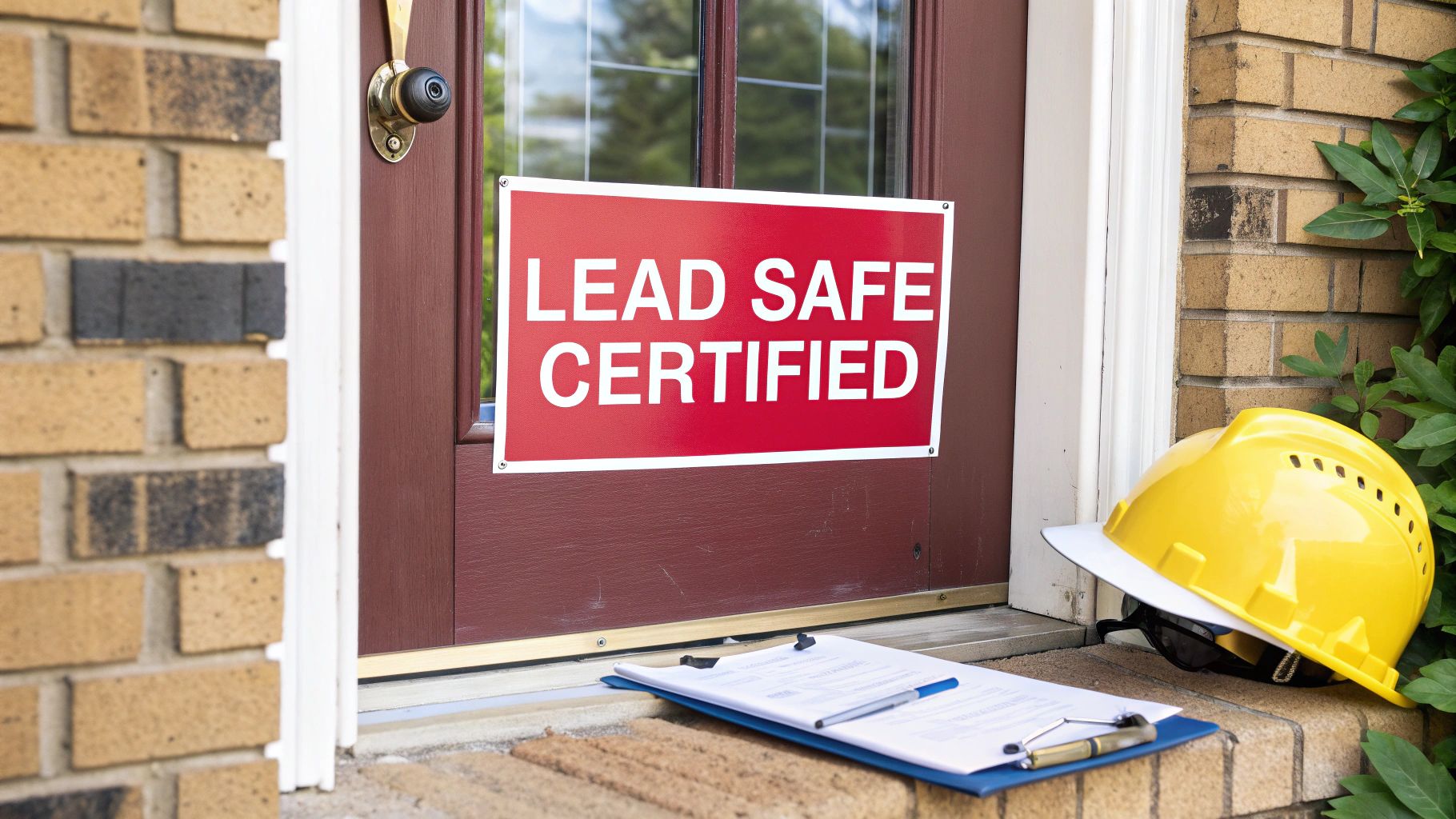
For many Cleveland landlords and property owners, the city's Lead Safe Certification mandate feels overwhelming. It's not just another piece of paperwork; for any rental property built before 1978, this law is a significant, ongoing financial and logistical burden. And if you're thinking of selling, you need to understand how it impacts your options.
Passed by Cleveland City Council in 2019 and enforced since March 2021, this certification is not optional if you want to legally rent out a property in the city. It requires re-certification every two years, creating a perpetual cycle of costs and inspections.
We understand the stressful situations Cleveland property owners are facing because of this ordinance. You might be:
- A small landlord with 1-3 units, now facing $800 to $2,000+ per unit every 24 months.
- Someone who inherited a rental property in Parma or Euclid and had no idea about this requirement.
- An out-of-state owner trying to manage compliance from a distance.
- Facing a potential $15,000 to $40,000 lead abatement bill you simply can't afford.
- A homeowner in Garfield Heights considering selling, worried about how this affects your property's value.
- Simply tired of the landlord life and looking for a way out of the compliance maze.
2026 Critical Update: The challenge intensified significantly in late 2024. After a shocking discovery that 11 children were poisoned in homes that had already been certified, the city scrapped the old "clearance exam." Now, all properties must undergo a more thorough and expensive Lead Risk Assessment. Combined with tougher enforcement under the Residents First legislation, the cost and complexity of maintaining a rental in Cleveland have skyrocketed, pushing many small landlords to sell.
This guide breaks down everything you need to know in 2026: the history of the law, the step-by-step process, the two types of certifications, realistic costs, and a practical alternative for those who decide the burden is too much: selling your rental property as-is.
Facing Cleveland's Lead Safe Certification requirements but don't want to continue as a landlord? Home Sweet Home Offers buys rental properties as-is—no certification needed. Call or text 216-200-8010.
How We Got Here: The Story Behind Cleveland's Lead Safe Law
To understand why the Lead Safe Certification is such a critical issue in 2026, you have to look at Cleveland's history. This isn't just bureaucratic red tape; it's a direct response to a decades-long public health crisis.
The core of the problem is Cleveland's housing stock. An astonishing 90% of the city's homes were built before 1978, the year the federal government banned lead-based paint. From Lakewood to Maple Heights, this toxic legacy has had devastating consequences, leading to thousands of local children suffering from lead poisoning, which can cause permanent neurological damage and learning disabilities.
In response, the Cleveland City Council passed Chapter 365 in July 2019, with the goal of making every rental property in the city lead-safe. After an 18-month preparation period for landlords, enforcement began rolling out by ZIP code in March 2021, with full citywide implementation by March 2023.
The Game Changer: When the Ordinance Got Serious
For the first few years, compliance was inconsistent. That changed dramatically in September 2024 with the passage of Mayor Bibb's Residents First legislation. This gave the ordinance real teeth:
- No Certificate, No Registration: You cannot register your rental property with the City of Cleveland without a valid Lead Safe Certificate.
- Evictions Halted: The Cleveland Municipal Housing Court now dismisses eviction filings from non-compliant landlords.
- Heftier Penalties: Fines and violations for ignoring the law were significantly increased.
This closed the loopholes. It became impossible to legally operate a rental in Cleveland without getting certified.
The 2024 Policy Pivot: From "Clearance" to "Assessment"
Then came the bombshell in October 2024. The city discovered that 11 children had been poisoned in homes already certified as "lead safe." The original process, a simple "Clearance Exam" with just 13 dust swabs, was proven to be dangerously insufficient.
In response, the Mayor's office issued an executive order that completely changed the program. The flawed clearance exams were abandoned. Now, all certifications require a much more intensive and expensive Lead Risk Assessment, shifting the focus from temporary fixes to permanent hazard abatement.
For landlords and homeowners in Cleveland, Parma, or Bedford, this history is a clear signal. The rules are getting tougher, costs are rising, and enforcement is intensifying. Every single pre-1978 rental is affected, with no grandfather clause. This ongoing burden is a key reason many are choosing to "sell my house fast Cleveland" to cash buyers who can handle the compliance.
Who Must Comply with the Lead Safe Ordinance?
Understanding whether this law applies to you is the first critical step. The rules are specific and enforcement is strict, affecting a vast number of properties across Cleveland.
Properties That Require Certification
The mandate applies to virtually all residential rental units in the City of Cleveland built before January 1, 1978. This includes:
- Single-family rental homes
- Duplexes and triplexes (each unit requires its own certification)
- Multi-family apartment buildings (for buildings with up to 20 units, every unit must be certified; for larger buildings, a representative sample is required)
It's important to note that this ordinance applies to properties within Cleveland's city limits. Surrounding suburbs like Lorain and Elyria have their own distinct regulations.
Properties Exempt from Certification
A property is exempt from the Lead Safe Certification requirement if it meets one of these conditions:
- Built after January 1, 1978: These homes were constructed after the federal ban on lead-based paint.
- Owner-Occupied: If you live in the property as your primary residence, it is exempt.
- Certified Lead-Free: If the property has undergone a full, permanent lead abatement and holds a 20-year certification.
Property Owner Responsibilities
If you own a pre-1978 rental, your legal obligations are clear and non-negotiable:
- You must first register your rental property with the City of Cleveland.
- You must obtain a valid Lead Safe Certification before a tenant moves in.
- You are required to submit the certification to the city via email.
- You cannot legally file for eviction in Cleveland Municipal Housing Court without a current certificate.
- You must re-certify the property every two years, indefinitely.
- You are responsible for maintaining lead-safe conditions between certifications.
The city has woven compliance into the very fabric of rental management. You cannot get your required Certificate Approving Rental Occupancy (CARO) without it, and code enforcement is actively targeting non-compliant properties. In 2026, "I didn't know" is not a defense. Even if your property is in pristine condition or you've had the same tenant for 20 years, the certification is mandatory.
Two Types of Certifications Explained
As a property owner in Cleveland, you have two distinct paths to compliance. Your choice will depend on your long-term goals, financial situation, and the condition of your property.
Option 1: The Two-Year Lead Safe Certification (Most Common)
This is the standard, recurring path most landlords take. It’s a temporary certification, valid for 24 months, that confirms your property currently has no active lead hazards.
What it is:
As of the 2024-2025 policy pivot, this certification is based on a Lead Risk Assessment, a much more thorough process than the old "Clearance Exam." It must be performed by an Ohio-licensed Lead Risk Assessor and is designed to identify potential lead hazards, not just the presence of lead dust.
What gets tested:
A Lead Risk Assessment is a comprehensive evaluation that includes:
- A visual inspection of all painted surfaces throughout the unit.
- An assessment of any deteriorating (chipping, peeling, or flaking) paint.
- Comprehensive dust wipe testing in multiple locations (far more than the original 13 points).
- Bare soil testing near the foundation, if applicable.
Cost:
- Lead Risk Assessment: Typically ranges from $800 to $2,000 per unit.
- This entire process and cost must be repeated every two years.
When to use it:
This option is most suitable if your property is in good condition with only minor potential hazards, or if you plan to sell within a few years. It requires a lower upfront cost but commits you to a perpetual cycle of inspections and potential repairs.
Option 2: The Twenty-Year Lead-Free Certification (Permanent Solution)
This is the "one-and-done" path for property owners who want a long-term solution and are prepared for a significant upfront investment.
What it is:
This certification confirms that all lead-based paint hazards have been permanently removed or encapsulated (abated). It is valid for 20 years, after which the property must be reassessed.
Requirements:
- Hire an Ohio-licensed Lead Abatement Contractor. This is not a DIY project.
- Complete a full abatement of all identified lead hazards.
- Pass a strict clearance test after the abatement work is finished.
- Submit all documentation to the city.
Cost:
- Lead Inspection & Risk Assessment (LIRA): $1,200 – $2,500
- Lead Abatement: $15,000 to $40,000+ per unit, depending heavily on the property's size and condition. A total cost of $20,000 to $60,000 for a single-family rental is common.
The Math: Making the Right Financial Decision
Choosing between these options is a critical financial decision.
- 2-Year Path: An average cost of $1,500 every 24 months adds up to $15,000 over 20 years—and that’s only for inspections, not including any remediation costs that may arise.
- 20-Year Path: A one-time investment of $30,000 solves the problem for two decades.
The break-even point is typically around 7 to 10 years. If you plan to hold the property long-term, the peace of mind and eventual cost savings of full abatement can be compelling. However, for many facing this choice, the high upfront cost is a non-starter.
Don't want to invest $15K-$60K in lead abatement? Selling your Cleveland rental property as-is avoids all certification requirements. Call or text 216-200-8010.
Step-by-Step Guide to the Certification Process in 2026
Navigating the Lead Safe Certification process can feel like a maze. Here is a clear, step-by-step breakdown to guide you through it.
Step 1: Register Your Rental Property
Before you can even begin, your property must be registered with the City of Cleveland. This is a non-negotiable first step.
- Go to the city's online Citizen Access Portal.
- Pay the required rental registration fee.
- Provide your property information and designate a local agent if you live out of state.
- You will receive a Rental Registration number, which is required for your certification application.
Step 2: Prepare Your Property for Inspection
Proper preparation can be the difference between passing on the first try and facing a costly failure.
- Look for hazards: Visually inspect for peeling, chipping, or flaking paint, especially on friction points like windows and doors. Check for bare soil near the foundation.
- Critical Cleaning: Before the inspection, perform a thorough wet-cleaning of all surfaces, paying special attention to window wells, sills, and floors. This significantly impacts dust wipe test results.
- Address obvious issues: It’s cheaper to hire an RRP-certified contractor to fix peeling paint or broken windows before the official inspection than to pay for a re-inspection after failing.
Step 3: Hire a Licensed Professional
You must hire an Ohio-licensed Lead Risk Assessor.
- Find vetted professionals through the Lead Safe Cleveland Coalition or search the Ohio Department of Health's database.
- Get multiple quotes, as prices can range from $800 to $2,000.
- Verify their license is current before scheduling the inspection.
Step 4: The Inspection is Performed
The Risk Assessor will conduct a comprehensive assessment that takes 2-4 hours. They will perform a visual inspection, take numerous dust wipe samples, and may use an XRF analyzer to test painted surfaces. You can expect lab results in 7-14 days.
Step 5: Receive the Assessment Report
- If You PASS: Congratulations! The assessor will provide a passing report. Proceed to Step 7.
- If You FAIL: You are not alone; 15-20% of properties fail the initial inspection. The report will detail the specific hazards that must be fixed. Proceed to Step 6.
Step 6: Remediate Hazards (If You Failed)
You must address every hazard identified in the report.
- Hire an RRP-certified contractor for the repairs (or get RRP-certified to do it yourself).
- Remediation can range from minor repairs (under $5,000) to major abatement ($15,000-$40,000+).
- After the work is complete, you must pay for a re-inspection (clearance testing), which costs an additional $400-$800.
Step 7: Submit to the City of Cleveland
Once you have a passing report, email it to bhrental@clevelandohio.gov, making sure to include your Rental Registration number. The city typically takes 2-4 weeks to process it and issue your Lead Safe Certification.
Step 8: Maintain and Repeat
Your certification is valid for 24 months. You are responsible for maintaining lead-safe conditions during this time and must repeat this entire process every two years.
Facing $10K-$50K in lead remediation costs? Selling your Cleveland rental property as-is to Home Sweet Home Offers means no certification required, no repairs, no hassle. Call or text 216-200-8010.
The Realistic Costs and Ongoing Burden for Cleveland Landlords
The financial impact of Cleveland's Lead Safe ordinance goes far beyond the initial inspection fee. For homeowners and landlords, it represents a significant and perpetual operating expense that can fundamentally change the profitability of a rental property.
Upfront Costs (First Certification)
The initial cost can vary dramatically based on your property's condition.
- Lead Risk Assessment: $800 – $2,000
- If the property fails (15-20% of properties do):
- Minor Remediation: $2,000 – $5,000
- Moderate Remediation: $5,000 – $15,000
- Major Remediation/Abatement: $15,000 – $40,000+
- Re-inspection Fee: $400 – $800
This means that while a best-case scenario might cost around $1,200, a property needing significant work could easily require an investment of over $25,000 just to get the first certificate.
Ongoing Costs (Every 2 Years, Forever)
This is not a one-time expense. The cycle repeats every 24 months.
- Re-certification Inspection: $800 – $2,000
- Potential Remediation: Even well-maintained properties can develop issues. Budget for potential repairs with each cycle.
When averaged out, you should plan for an ongoing compliance cost of $400 to $1,000+ per unit, per year. For a landlord in University Heights or Bedford with multiple units, these costs multiply quickly, turning a portfolio into a financial drain.
- 3 units x $1,500 = $4,500 every two years
- 5 units x $1,500 = $7,500 every two years
- 10 units x $1,500 = $15,000 every two years
The Hidden Costs
The financial burden isn't just about the checks you write. Consider the "soft costs":
- Time: Hours spent finding, vetting, and scheduling contractors and inspectors.
- Vacancy: Lost rent during lengthy remediation projects.
- Administrative Hassle: The mental energy spent tracking deadlines and paperwork for multiple units.
- Stress and Liability: The constant worry about compliance and potential legal issues.
With the 2024 pivot to more expensive risk assessments, the financial equation has changed for many. Small "mom-and-pop" landlords are finding that an extra $1,500 per unit every two years makes their once-profitable properties financially unviable, forcing them to consider selling.
Common Challenges and Problems for Property Owners
The path to lead safe compliance is filled with frustrating and costly obstacles, especially for everyday homeowners and small-scale landlords in Cleveland and surrounding areas like Parma and Lakewood. We see these challenges firsthand and understand the stress they cause.
The Financial Burden on Small Landlords
The ordinance disproportionately impacts "mom-and-pop" landlords who own 1-3 units. For them, a recurring $1,500-$4,500 expense every two years isn't a simple line item—it can wipe out their entire profit margin. Many inherited these properties and never planned on navigating such complex regulations. They can't raise rents enough to cover these costs, turning a source of supplemental income into a financial liability.
Out-of-State Landlord Nightmares
For an out-of-state landlord, managing this process from a distance is a logistical nightmare. Coordinating inspector access with tenants, overseeing expensive remediation work remotely, and verifying the quality of repairs becomes incredibly difficult and stressful.
Properties with Extensive Lead Hazards
Some of Cleveland's older homes, particularly those built before 1940, have lead paint everywhere. When abatement costs soar to $40,000-$60,000 on a property valued at $100,000, the investment makes no financial sense. You can't legally rent it without certification, but you can't afford the work to get certified, leaving you trapped with a non-performing asset.
Policy Uncertainty and Rising Costs
The rules are not set in stone. The city's pivot from clearance exams to risk assessments in 2024 unexpectedly increased costs for everyone. This uncertainty makes it difficult to plan long-term and creates anxiety about what future changes might bring.
Tenant-Related Complications
Getting a tenant's cooperation for inspections and remediation work can be a major hurdle, especially with difficult tenants. This is particularly problematic because you cannot file for eviction without a valid Lead Safe Certificate, creating a frustrating catch-22.
The Emotional Toll
Beyond the financial and logistical strain is the emotional toll. Landlords report feeling constant stress over compliance, fear of liability even after certification, and frustration with the bureaucracy. Many feel trapped, unable to afford the certification but also unable to easily sell a property with known lead issues on the traditional market. It's no wonder so many are saying, "I just want out."
Overwhelmed by Cleveland's Lead Safe Certification requirements? You don't have to keep being a landlord. Home Sweet Home Offers buys Cleveland rental properties as-is—no certification, no remediation, no compliance burden. We handle everything. Call or text 216-200-8010.
Resources and Assistance Available for Property Owners
While the compliance process can feel isolating, there are resources available in Cleveland to help property owners navigate the requirements and potentially offset some of the costs.
Lead Safe Resource Center
This should be your first call. It's a centralized hub offering free assistance to landlords and homeowners.
- Phone: (833) 601-5323
- Services: They can answer your questions, help you understand the process, and connect you with vetted, licensed professionals. They are also the primary point of contact for financial assistance programs.
Lead Safe Cleveland Coalition
This non-profit organization is a key player in the city's lead safety efforts.
- Website: leadsafecle.org
- Services: They maintain a public list of trained and vetted Lead Risk Assessors and contractors. They also help administer grant and loan programs designed to help property owners cover the costs of remediation.
Financial Assistance Programs
Several programs exist to provide grants or loans, but they often have strict eligibility requirements and limited funding.
- Lead Hazard Control Program: Run by the City of Cleveland's Department of Community Development, this program offers grants to income-qualified property owners to help cover abatement costs.
- Lead Safe Home Fund: This fund, supported by local foundations, also provides financial support. Applications are typically managed through the Lead Safe Resource Center.
City of Cleveland & State Resources
- Department of Building & Housing: The city has a dedicated team to provide technical assistance, especially for owners of 1-3 family rentals. You can reach them at bhrental@clevelandohio.gov.
- Ohio Department of Health (ODH): The ODH website maintains the official, searchable database of all licensed Lead Risk Assessors, Abatement Contractors, and RRP-Certified firms in the state.
A Reality Check: While these programs are valuable, it's important to be realistic. Funding is limited, the application process can be slow, and grants are competitive. Most landlords will still need to pay for a significant portion of the costs out of pocket, and these programs generally do not cover the ongoing, biennial re-certification inspection fees.
Selling vs. Continuing as a Landlord: A Tough Decision
The Lead Safe Certification ordinance forces every Cleveland rental property owner to make a critical business decision. Do you commit to the ongoing costs and complexities of compliance, or is it time to sell and move on?
When Does Continuing as a Landlord Make Sense?
Staying in the rental game can still be a good move if your situation aligns with these factors:
- Strong Cash Flow: Your property generates enough profit to comfortably absorb the $1,500+ biennial inspection cost and potential repair bills.
- Good Property Condition: Your rental is in excellent shape and likely to pass inspections easily, minimizing the risk of a massive remediation bill.
- Long-Term Strategy: You plan to own the property for 10+ years and are comfortable with the ongoing management and liability.
- Efficient Systems: You have the organizational skills to track deadlines, manage contractors, and handle the paperwork without overwhelming yourself.
When Should You Seriously Consider Selling?
For many owners, the math and the stress simply no longer add up. Selling becomes the most logical path forward in these common scenarios:
- You Inherited the Property: You never planned to be a landlord, and now you're facing a complex and expensive problem. Cashing out an inherited rental property provides a clean break.
- The Property Has Marginal Cash Flow: If the certification costs push your property from barely profitable to losing money, it’s time to cut your losses and reinvest your capital elsewhere.
- You're Facing Extensive Lead Issues: A remediation quote of $30,000-$60,000 on a property that isn't worth much more makes no financial sense. Selling as-is transfers that problem to a buyer equipped to handle it.
- You're an Out-of-State Landlord: The burden of managing compliance from afar is too high. Selling an out-of-state rental property simplifies your life.
- You're Simply Tired of Being a Landlord: Tenant issues, late-night repairs, and now this—the lead certification is the "last straw."
The financial benefit of selling is clear: you avoid an immediate $10,000-$40,000 remediation cost and the perpetual $1,500 fee every two years. You get a lump sum of cash and, more importantly, peace of mind.
However, selling a property with known lead issues on the traditional market is difficult. You must disclose the hazards, which scares away most buyers and disqualifies those using FHA/VA loans. This is where professional cash buyers provide a critical solution.
Decided to exit the Cleveland rental market? Home Sweet Home Offers specializes in buying rental properties as-is—no Lead Safe Certification needed, no remediation required, fast closing. We buy properties with tenants in place or vacant. Call or text 216-200-8010.
Frequently Asked Questions About Lead Safe Certification
Navigating this ordinance can be confusing. Here are straightforward answers to the most common questions we hear from Cleveland property owners.
Q: Do I need Lead Safe Certification if I live in the property myself?
A: No. Owner-occupied properties are exempt. The requirement only applies to residential rental units where the owner does not live in the property.
Q: What if my property was built in 1979?
A: Properties built after January 1, 1978, are exempt because lead-based paint was banned for residential use that year. You should have documentation of the build date available.
Q: Can I do the lead remediation work myself?
A: You can, but only after you obtain an EPA RRP (Renovation, Repair, and Painting) Certification through proper training. However, the final inspection must always be done by an independent, Ohio-licensed professional.
Q: What happens if I don't get certified?
A: You cannot legally rent the property. The Cleveland Municipal Court will dismiss any eviction cases you file. You also risk code enforcement violations, significant fines, and will be unable to obtain your mandatory rental registration.
Q: How much does it really cost?
A: The first certification costs $1,200-$2,000 if you pass immediately. If remediation is needed, add $5,000 to $40,000+. Re-certification every two years costs another $800-$2,000. Over 20 years, you can expect to pay a minimum of $15,000-$30,000 for inspections alone.
Q: Can I sell my rental property to avoid this?
A: Yes. Selling to a cash buyer who buys "as-is" is a common and effective solution. It means no Lead Safe Certification is required on your part, and you don't have to perform any remediation. Home Sweet Home Offers specializes in buying Cleveland rental properties this way. Call 216-200-8010.
Q: What's the difference between a clearance exam and a risk assessment?
A: The clearance exam was a simpler, less reliable test (13 dust swabs) that Cleveland stopped using in 2024 after children were poisoned in certified homes. The new standard, a Lead Risk Assessment, is a much more comprehensive and expensive inspection involving a full visual assessment and more extensive testing.
Q: Can I pass the inspection costs on to my tenants?
A: No, you cannot directly charge tenants for certification costs. This is the landlord's legal and financial responsibility. You can only raise rent within what the local market will bear.
Your Path Forward: Comply, Abate, or Sell
Cleveland's Lead Safe Certification is a permanent reality for rental property owners. Passed in 2019 and strengthened significantly in 2024, this mandatory ordinance requires a costly inspection every two years, indefinitely, for all pre-1978 rentals. With minimum costs of $800-$2,000 per cycle and potential remediation bills reaching $40,000 or more, it has created a significant financial and administrative burden.
This is especially challenging for small landlords, out-of-state owners, and those who have inherited property in Cleveland, Parma, or Garfield Heights.
You have three clear paths forward:
- Comply: Commit to the ongoing two-year cycle of inspections and repairs as a cost of doing business.
- Full Abatement: Make a large, one-time investment of $20,000-$60,000+ to get a 20-year certification and remove the recurring hassle.
- Sell: Exit the rental business entirely, transferring the compliance burden and costs to a new owner.
For a growing number of landlords, selling makes the most financial and personal sense. Cleveland's ordinance, while well-intentioned, has created an unsustainable situation for many, where the ongoing costs, stress, and liability of being a landlord are no longer worth it. Only you can decide what's right for your situation. Run the numbers, consider the stress, and choose the path that aligns with your long-term goals.
Facing Cleveland's Lead Safe Certification requirements but ready to exit the rental business? Home Sweet Home Offers provides a simple solution: we buy Cleveland rental properties as-is—no Lead Safe Certification needed, no $20K-$40K remediation required, no 2-year recertification cycles, no compliance stress. We handle tenant situations, buy properties with lead issues, and close fast. Whether you have 1 unit or 10, whether you're local or out-of-state, we can help. Call or text 216-200-8010 for a free, no-obligation cash offer today.