
Discovering asbestos in your home is a moment that can make any Cleveland homeowner’s stomach drop, especially when you're planning to sell. It's a concerning discovery, but you're far from alone. The reality is that asbestos is present in the vast majority of beautiful homes built across Cleveland and suburbs like Parma, Lakewood, and Euclid before 1980.
The most important thing to understand is this: asbestos doesn't make your home unsellable. It simply means you need the right strategy. For many homeowners dealing with an inherited older home, a surprise inspection finding, or the overwhelming cost of removal, the traditional sales route can feel impossible. This is an extremely common issue for Cleveland-area sellers—not a unique or unusual problem.
With 2026 mortgage rates in the low 6s, buyers using FHA loans face strict property requirements, and asbestos disclosure can trigger inspection contingencies that kill deals before closing. The path forward requires understanding your options beyond expensive professional abatement, and that's what this guide is for. We'll show you how "selling house with asbestos Cleveland" can be a straightforward process.
Whether you've just discovered asbestos or own a pre-1980 home you need to sell, Home Sweet Home Offers buys houses with asbestos as-is. Call or text 216-200-8010.
Understanding Asbestos in Cleveland Homes
Before you can form a strategy, it helps to know what asbestos is and why it’s so prevalent in our local housing stock.
Asbestos is a natural mineral fiber that was prized for its incredible fire resistance, durability, and insulating properties. It was used extensively in building materials until the early 1980s. While the federal government began restricting its use in 1973, existing stockpiles were used for years after. A good rule of thumb: if your home was built before 1980, it likely contains some asbestos materials. Homes built between 1940 and 1970 have the highest probability.
Why Is Asbestos So Common in Cleveland?
Cleveland's major housing boom occurred between the 1920s and 1960s, a period that perfectly coincided with the peak use of asbestos in construction. The charming Working-class neighborhoods and suburbs that sprang up during the 1940s-1970s almost universally used these materials. It’s estimated that over 80% of Cleveland-area homes built before 1980 contain asbestos in some form.
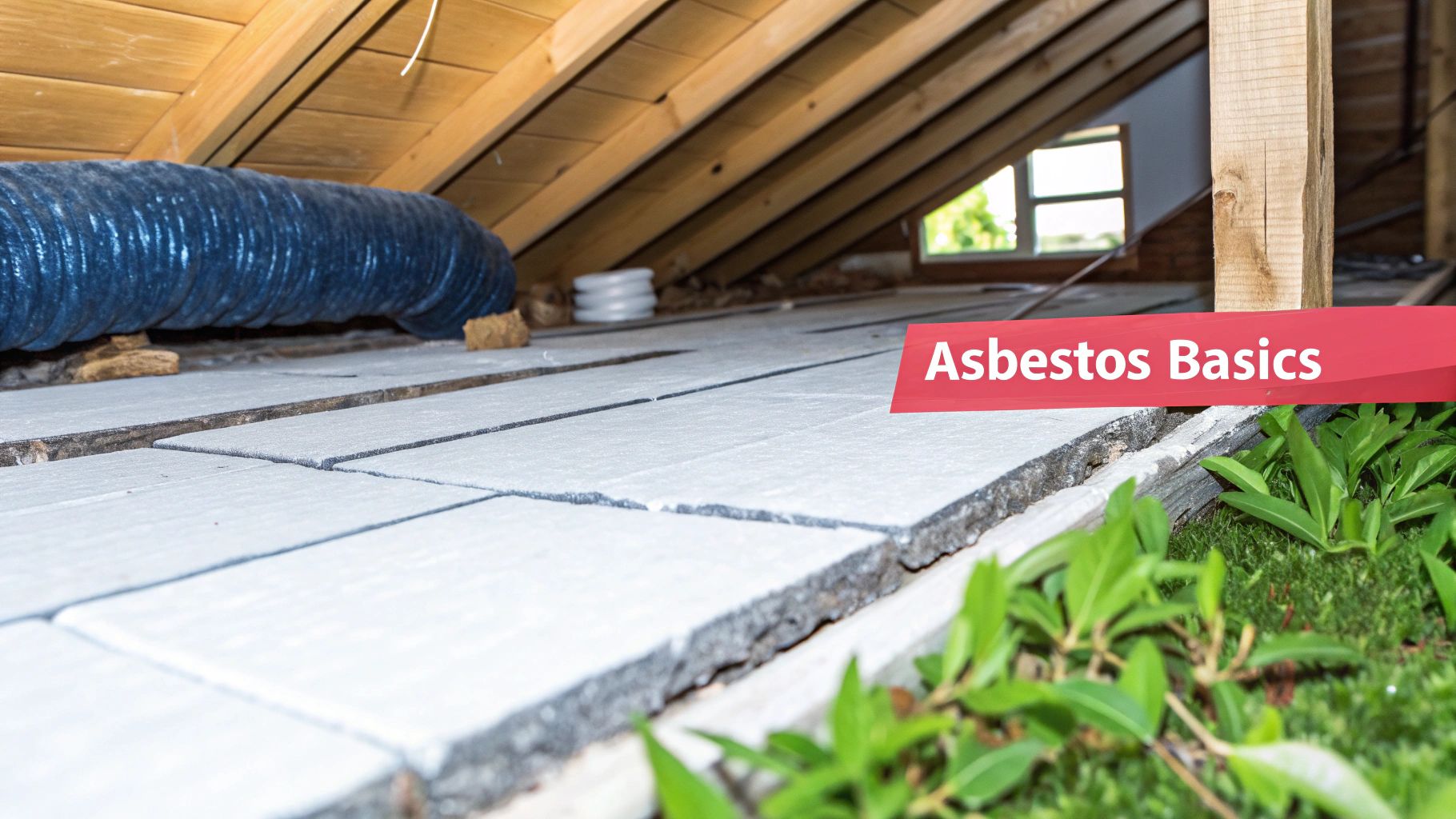
Where Asbestos is Commonly Found
Asbestos could be in multiple places in a single home. Here are the most common spots:
- Floor tiles (especially the old 9×9 inch vinyl tiles in basements and kitchens)
- Pipe insulation (a white or gray, chalky or cloth-like wrapping on pipes)
- Furnace and duct insulation
- Vermiculite attic insulation (loose-fill, pebble-like, often with a silver-gold sheen)
- Popcorn or textured ceilings installed before the early 1980s
- Roofing shingles and siding (asbestos-cement products)
- Joint compound and plaster
- Window glazing and caulking
When is Asbestos Dangerous vs. Safe?
This is the most critical distinction. Asbestos is dangerous when it becomes "friable," meaning it’s crumbling, damaged, or can be crushed into a powder. This often happens during renovation or demolition when materials are cut, sanded, or drilled, releasing microscopic fibers into the air. Inhaling these fibers can cause serious lung diseases like mesothelioma and asbestosis, often with a long latency period of 20-50 years.
However, when asbestos is intact, undisturbed, and encapsulated ("non-friable"), the risk is very low. Solid floor tiles or sealed pipe wrap are not actively releasing fibers. Many Cleveland homeowners have lived safely with intact asbestos for decades without issue.
Testing & Identification of Asbestos
While you can't be 100% certain without professional testing, there are some strong visual clues that asbestos may be present in your older Cleveland home.
Visual Identification Clues
- 9×9 inch floor tiles are the most common and easily recognizable sign.
- White or gray pipe wrapping on basement heating pipes.
- Popcorn ceilings installed before 1980.
- Vermiculite insulation in the attic, which looks like loose, gray-brown or silver-gold pebbles.
Remember, you cannot confirm asbestos by visual inspection alone. Professional testing is the only way to be certain.
The Testing Process
- Who performs testing? Only an Ohio-licensed asbestos inspector can legally take samples. Do not use DIY test kits; they are unreliable and not legally valid for disclosure purposes.
- How does it work? The inspector takes small, carefully contained samples of suspected materials. These are sent to a certified laboratory for analysis.
- What are the results? You’ll receive a report in 3-5 business days that identifies the location, type, and condition (friable or non-friable) of any asbestos found.
Testing Costs in Cleveland
- A basic inspection with 5-10 samples typically costs $300-$500.
- A more comprehensive, whole-house inspection can run $500-$800.
- Each additional sample usually costs $25-$50.
To Test or Not to Test? The Disclosure Dilemma
This is a strategic decision for sellers.
- When to Test: If a buyer requests it during their inspection, if you're planning renovations (it's legally required), or if materials are visibly deteriorating and you need to know the extent of the problem for a traditional sale.
- When Not to Test: When you're Selling as-is to cash buyer. We assume asbestos is present in pre-1980 homes and factor that into our process. Testing creates a formal knowledge of the issue, which then legally requires disclosure. If you can't afford both testing and potential abatement, testing may not be your best first step.
Many sellers of older homes choose not to test. Instead, they handle disclosure by stating the facts: "Home was built in [year], and materials containing asbestos were commonly used during this era and may be present." This is a truthful and legally sound approach that avoids the cost and formal disclosure obligation created by testing.
Disclosure Requirements for Asbestos in Ohio
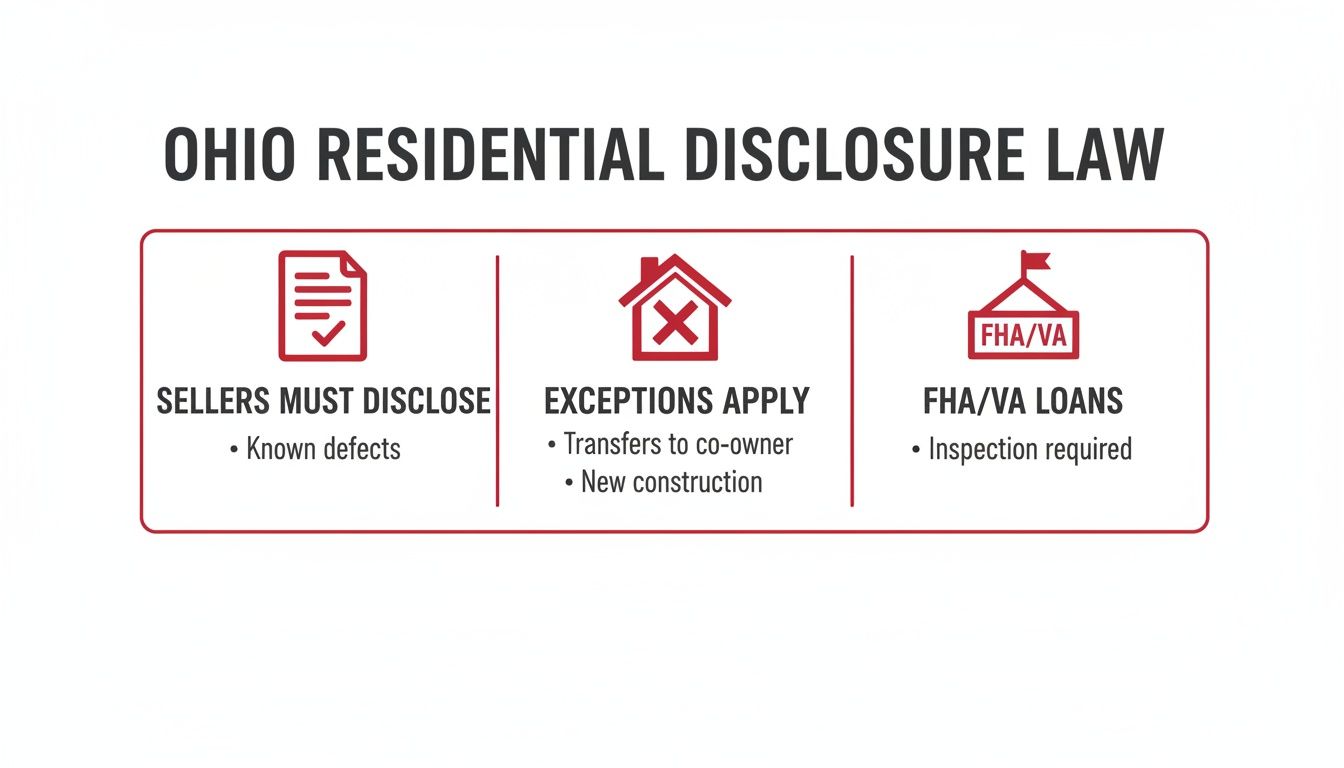
Navigating the legal requirements for disclosure can feel intimidating, but the rules in Ohio are relatively straightforward. The key principle is honesty about what you know.
Federal vs. Ohio Law
There is no federal law requiring homeowners to test for or disclose asbestos in a residential sale (unlike lead-based paint). However, Ohio state law is what matters here. The Ohio Residential Property Disclosure Form is mandatory for almost all home sales. This legal document requires you to disclose all known material defects.
The key word is "known."
- If you have had your home tested and the results confirmed asbestos, you must disclose it.
- If you have not tested, you can legally and truthfully state "Unknown" on the form.
How to Disclose Properly
Your approach to disclosure should match your level of knowledge.
- If you tested positive: Disclose the facts clearly. Provide the location, type, and condition of the asbestos, and attach a copy of the test results.
- If you haven't tested (but own a pre-1980 home): A common and acceptable statement is: "Home built in [year]. Asbestos-containing materials were commonly used in construction of this era and may be present. Seller has performed no testing and has no direct knowledge of its presence."
The Consequences of Non-Disclosure
Failing to disclose a known asbestos issue is a serious mistake. If the buyer discovers it after closing and can prove you knew about it, they can sue you for fraud, misrepresentation, and non-disclosure. You could be held liable for the full cost of abatement plus other damages. Ohio courts do not look kindly on this; it is never worth the risk.
FHA & VA Loan Requirements: The Real-World Obstacle
While Ohio law focuses on disclosure, federal lending rules often create the biggest challenge for Cleveland sellers.
- FHA Loans: FHA doesn't automatically reject homes with asbestos. However, if any asbestos-containing material is deteriorating, damaged, or friable, an FHA appraiser will flag it as a health and safety hazard. The lender will refuse to finance the property until it's professionally remediated or encapsulated. This rule kills many deals for Cleveland first-time buyers who rely on FHA financing.
- VA Loans: The requirements are very similar to FHA's. The property must be deemed safe and sound, and deteriorating asbestos is a clear hazard that will stop a VA-backed loan in its tracks.
In 2026, with mortgage rates in the low 6s, FHA and VA loans represent a significant buyer pool in the $150K-$350K range—the price point of most pre-1980 Cleveland homes with potential asbestos.
The Staggering Cost of Asbestos Abatement & Remediation
For most Cleveland homeowners, the biggest shock isn't the presence of asbestos—it's the five-figure price tag for removing it. Asbestos abatement is the professional removal of these materials, and it's a heavily regulated process that must be done by licensed, certified contractors in Ohio. It is absolutely not a DIY project; it's illegal and extremely dangerous to attempt yourself due to the risk of airborne fibers.
Cleveland Asbestos Abatement Costs: A Realistic Breakdown
Costs can vary based on the scope, location, and accessibility of the materials. Here are typical price ranges in the Cleveland market:
- Floor Tile Removal: $5 – $15 per square foot. A 1,000 sq. ft. basement could cost $5,000 – $15,000.
- Pipe Insulation Removal: $10 – $25 per linear foot. An average basement with 100-200 feet of pipes could run $1,000 – $5,000.
- Popcorn Ceiling Removal: $3 – $7 per square foot. A 1,500 sq. ft. home could cost $4,500 – $10,500.
- Vermiculite Attic Insulation Removal: This is one of the most expensive projects, often requiring a full attic clean-out. Expect costs of $10,000 – $25,000.
- Whole-House Abatement: If multiple materials are involved, costs can easily range from $15,000 to $40,000+. For larger, older homes, quotes can exceed $60,000.
The Financial Reality in Cleveland
These costs are significant on their own, but they're especially impactful when viewed as a percentage of a home's value.
- On a $120,000 home, a $20,000 abatement is 17% of its value.
- On a $180,000 home, it's over 11%.
- On a $250,000 home, it's 8%.
For most homeowners, coming up with this kind of cash is simply not feasible.
Cheaper Alternatives to Full Abatement
- Encapsulation: Sealing asbestos materials with a special coating. This costs around $2-$6 per square foot and is a good option for intact materials, though it's not a permanent solution.
- Enclosure: Covering asbestos materials, like installing new flooring over old tiles. This isolates the asbestos but leaves it in place.
- Sell As-Is to a Cash Buyer: This is the most direct solution. You don't pay for any abatement. The buyer assumes the responsibility and cost after the sale, saving you tens of thousands of dollars and months of hassle.
In 2026, licensed asbestos abatement contractors in Cleveland are booking 4-8 weeks out, and costs have increased 20-30% since 2022 due to labor shortages and disposal fee increases.
Facing $15K-$40K in asbestos abatement you can't afford? Home Sweet Home Offers buys houses with asbestos as-is—no removal required. Call or text 216-200-8010.
Why a Traditional Home Sale Often Fails Over Asbestos
Listing a home with asbestos on the open market can feel like navigating a minefield. Many sellers find themselves stuck in a frustrating cycle of promising offers that collapse under the weight of buyer fear, financing hurdles, and inspection contingencies.
The Buyer Reaction
The word "asbestos" itself is enough to scare off many potential buyers. Decades of media coverage have created a level of fear that often outweighs the actual risk, especially for younger buyers under 40. For them, it’s an emotional decision, not a rational one. They see a potential health hazard and a massive, unknown expense, and they walk away rather than deal with it.
Financing Complications Are the Real Deal-Killer
Even if a buyer isn't scared off, their lender probably will be.
- FHA Loans: As mentioned, this is the biggest obstacle. An FHA appraiser will flag any deteriorating asbestos—like damaged pipe insulation or crumbling floor tiles—as a health and safety risk. The loan will not be approved until the issue is professionally remediated. Since most Cleveland first-time buyers use FHA loans, this disqualifies a huge portion of your potential market.
- VA Loans: VA requirements are similarly strict. Veterans often use $0 down loans and don't have the cash reserves to cover a surprise abatement bill demanded by their lender.
- Conventional Loans: While more flexible, lenders and their appraisers are still concerned about property condition and liability, and may require remediation for significant issues.
The Inspection Contingency Nightmare
This is how most deals fall apart.
- A buyer makes an offer, and you accept.
- Their inspector notes the home's age and recommends asbestos testing.
- The test confirms asbestos is present.
- The buyer panics and demands a $15,000-$30,000 credit or that you pay for full abatement before closing.
- You can't afford their demand, so you refuse.
- The buyer uses their inspection contingency to back out of the deal, and you're back to square one.
This cycle can repeat itself, leaving your home stigmatized on the market. After 6-12 months later, still unsold, the stress and carrying costs become overwhelming.
With 2026 mortgage rates in the low 6s and home prices still elevated, buyers are stretching budgets for monthly payments—they have zero appetite for $15K-$30K asbestos abatement on top of their down payment and closing costs.
Tired of buyers walking away when they discover asbestos? Home Sweet Home Offers buys houses with asbestos in any condition—no inspection contingencies, no buyer fear, no financing requirements. Call or text 216-200-8010.
The Solution: Selling Your House As-Is to a Cash Buyer
For Cleveland homeowners feeling trapped by an asbestos problem, there is a clear, straightforward path forward: selling your house as-is to an experienced cash home buyer. This approach eliminates every single one of the challenges that cause traditional sales to fail.
Why Cash Buyers Don't Fear Asbestos
Unlike retail buyers, professional investors like Home Sweet Home Offers are not intimidated by asbestos. We see it for what it is: a common, manageable issue in the older homes we specialize in.
- We Are Experienced: We work with pre-1980 Cleveland homes every day. We expect to find asbestos and have a proven process for handling it.
- No Lenders Involved: We buy with our own cash, so there are no FHA appraisers or bank underwriters to kill the deal over frayed pipe insulation.
- We Handle Abatement Post-Closing: We have established relationships with licensed abatement contractors and get professional pricing. We take on the entire problem after the sale is complete, so it’s no longer your concern.
- It's a Business Transaction: Our decision is based on numbers and logistics, not fear or emotion.
Our Simple, Transparent Process
- Contact Us: Call or text 216-200-8010 and tell us about your property. There's no pressure and no obligation.
- Property Evaluation: We’ll schedule a quick, convenient walkthrough to assess the home's overall condition, including any asbestos materials.
- Receive Your Cash Offer: Within 24 hours, you'll get a fair, transparent cash offer based on the home's as-is condition. We'll explain exactly how we've factored in the future abatement costs.
- Close Fast: If you accept, we can close in as little as 7-14 days. You pay zero commissions or closing costs. You walk away with cash in hand, and the asbestos is our problem to solve.
The Math: Traditional Sale vs. Cash Sale
Let’s compare the potential financial outcomes.
| Metric | Traditional Sale Attempt | Cash Sale As-Is |
|---|---|---|
| Sale Price / Offer | $205,000 (after negotiations) | $175,000 |
| Asbestos Abatement | -$18,000 | -$0 |
| Realtor Commissions (6%) | -$12,300 | -$0 |
| Seller Closing Costs | -$2,500 | -$0 |
| Carrying Costs (8 months) | -$5,000 | -$1,000 (2 weeks) |
| Net to You | $167,200 | $174,000 |
| Timeline & Stress | 8-12 months of stress | 2-3 weeks, stress-free |
In this common scenario, the "lower" cash offer actually puts $6,800 more cash in your pocket nearly a year faster, without any of the headaches. Selling as-is to Home Sweet Home Offers is often the smartest financial decision.
Ready to sell your Cleveland home with asbestos without the stress of abatement and uncertain buyer reactions? Home Sweet Home Offers buys houses as-is throughout Cleveland—we handle the asbestos after closing. Call or text 216-200-8010.
Special Asbestos-Related Selling Situations
The challenge of asbestos is often compounded by other life circumstances. We have experience helping homeowners in all types of situations move forward.
- Inherited Home with Asbestos: This is incredibly common when inheriting 1950s-1970s parent's home. Heirs often live out-of-state, don't want to invest $20K+ in a property they never lived in, and need to settle the estate quickly.
- Rental Property with Asbestos: Tired landlords dealing with deteriorating materials face potential liability and legal risks. The low rents on an older Rental property often don't justify a massive abatement expense, making it a perfect Landlord burnout scenario.
- House with Multiple Issues: Often, asbestos is just one problem among many. When you're also facing a bad roof and serious foundation issues, selling as-is is the only practical solution.
- Divorce Situation: When a couple needs to liquidate assets quickly and fairly, neither party wants to spend time and money on abatement. A cash sale provides a fast, clean resolution for a Divorce situation.
- Facing Foreclosure: When you're Facing foreclosure, you have no time or money for remediation. A fast cash sale is often the only way to avoid losing the house to the bank.
- Relocating for Work: A new job that starts in 30 days doesn't leave time for a 2-4 month abatement and sale process. You need certainty and speed.
Whatever your specific asbestos situation, Home Sweet Home Offers has handled it before. Call or text 216-200-8010 to discuss your property.
Living Safely with Asbestos (If You're Not Selling Yet)
If you decide not to sell immediately, it's important to know that you can live safely with asbestos as long as it's managed properly. The key is to avoid disturbing it.
Best Practices for Homeowners
- Don't Disturb Materials: Never sand, drill, cut, scrape, or tear out materials you suspect contain asbestos. This is what creates dangerous airborne fibers.
- Monitor Condition: Periodically check on the materials. Look for signs of damage, crumbling, or deterioration, especially after any water damage. If the condition worsens, consult a professional.
- Avoid DIY Renovation: Do not attempt to renovate areas with asbestos yourself. Ohio law requires licensed contractors to test and follow specific safety protocols when working around these materials.
- Consider Encapsulation: For materials in decent condition, professional encapsulation can seal the fibers and is much cheaper than full removal.
- Inform All Contractors: Always tell any plumber, electrician, or other professional working in your home about the potential presence of asbestos to protect them and yourself.
Providing this balanced information shows we're focused on helping homeowners find the right solution for their situation, not just pushing a sale.
Frequently Asked Questions About Selling a House with Asbestos
Q: Does every house built before 1980 have asbestos?
A: Not 100% certain without testing, but the vast majority do. Asbestos was standard in building materials from the 1940s through early 1980s. Assume any pre-1980 Cleveland home contains some asbestos.
Q: Do I have to remove asbestos before selling in Ohio?
A: No. Ohio law doesn't require asbestos removal before selling. You must disclose known asbestos presence, but you can legally sell the home as-is with asbestos in place.
Q: How much does asbestos abatement cost in Cleveland?
A: Varies widely. Floor tile removal: $5K-$15K. Pipe insulation: $1K-$5K. Popcorn ceiling: $4.5K-$10.5K. Vermiculite insulation: $10K-$25K. Whole-house: $15K-$40K+.
Q: Can I just cover asbestos floor tiles with new flooring?
A: Yes, this is called "enclosure" and is legally acceptable. Many homeowners install new flooring directly over asbestos tiles. However, future buyers will still want to know it's there.
Q: Will FHA buyers accept a house with asbestos?
A: Only if asbestos materials are intact and non-friable. Any deteriorating, damaged, or crumbling asbestos must be remediated before FHA will finance. This requirement causes many FHA deals to fail.
Q: What if I don't disclose asbestos and the buyer finds out later?
A: If you knew about asbestos and didn't disclose, you can be sued for fraud and non-disclosure. You'd be liable for abatement costs plus damages. Always disclose what you know.
Q: Should I test for asbestos before selling?
A: Depends on your strategy. If selling as-is to a cash buyer, testing isn't necessary—we assume it's present. If attempting a traditional sale, testing may be required by the buyer's lender. Testing creates a disclosure obligation.
Q: Is asbestos really that dangerous?
A: When intact and undisturbed, asbestos poses minimal risk. The danger is when fibers become airborne—during renovation, demolition, or when materials deteriorate. Inhalation causes serious lung diseases with long latency periods. Learn more about working with a legitimate cash buyer.
Your Path Forward
Selling a house with asbestos in Cleveland doesn't have to be an ordeal. While the traditional market is full of obstacles, from buyer fear to lender rejections, you have a clear and certain alternative.
Asbestos is present in most Cleveland-area homes built before 1980, and Ohio law requires disclosure, not removal. But with abatement costs running from $15K to $40K+, and FHA/VA financing requirements killing deals, a traditional sale is often impractical. In 2026's market with mortgage rates in the low 6s and FHA loans common in Cleveland's price ranges, asbestos has become an even bigger obstacle to traditional sales.
The solution is to work with a professional cash buyer who understands these properties. We buy houses as-is, which means we handle the abatement after closing. You get a fast, certain transaction with no financing contingencies, no commissions, and no dealing with buyer fear. Our pricing is transparent, factoring in the future costs so you don't have to.
Dealing with asbestos in your Cleveland home doesn't have to mean expensive abatement or months of failed sales. Home Sweet Home Offers buys houses with asbestos as-is throughout Cleveland and all surrounding suburbs—no abatement required, no buyer fear, no financing contingencies. We handle the asbestos after closing so you can move forward. Whether your home has asbestos floor tiles, pipe insulation, vermiculite attic insulation, or all of the above, we buy in any condition. Call or text 216-200-8010 for a fast, fair, no-obligation cash offer today.
Sources
- EPA Asbestos Information and Resources
- Ohio EPA Asbestos Program
- OSHA Asbestos Standards
- Ohio Department of Health
- Cleveland Division of Air Quality
- Asbestos abatement contractor cost estimates (Cleveland market)
- Ohio Revised Code (disclosure requirements)