
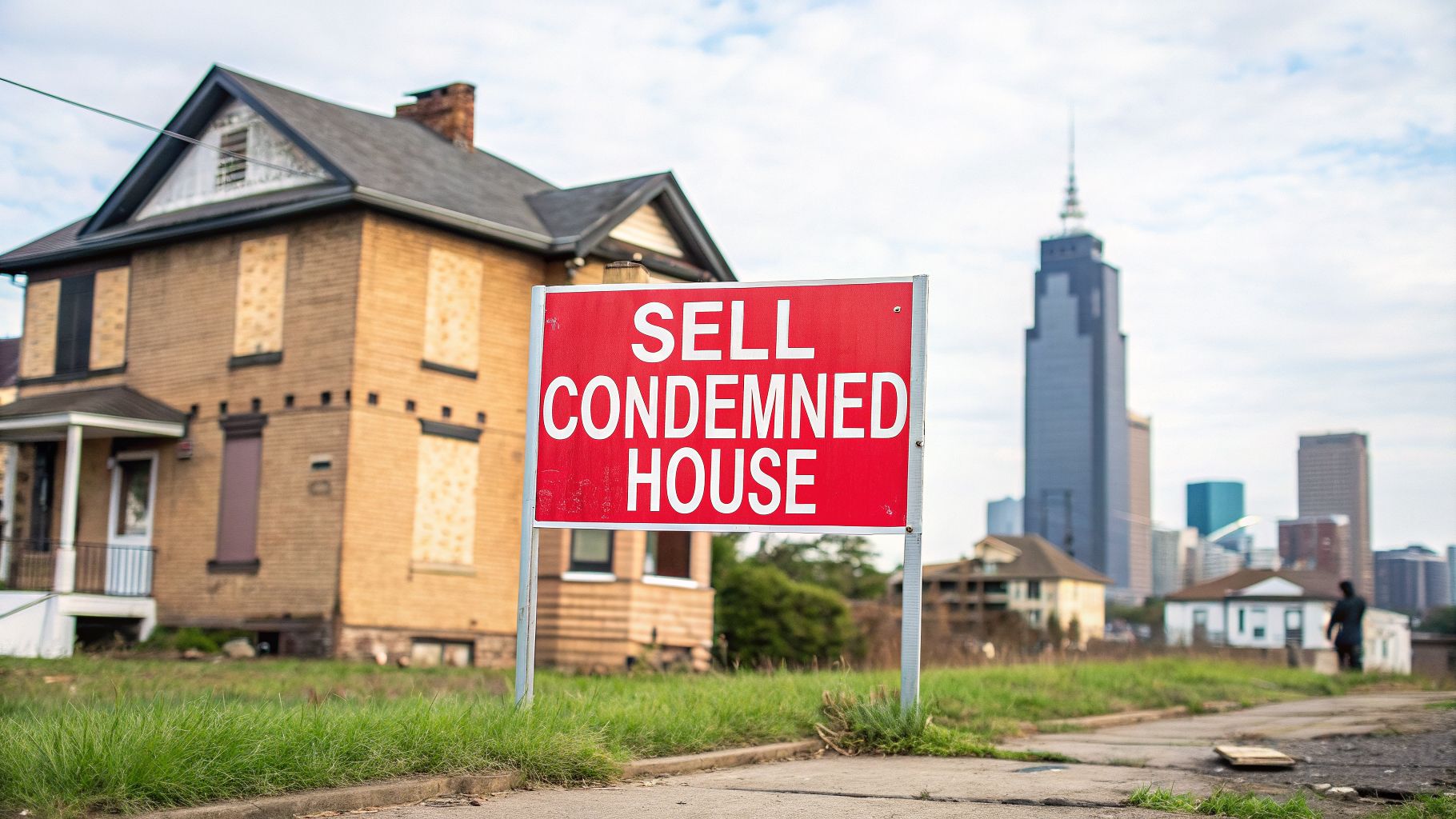
Facing a condemned tag or a demolition order on your Cleveland property is one of the most stressful situations a homeowner can experience. It feels like your back is against the wall, with the city breathing down your neck and the financial burden feeling heavier by the day. We understand. Whether you inherited a house in Parma you can't afford to fix, are a tired landlord in Lakewood dealing with a neglected rental, or are facing foreclosure in Euclid, that official notice is a gut-punch.
But here’s the crucial thing to know: you have options.
Yes, you can absolutely sell a house in Cleveland that’s been slapped with a condemned tag or even a demolition order. The key is working with a specialized cash home buyer. This route lets you sell the property completely as-is, sidestepping the nightmare of city fines and impossible repairs, and puts cash in your hand before a wrecking ball shows up. This is the off-market solution, because no traditional lender will ever finance a home that’s deemed uninhabitable.
What a Condemned Notice Really Means for Your Cleveland Home
Getting that official notice from the City of Cleveland—or a nearby suburb like Euclid or Parma—is overwhelming. Seeing a bright orange or red sticker on the front door feels final, like the property is a total loss. But take a deep breath. This isn't an instant death sentence for your house; it's a formal, legal warning that the building is considered unsafe for anyone to live in.
Panic is a normal first reaction, especially if you inherited this property or a rental has fallen into a state of serious disrepair. You’re probably thinking about fines, liability, and the city’s demolition crew. Let’s swap that fear for facts. The city isn’t out to get you; they’re just following a process to protect the public from a hazardous building.
Why Cleveland Properties Get Condemned
A house doesn't get a condemned notice out of the blue. It’s almost always the result of long-term neglect or a sudden, catastrophic event. The City of Cleveland's Department of Building and Housing, and similar departments in places like Lakewood and Garfield Heights, will issue these notices for a few critical reasons.
The main triggers we see for condemned notices are:
- Severe Structural Failure: This is the big one. Think of a collapsing roof, a crumbling foundation, or bowing walls. In older Cleveland-area homes, this often happens after years of slow water damage or termite infestation finally take their toll. This is a common issue for families who inherit a property and can't afford the major repairs.
- Major Fire or Storm Damage: A house that's been gutted by fire or had its roof torn off by a storm is an obvious hazard. If it’s open to the elements, the city will act fast.
- Prolonged Vacancy and Vandalism: An abandoned house in a neighborhood like Collinwood or Slavic Village is a magnet for trouble. Once it’s been stripped of copper wiring and plumbing and left open for squatters, the city has to step in. This is a huge risk for out-of-town heirs or landlords tired of dealing with problem tenants.
- Serious Health Hazards: We’re talking about extreme black mold, friable asbestos that’s exposed, or severe infestations of rats or roaches that make the home completely uninhabitable. These issues can arise when owners face financial hardship and can't keep up with maintenance.
- Lack of Essential Utilities: A property with no safe, working electricity, no clean running water, or no functioning sewer system can't be legally occupied.
It's crucial to know that a "condemned" status means the house is deemed unfit for human life. A "demolition order" is the next, more serious step, where the city has scheduled the property to be torn down at the owner's expense.
Condemned Tag vs Demolition Order Key Differences
It's easy to use "condemned" and "demolition order" interchangeably, but they represent very different stages in the city's process. Knowing which notice you received is the first step to figuring out your next move.
Here's a quick reference to help you tell them apart.
| Factor | Condemned Tag | Demolition Order |
|---|---|---|
| Meaning | The property is unsafe and uninhabitable in its current state. | The city has officially scheduled the property to be torn down. |
| Urgency | High. You have a limited time to appeal or present a plan for repairs. | Extreme. The clock is ticking toward a specific demolition date. |
| Owner's Options | You may be able to make repairs, bring it up to code, and have the status lifted. | Repair is often no longer an option; the primary goal is to resolve the situation before the city demolishes it. |
| Best Solution | A quick home sale in Cleveland to a cash buyer can resolve the issue before it escalates. | Selling fast for cash is often the only way to avoid demolition costs and get money from the property. |
Understanding the distinction is key. A condemned tag is a serious warning with a short window to act, while a demolition order is the final notice before the city takes over.
Whether you're in Lorain, Elyria, or right here in Cleveland, facing a condemned tag is stressful. You're juggling a financial liability, a safety hazard, and a ticking clock. But you still have options. At Home Sweet Home Offers, we buy houses in Cleveland in exactly this condition. We know the city’s process inside and out and can give you a fast cash offer to take this problem off your hands for good.
Your First Moves After Getting a Demolition Notice
Finding a demolition notice or a bright orange condemned tag plastered on your door is a gut-punch. It’s an official, intimidating document from the City of Cleveland or a suburb like Lakewood or Parma, and it's specifically designed to demand your immediate attention. In those first 24 to 48 hours, it’s so easy to feel paralyzed by panic.
But taking a few strategic, proactive steps can give you back a sense of control.
The very first thing to do is take a deep breath and resist the powerful urge to ignore it. A demolition order is the city’s final warning before they schedule the teardown, and the clock is officially ticking. Your job right now is to shift from reactive fear to strategic planning, and that starts with understanding exactly what you’re up against.
Verify and Understand the Notice
Before you do anything else, make sure the notice is legitimate. Look for official letterhead from the Cleveland Department of Building and Housing or the equivalent municipal office for your city, whether it's Garfield Heights or Euclid.
The document should clearly list the property address, the specific violations that led to this, and most importantly, critical deadlines.
Your notice will spell out key dates for:
- Appealing the Order: You have a right to appeal, but that window is often incredibly short—sometimes just a few days. Don't miss it.
- Submitting a Repair Plan: If repairs are still on the table, you’ll have a deadline to present a viable plan of action to the city.
- The Demolition Date: If it’s a final demolition order, it might even list the scheduled date or a timeframe for the teardown.
This flowchart shows the typical path a homeowner faces after getting that dreaded notice.

As you can see, whether the notice marks the property as uninhabitable or schedules it for demolition, you're being forced to make a decision, and fast.
Secure the Property and Protect Yourself
A vacant, condemned house is a massive liability. It's basically an open invitation for vandalism, squatters, or accidents, and as the owner, you are legally on the hook for anything that happens on the property. From University Heights to Elyria, unsecured condemned properties can quickly become huge neighborhood problems.
Here are your immediate next moves:
- Post "No Trespassing" Signs: Make it crystal clear that entry is forbidden. This is a basic but essential legal protection.
- Board Up Windows and Doors: Secure every possible entry point to prevent unauthorized access. This simple step helps protect you from liability if someone gets hurt sneaking inside.
- Contact Your Insurance Company: This is a crucial, time-sensitive call. You need a clear guide to understanding homeowners insurance coverage in this specific situation, as some policies become void once a property is vacant for a certain period.
Key Takeaway: Securing the property isn't just about protecting a building; it's about protecting yourself from serious legal and financial risk while you figure out what to do next.
At this point, you're really at a crossroads. Do you have the time, money, and sheer energy to fight the city and attempt massive repairs? Or is there a faster, more certain way out of this mess?
For many Cleveland homeowners we've worked with, especially those dealing with an inherited property or facing financial distress, the answer is clear. This is the moment to seriously explore selling your house as-is.
Companies like ours, Home Sweet Home Offers, specialize in these exact situations. We provide fast cash offers for houses in Cleveland and surrounding areas like Maple Heights and Bedford, no matter their condition. We can assess the property, give you a fair offer, and handle all the paperwork with the city, often stopping a demolition in its tracks. You can turn a huge liability into cash in your pocket without making a single repair.
The Hard Reality of Repairing a Condemned Cleveland Property
When you see that condemned notice slapped on your property, your first instinct is probably to roll up your sleeves and start fixing things. We get it. It’s an admirable reaction—you want to save your investment. But we need to have an honest conversation about what that path really looks like, especially for an older Cleveland home that the city has already flagged as uninhabitable.

This isn't a weekend DIY project. We're not talking about a simple kitchen remodel or a fresh coat of paint. Repairing a condemned house is a monumental undertaking, with costs that almost always spiral far beyond what you first imagine. For most homeowners facing financial hardship or dealing with an inherited property, the numbers just don't add up.
The True Cost of Code Compliance
Here’s the biggest hurdle most people don't see coming: you have to bring the house up to current building codes. Think about it—a house built in the 1920s in a neighborhood like West Park or Old Brooklyn was constructed under a completely different set of rules. To get that condemned tag lifted, the city won't let you just patch the old problems. You're looking at a major overhaul.
This often means:
- Complete Electrical Rewiring: That old knob-and-tube wiring? It’s an immediate non-starter. A full rewire to meet modern safety standards will easily run you $15,000 to $25,000 or more for an average-sized home.
- Plumbing Overhaul: If you’ve got corroded galvanized pipes or failing cast-iron sewer lines, they all have to go. Replacing them with modern PVC or PEX is messy, invasive work that tears up walls and floors.
- Structural Fortification: Is the foundation crumbling? Is the roof structure sagging? You’ll need specialized—and expensive—contractors to make the house sound again.
- Modern Safety Requirements: This includes hardwired smoke detectors, proper egress windows in every bedroom, and a dozen other features that probably didn't exist when the house was first built.
Key Insight: You aren’t just fixing what’s broken. You are essentially rebuilding the house to satisfy the meticulous requirements of today’s city inspectors. This is where the costs explode.
Navigating the Maze of Permits and Inspections
The financial burden is only half the battle. The logistics can feel like a full-time job. Before a single hammer swings, you'll need architectural plans and structural engineering reports, which can cost thousands right out of the gate. Then you get to dive into the City of Cleveland's permit process, which is notoriously slow and demanding.
Every single phase of the repair—foundation, framing, electrical, plumbing, HVAC—needs its own permit and its own inspection. If an inspector finds one thing they don’t like, all work stops. Those delays get expensive, fast.
This problem is even worse for vacant properties. The longer a house sits empty, the more issues pop up. It's a major reason for the 1.4 million vacant homes across the country. A specialist buyer like Home Sweet Home Offers can cut through this red tape, but going it alone is tough. For example, failing the repair process could leave you on the hook for demolition fees, which average $15,000+ in urban areas—a cost you absolutely want to avoid.
Hidden Costs That Catch You by Surprise
Beyond the big-ticket items, condemned properties are notorious for hiding expensive secrets. If the home was condemned due to hoarding or neglect, you could be staring down serious contamination issues.
For instance, dealing with severe biohazards requires a deep understanding of the proper procedures, as the rules for biohazard cleanup for condemned properties are strict. This isn’t a job for a standard cleaning crew; it involves specialists and specific disposal methods, adding another significant expense.
Other nasty surprises often include:
- Pest Extermination: A severe termite or rodent infestation can require extensive, costly treatment.
- Mold Remediation: Black mold is a health hazard that demands professional removal to make the home safe for anyone to live in.
- City Fines: You may have already racked up fines during the period of non-compliance.
- Utility Reconnection Fees: Getting gas, water, and electricity turned back on after they've been shut off can be surprisingly expensive.
When you add it all up—the structural work, code updates, permits, reports, and all the hidden costs—you could easily be looking at a six-figure renovation. If you're struggling financially, inherited a property you can't afford, or are simply done with the stress, this path is often completely unrealistic. Our guide on selling a house with code violations digs deeper into this.
It’s exactly why so many Clevelanders in this situation decide to sell their house as-is to a cash buyer who has the experience and capital to take on a project of this scale.
Why Selling to a Cash Buyer Is Often the Best Path Forward
Let's be direct. When your Cleveland home has a condemned notice or demolition order slapped on it, a traditional MLS listing isn't just difficult—it's nearly impossible. Buyers who need a conventional mortgage simply can't get financing from a bank for a property that's officially been deemed uninhabitable. It's an automatic deal-killer. That reality can feel like hitting a brick wall, especially when you’re already under a mountain of stress.

But this is exactly where a powerful, often-overlooked solution comes into play. Pivoting to a specialized cash home buyer isn’t just an alternative; for a condemned property, it’s the most realistic path forward. It’s about trading a seemingly hopeless situation for a certain, immediate, and stress-free outcome.
Here at Home Sweet Home Offers, we see this scenario play out every day in Cleveland and the surrounding suburbs like Maple Heights, Bedford, and Parma. We watch homeowners turn a property that has become a huge financial and emotional liability into a cash asset, providing instant relief and a clean break.
The Immediate Benefits of a Cash Sale
When you’re staring down a demolition deadline, the advantages of working with cash home buyers in Cleveland are crystal clear. There’s no ambiguity, no waiting games, and no surprise costs.
Here’s what you get to experience:
- Zero Repairs, Period. We really mean it. You don't have to fix a single thing. We buy houses in Cleveland completely as-is, no matter how severe the damage or long the list of code violations.
- A Guaranteed Fast Cash Offer. You'll get a firm, all-cash offer, often within 24 hours of our walkthrough. This isn't a "maybe" or a "we'll see"—it's a concrete number you can count on.
- Beat the City's Deadline. A fast closing—we can often wrap things up in as little as 7-14 days—means you can sell the property and transfer responsibility long before the city’s demolition crew shows up. This move alone saves you from getting billed for the demolition costs.
- No Realtor Commissions or Closing Costs. Forget about handing over 6% of your sale price to a realtor or getting hit with thousands in closing fees. The offer we make is the amount of cash you walk away with.
This strategy is especially critical for properties facing condemnation. While move-in-ready homes are selling well in Cuyahoga County, listings that need major work often linger, especially with buyers being much pickier. A condemned house simply doesn't stand a chance on the traditional market.
The Core Advantage: Selling for cash transforms a condemned property from a money-draining liability into a valuable asset. You're not just avoiding demolition fees; you're actively getting paid for a house that most people would consider worthless.
Certainty in an Uncertain Time
Beyond the speed and financial perks, the most valuable thing a cash sale provides is certainty. You get to eliminate all the "what-ifs" that come with a condemned property.
- What if the repairs cost way more than I budgeted?
- What if the city denies my appeal?
- What if I just can’t find a buyer in time?
Working with a local expert who knows how to navigate the specific complexities in Cleveland, Maple Heights, and Bedford removes all that guesswork. We're the ones who handle the tough conversations and paperwork with the city’s Building and Housing department. You get a guaranteed sale on a date that works for you, without all the stress.
We've helped homeowners in situations just like yours turn things around completely. It could be an inherited property in Lorain you can’t manage, a fire-damaged house in Euclid, or a rental in Garfield Heights that was neglected for far too long. No matter the story, there is a way out.
Selling to a cash buyer provides the fastest, most straightforward path to peace of mind. It’s about taking back control and finally moving forward without the weight of a condemned property on your shoulders. You can explore a more detailed comparison of the pros and cons of selling to Cleveland cash buyers in our other guide.
How We Buy Condemned Houses in Cleveland
When you're staring down a condemnation notice, the last thing you need is a complicated, confusing selling process. We’ve built our entire approach to be the complete opposite—it’s straightforward, transparent, and founded on trust. We're here to show you there’s a clear path out of this incredibly stressful spot, and you’ve got a reliable local partner ready to walk you through it.
Our process isn't about finding every last fault with your property; it's about finding a real, workable solution. A lot of homeowners we talk to worry that cash buyers are just out to lowball them. At Home Sweet Home Offers, our goal is to put a fair, workable offer in your hands—one that brings immediate relief and frees you from a massive liability.
Your First Step Is a Simple Conversation
It all starts the moment you decide to reach out. Give us a call at 216-200-8010 or fill out a form on our website. That first chat is always free, completely confidential, and comes with absolutely zero obligation to take another step.
This is your chance to just tell us what's going on. Maybe you inherited a property in University Heights that’s fallen into serious disrepair, or you're just done with the constant code violations on a rental in Elyria. Perhaps you're facing a looming demolition order in Lorain. Whatever it is, we’re here to listen without any judgment. We get the pressure you're under.
A Fast and Professional Assessment
After our initial talk, we need to evaluate the property. With a condemned house, this isn’t your typical home inspection, and your safety is always our number one priority.
Here’s how we handle it:
- Exterior and Public Record Review: If the house is too dangerous to set foot in, we don't have to. Our team is experienced in evaluating properties from the outside, digging into city records, and analyzing the details on the condemnation notice itself.
- Quick and Respectful Walkthrough (If Safe): If it's safe to enter, one of our local Cleveland specialists will do a brief walkthrough. We’re not there to pick it apart; we’re just getting a clear, professional picture of the work required to bring the home back to life.
- No Need to Clean or Prepare: Seriously. You don’t have to clean anything, haul out belongings, or make any preparations. We know how to look past the clutter and the damage to see the property's underlying potential.
This assessment is fast. We know time is of the essence, especially when you have a demolition deadline from the city breathing down your neck.
A Fair Cash Offer in Your Hands Within 24 Hours
Once our assessment is done, we move quickly. You won't be left hanging for weeks, wondering if a solution will ever materialize. Within just 24 hours, we’ll present you with a fair, all-cash offer for your property.
Our offer is calculated with care. We factor in:
- The estimated cost of all the repairs and code updates needed.
- The risk involved with the condemnation or demolition order.
- The current market value of similar homes in the area after a full renovation.
Our Promise of Transparency: The offer we make is the exact amount of cash you’ll walk away with. We pay for all the closing costs, and you’ll never see a single commission, agent fee, or hidden charge. It’s a clean, simple transaction designed to get you the most cash possible out of a difficult asset.
If you accept our offer, we can close the deal in as little as 7 to 14 days. We work on your timeline, not the other way around. The moment we have a signed agreement, our team takes over completely. We’ll handle all communication with the City of Cleveland or your local municipality to address the notice, stop the fines, and prevent a costly demolition.
Selling your condemned house isn't about giving up—it’s about choosing the smartest, most certain path forward. Let us show you how we can help.
Common Questions About Selling a Condemned House
Getting that condemnation notice taped to your door brings on a wave of stressful, urgent questions. It's easy to feel paralyzed by the uncertainty. We get it. We've talked to countless Cleveland homeowners in your exact situation, and below are the direct answers to the most common concerns we hear.
Can I Legally Sell My House If It Has a Demolition Order in Ohio?
Yes, absolutely. There is nothing in Ohio law that stops you from selling your property, even if a demolition order is hanging over its head. The one non-negotiable rule is that you must disclose the property's full status—including the condemnation and the demo order—to any potential buyer.
This disclosure requirement is the main reason a traditional sale on the MLS just isn't in the cards. Think about it: no bank will approve a mortgage for a regular buyer to purchase a house that's been flagged for demolition. This is where a professional cash buyer becomes your best, and often only, option. We have the experience to handle these legal complexities and work directly with city departments in Cleveland, Parma, or Lorain to get the order resolved after we buy the property from you.
Will a Cash Offer Be Much Lower Than My Home's Normal Market Value?
We'll be straight with you—an offer on a condemned house will be lower than what you'd see for a similar, move-in-ready home on Zillow. It's important to set realistic expectations. Our offer is carefully calculated to account for the very real costs and significant risks we take on, which include:
- Massive Repair Costs: This isn't just new paint and carpet; it's bringing the entire structure up to current building codes.
- Demolition Risk: The looming possibility that the city could still order a complete teardown.
- City Fines and Liens: We have to account for potential existing debts tied to the property.
- Holding Costs: This includes property taxes, insurance, and security while we work through the resolution process with the city, which takes time.
While the offer number is lower, it puts immediate cash in your pocket for an asset that is, right now, a huge liability. A fast cash offer in Cleveland frees you from the burden of demolition fees, ongoing property taxes, and the constant stress of owning an unsafe building. To understand this better, check out our article on how you can sell a house as-is.
How Quickly Can You Buy My House to Stop the Demolition?
Speed is our single biggest advantage. While a traditional home sale drags on for months, we buy houses in Cleveland and can often close the deal in as little as 7 to 14 days. When you have a demolition date circled on the calendar, every single day counts.
The moment we have a signed purchase agreement, we can take that document directly to the city's building department. This proves to them that a responsible party has taken control of the property and has a viable plan to fix the situation. More often than not, this action alone is enough to halt the demolition process, giving everyone breathing room. This is a level of speed and intervention that no traditional real estate agent can offer.
Abandoned properties are a serious problem in our area. These "zombie foreclosures" plague Cleveland, hitting a staggering 9.9 percent rate in the first quarter of 2024, a rate higher than metros like Baltimore and St. Louis. Cuyahoga County is one of the top four counties in Ohio for these vacant homes, a situation often accelerated when a condemnation tag is placed on an inherited property, a home caught in a divorce, or one owned by a tired landlord. You can see more on this trend over at Realtor.com. Selling quickly to a cash buyer is a proactive step that prevents your property from becoming another one of those statistics.
Facing a condemned property in Cleveland, Maple Heights, or Euclid can feel incredibly isolating, but you aren't alone and you have a clear way out. The best next step is to get a no-obligation cash offer to see exactly what your options are. At Home Sweet Home Offers, we specialize in these complex situations and are ready to provide you with a fast, fair, and certain solution. Contact us today at 216-200-8010 or visit us at https://www.homesweethomeoffers.com to take that first step toward peace of mind.