
If you’re a homeowner in Cuyahoga County, opening your mail in July 2024 probably felt like a shock. Seeing your property value jump by an average of 32% is enough to make anyone’s stomach drop. Many homeowners in Cleveland, Parma, and Garfield Heights immediately felt a sense of panic, wondering, "Can I afford to stay in my home?"
Here’s the critical message you need to hear: a higher property value does not mean your tax bill will increase by the same percentage. Thanks to a crucial Ohio law called House Bill 920, there’s a buffer that protects you from proportional tax hikes. But even with that protection, many will see higher bills. With 2026 property tax bills reflecting the 2024 reappraisal's 32% average increase, Cleveland homeowners are experiencing the largest value jump in over 30 years—many seeing bills that strain fixed incomes and threaten housing affordability.
This guide is designed to cut through the confusion and answer every question you have. We understand the stress this causes, especially if you're on a fixed income or inherited a property and are now facing an unexpected financial burden. We'll break down this complex system into simple, actionable steps.
What This Guide Covers
We've created the most comprehensive resource available to help you navigate your Cuyahoga County property taxes. We'll cover:
- How Taxes Are Calculated: A simple, step-by-step breakdown.
- The 2024 Reappraisal: Why values in Cleveland jumped 49% and what it means.
- House Bill 920 Explained: The law that saves you from a massive tax shock.
- How to Appeal Your Valuation: A guide to both the informal and formal processes.
- Tax Relief Programs: Find out if you qualify for the Homestead Exemption and other aid.
- Impact on Sellers: How rising taxes affect homeowners considering selling their Cleveland home.
If you’re facing financial hardship or simply feel overwhelmed by the rising cost of homeownership, you have options. Considering selling due to rising property taxes? Home Sweet Home Offers buys Cleveland homes as-is with fast closings. Call or text 216-200-8010.
The Sexennial Reappraisal Cycle: Why Your Value Changed
To understand your new tax bill, you first need to understand where your property's value comes from. It isn't arbitrary; it’s part of a state-mandated process designed to ensure a fair and equitable distribution of the property tax burden across all 522,000+ parcels in Cuyahoga County. This system is built on a predictable, multi-year cycle.
What is a Sexennial Reappraisal?
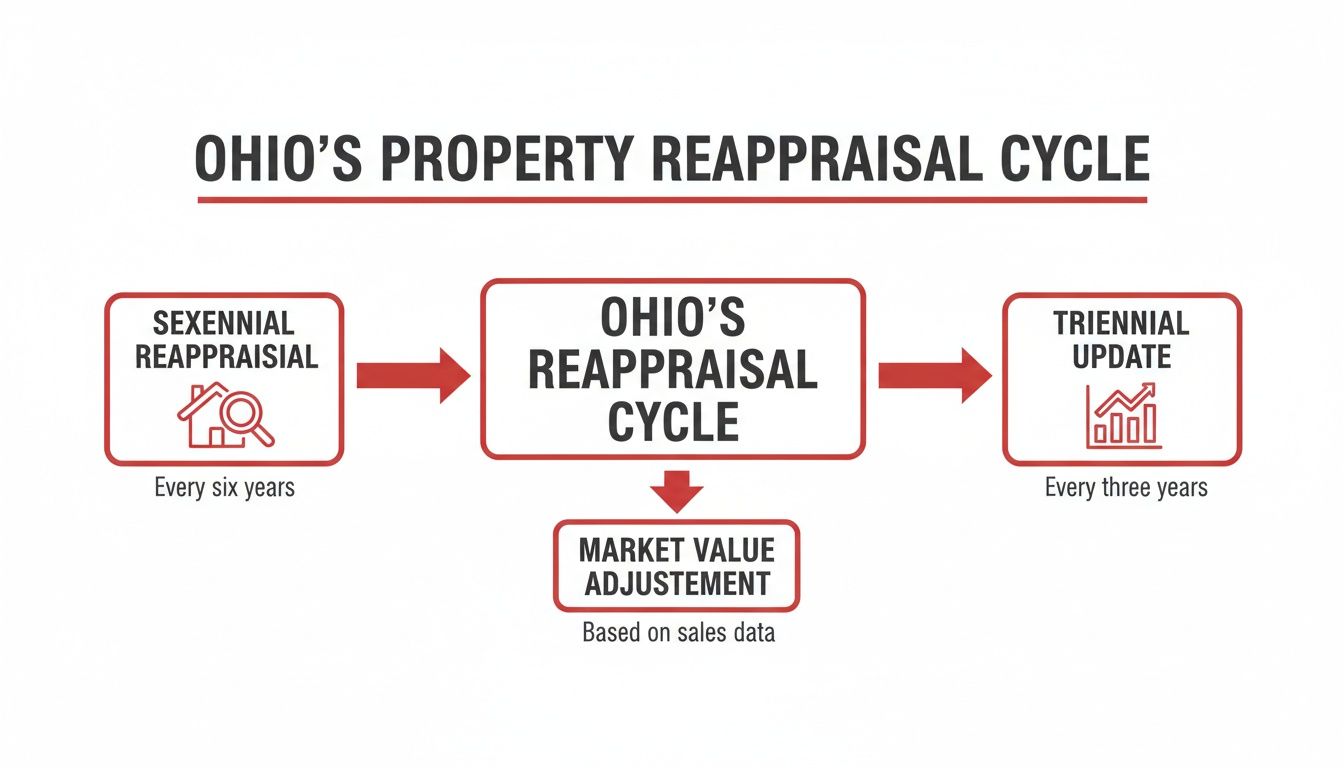
The "sexennial" reappraisal is a comprehensive, deep-dive valuation of every single property in the county that happens every six years. It’s required by the Ohio Department of Taxation for every county in the state. Cuyahoga County's full reappraisals occurred in 2012, 2018, and most recently in 2024. The next one is scheduled for 2030.
This is an intensive, 18-month process where state-licensed appraisers physically view or use advanced modeling to review every property. They use three main approaches to determine market value:
- Market Estimate Approach: Analyzing recent sales of comparable properties in your neighborhood.
- Cost Approach: Estimating what it would cost to build your home today, minus depreciation.
- Multiple Regression Analysis: Using statistical models to analyze sales data and property characteristics.
The values established in the 2024 reappraisal will apply to your tax bills for 2025 and remain in effect through 2027.
What is a Triennial Update?
Halfway between each full reappraisal, the county conducts a triennial update. This happens every three years (the last was in 2021, the next is in 2027). Unlike the sexennial, this is a less intensive process based primarily on statistical analysis of sales data from the previous three years. No one physically inspects every property; it's a market adjustment to keep values in line with recent trends. For example, the 2021 update resulted in a 16% average increase.
2024 Sexennial Reappraisal Timeline
- October 2022: The process began.
- July 9, 2024: Proposed new values were released.
- July-August 2024: Homeowners could file informal appeals.
- January 1 – March 31, 2025: The window for filing formal complaints opens.
- 2025 Tax Bills: The first bills reflecting the new values will be issued.
This cycle ensures that as home values change at different rates across communities like Lakewood, Bedford, and University Heights, the tax burden is periodically redistributed to reflect current market realities. When you receive your "Proposed Value Notice," it shows the county's determination of your Market Value and Assessed Value and provides information on how to begin the appeal process if you believe there's an error.
2024 Reappraisal Results: A Look at the Numbers
The 2024 reappraisal delivered some of the most dramatic value increases in a generation. The average residential property value across Cuyahoga County jumped by 32.22%, catching up on six years of market appreciation, including the unprecedented housing boom during the COVID-19 pandemic.
Why Such a Large Increase?
The last full reappraisal was in 2018. Between then and now, the housing market exploded. From 2020 to 2022, we saw:
- Fierce bidding wars driving prices well over asking.
- A surge in no-inspection, cash offers.
- Extremely low inventory, which pushed values up dramatically.
In many parts of Cleveland and its suburbs, home prices surged 40% or more. The 2024 reappraisal was simply the moment the county’s official records caught up with that reality.
Increases by Community: A Tale of Two Markets
The increases were not uniform. Inner-ring suburbs, many of which were hit hard by the 2008 financial crisis, saw the largest percentage jumps as their markets recovered and, in some cases, gentrified.
Highest Increases:
- East Cleveland: 67% (average value from $31,200 to $52,300)
- Maple Heights: 59%
- Garfield Heights: 52%
- Cleveland (City): 49%
Conversely, more affluent communities with already high home values saw smaller percentage increases, even if the dollar amounts were large.
Lowest Increases:
- Hunting Valley: 15% (average value from $1.3M to $1.5M)
- Moreland Hills: ~20%
- Westlake: ~27%
A Closer Look at Cleveland and Key Suburbs
- Cleveland: A 49% average increase, with neighborhoods like Tremont and Ohio City seeing jumps over 60%.
- Parma: ~35% increase.
- Lakewood: ~38% increase.
- Cleveland Heights: ~42% increase.
- Shaker Heights: ~25% increase.
The results sparked immediate concern, particularly from seniors on fixed incomes and homeowners in areas like East Cleveland and Garfield Heights. One Garfield Heights resident saw her home's value double from $45,000 to $107,000. In response to public anxiety, the county held numerous information sessions and launched an online property tax calculator, emphasizing that House Bill 920 would prevent taxes from rising proportionally with values. Still, over 20,000 homeowners filed informal appeals, signaling widespread concern about housing affordability.
How Property Taxes Are Calculated: A Step-by-Step Breakdown
Understanding your tax bill can feel overwhelming, but the actual formula is surprisingly straightforward. It all comes down to three key components.
The Basic Formula: Assessed Value × Millage Rate = Annual Property Tax
Let's break down each part of that equation.
Step 1: Market Value (Appraised Value)
This is the starting point. It's the county's official estimate of what your property is worth on the open market, based on factors like recent comparable sales, location, square footage, and condition. This is the number you saw on the valuation letter you received in July 2024.
Step 2: Assessed Value (The 35% Rule)
Under Ohio law, you are not taxed on your home's full market value. Instead, you are taxed on just 35% of that value. This is called the Assessed Value, and it's your actual taxable base.
- Calculation: Market Value × 0.35 = Assessed Value
- Example: If your home's market value is $200,000, your assessed value is $200,000 × 0.35 = $70,000.
Step 3: Millage Rate (The Tax Rate)
The final piece is the Millage Rate. One "mill" is equal to $1 of tax for every $1,000 of assessed value. This rate varies significantly from one city to another because it's a combination of individual levies voted on to fund:
- School districts (typically ~60% of your bill)
- City or township services
- County government
- Public libraries
- Cleveland Metroparks
This is why two homes with the same market value in different suburbs can have wildly different tax bills.
Examples of Cuyahoga County Effective Tax Rates (2024):
- Lowest: Cuyahoga Heights (1.66%) and Independence (1.81%)
- Highest: University Heights (3.66%), Garfield Heights (3.74%), and Shaker Heights (3.76%)
Putting It All Together: Real Calculation Examples
Example 1: A home in Cleveland (CMSD District)
- Market Value: $200,000
- Assessed Value: $200,000 × 0.35 = $70,000
- Effective Millage Rate: ~2.6% (26 mills)
- Annual Property Tax: $70,000 × (26 / 1,000) = $1,820
Example 2: A home in Shaker Heights
- Market Value: $300,000
- Assessed Value: $300,000 × 0.35 = $105,000
- Effective Millage Rate: ~3.76% (37.6 mills)
- Annual Property Tax: $105,000 × (37.6 / 1,000) = $3,948
The rate you actually pay is the Effective Rate, which is the Voted Rate (what appeared on the ballot) after reductions from House Bill 920 are applied. The effective rate is always lower, which we'll explain next.
House Bill 920 Explained: Your Shield Against Tax Shock
If there is one concept every Ohio homeowner must understand, it's House Bill 920. Passed in 1976, this law is a powerful protection designed to prevent your property taxes from automatically skyrocketing just because property values go up. Its core purpose is to prevent local governments from receiving an unvoted tax windfall due to inflation.
Before HB 920, a 30% increase in your home's value meant a 30% increase in your taxes. It was unsustainable. Today, the system works differently. When property values in a community rise, HB 920 automatically reduces the tax rate (millage) for voted levies to ensure the taxing district collects roughly the same amount of money as it did the year before.
How HB 920 Affects Your Individual Tax Bill
The law works by redistributing the tax burden. Your personal tax bill will go up or down depending on how your property's value changed compared to the average in your community.
- Scenario 1: Your home's value increased by the exact community average. If your property in Cleveland went up by 49% (the city average), your share of the tax burden for voted levies will stay about the same.
- Scenario 2: Your home's value increased more than the average. If the average in your community was 30% but your home's value jumped 45%, you will see a tax increase. You are now responsible for a slightly larger piece of the tax pie.
- Scenario 3: Your home's value increased less than the average. If the average was 30% but your property only went up by 15%, your taxes will likely decrease. Your share of the burden has shrunk.
This is precisely why a 32% county-wide value increase does not translate to a 32% tax hike. For most, the actual tax increase will be in the single-digit percentages.
Important Limitations of HB 920
However, this protection is not absolute. HB 920 does not apply to certain types of millage, and these exceptions are where most tax increases come from:
- Inside Millage: The first 10 mills authorized by the Ohio Constitution are not subject to reduction and will increase proportionally with your home's value.
- Charter Millage: Some charter cities, like Cleveland, have provisions that exempt certain levies from HB 920.
- The 20-Mill Floor: This is the most critical exception. Ohio law requires school districts to collect a minimum of 20 mills for operations. When HB 920 reductions would push a district's rate below this "floor," the reductions stop. Those 20 mills then become inflationary, rising directly with property values. Most districts in Cuyahoga County are at this floor.
The bottom line: HB 920 softens the blow significantly, but it doesn't eliminate it entirely. For homeowners already struggling, even a small increase can feel overwhelming. If property taxes are making it difficult to afford your home, remember you have options. Selling your home to Home Sweet Home Offers means no more tax burden and a fast cash closing. Call or text 216-200-8010.
Inside Millage, Outside Millage & The 20-Mill Floor
To truly understand your tax bill, you need to know about the two types of millage and the single most important exception to tax reduction rules: the 20-mill floor. This concept explains where most of the "sticker shock" from the 2024 reappraisal comes from.
Inside Millage vs. Outside Millage
Inside Millage:
- These are the first 10 mills of property tax authorized by the Ohio Constitution.
- They do not require voter approval.
- They are not protected by House Bill 920, meaning they are inflationary. When your property value goes up 30%, the taxes from inside millage go up 30%.
- This is a relatively small portion of your total bill, but it does grow with your home's value.
Outside Millage:
- This includes all levies approved by voters for schools, libraries, parks, and other services.
- This is the vast majority (85-90%) of your tax bill.
- It is protected by House Bill 920 and is not inflationary (unless the district is at the 20-mill floor).
The 20-Mill Floor: The Most Important Concept
This is the critical exception to HB 920's protections. Ohio law mandates that every school district must collect a minimum of 20 mills (a 2% tax rate) for operating expenses.
How it Works:
- If a school district's total effective operating millage would be reduced below 20 mills by HB 920, the reduction stops. The district is then considered "at the floor."
- Once a district is at the floor, those 20 mills are no longer protected by HB 920. They become inflationary, just like inside millage.
- Most suburban school districts in Cuyahoga County, including Cleveland, Parma, and Garfield Heights, are at or very near the 20-mill floor.
Impact of a District at the Floor:
When your school district is at the 20-mill floor, the portion of your taxes funding school operations will increase directly with your property's value.
- Example: Your home's assessed value goes from $70,000 to $91,000 (a 30% increase).
- Your school taxes (at 20 mills): Will increase from $1,400 ($70,000 x 0.020) to $1,820 ($91,000 x 0.020)—a 30% increase.
Since school taxes make up about 60% of the average tax bill, this is where homeowners feel the biggest pinch. A 30% increase on 60% of your bill is a significant and noticeable jump in your total payment. To know your specific situation, you must check if your school district is at the 20-mill floor.
Real-World Tax Bill Examples: Before and After
Let's move from theory to reality. Here are concrete examples of how the 2024 reappraisal is expected to affect homeowners in different communities across Cuyahoga County.
(Note: These are estimates based on public data and may vary.)
Example 1: Cleveland Homeowner (CMSD District)
- Before (Market Value: $100,000): Annual Tax Bill: ~$2,645
- After 49% Increase (Market Value: $149,000): Estimated Annual Tax Bill: ~$3,099
- The Change: An increase of $454 per year. This is a ~17% tax increase on a 49% value increase, showing HB 920 at work.
Example 2: Garfield Heights Homeowner
This real-world example features a 71-year-old homeowner on a fixed income.
- Before (Market Value: $45,000): Annual Tax Bill: ~$1,685
- After 107% Increase (Market Value: $93,000): Estimated Annual Tax Bill: ~$3,100
- The Change: An increase of $1,415 per year. Her monthly tax payment nearly doubles, from $140 to $258, consuming 17% of her fixed income. "I might have to walk away after 35 years," she said.
Example 3: Shaker Heights Homeowner
- Before (Market Value: $300,000): Annual Tax Bill: ~$3,948
- After 25% Increase (Market Value: $375,000): Estimated Annual Tax Bill: ~$4,791
- The Change: An increase of $843 per year.
Example 4: Independence Homeowner (Low Tax Rate)
- Before (Market Value: $250,000): Annual Tax Bill: ~$1,579
- After 24% Increase (Market Value: $310,000): Estimated Annual Tax Bill: ~$1,910
- The Change: An increase of $331 per year.
Key Takeaways from the Examples
- The percentage increase in taxes is always much lower than the percentage increase in value.
- However, the dollar amounts can still be substantial and create real financial hardship.
- Low-income homeowners and seniors on fixed incomes are hit the hardest, as the increase represents a much larger portion of their disposable income.
You can get a personalized estimate using the online Property Tax Calculator available on the Cuyahoga County Fiscal Officer's website.
If you can't afford the new property tax burden, you are not trapped. Selling to Home Sweet Home Offers eliminates the problem entirely. We provide a sell your house fast solution with a quick closing and no repairs needed. Call or text 216-200-8010.
How to Appeal Your Property Valuation
If you believe the county’s valuation of your home is inaccurate, you have the right to challenge it. The appeal process can seem daunting, but it's a critical tool for homeowners. There are two distinct paths you can take.
Process 1: Informal Review (Your First Step)
This is the simpler, initial option that happens in the summer immediately following a reappraisal. For the 2024 reappraisal, the deadline was August 30, 2024. During this process, you submit evidence directly to the Fiscal Officer's appraisal department online or by mail.
What to Include:
- A recent professional appraisal (strongest evidence).
- Photos documenting property damage or significant deferred maintenance.
- Comparable sales of similar homes in your area that sold for less.
- Certified contractor estimates for major repairs.
In 2024, over 20,000 homeowners filed informal appeals, and many received some reduction. It is a worthwhile first step in any reappraisal year.
Process 2: Formal Tax Complaint (The Official Appeal)
This is a more rigorous and formal process. You can file a formal complaint with the Cuyahoga County Board of Revision (BOR) whether you participated in the informal review or not.
Timeline:
- Filing Period: January 1 – March 31, 2025.
How it Works:
Unlike the informal review, a formal complaint requires you to attend a hearing to present your case. The burden of proof is on you to show that the county's valuation is wrong.
Evidence Needed (A higher standard is required):
- A professional appraisal from the last calendar year is almost essential for success.
- Dated photographs of your property's current condition.
- Certified repair estimates from licensed contractors.
- A recent closing statement if you just purchased the property.
The Hearing:
You (or an attorney) will present your evidence to a three-member board. A county appraiser will defend their valuation. The board will then make a formal decision in writing.
When to Appeal
You should definitely appeal if:
- Your home's value increased significantly more than your neighbors'.
- Your property has major defects the county may have overlooked.
- You have recent comparable sales data that supports a lower value.
Success rates are significantly higher for appeals backed by a professional appraisal (40-60%) compared to those without (10-20%).
The stress of gathering evidence, paying for an appraisal, and attending a hearing can be too much for many homeowners. If you're dealing with an inherited home or are simply too overwhelmed, there's another way. Too stressed about property taxes to fight an appeal? Selling your Cleveland home to Home Sweet Home Offers means no more tax bills, no appeal process, and a fast cash closing. Call or text 216-200-8010.
Tax Relief Programs & Assistance
For many homeowners, especially seniors and those on a fixed income, a property tax increase can be a serious financial strain. Fortunately, Cuyahoga County and the State of Ohio offer several programs designed to ease this burden.

Homestead Exemption
This is one of the most significant tax relief programs available. It allows eligible homeowners to exempt up to $27,200 of their home's market value from property taxation.
Who Qualifies?
- Homeowners age 65 or older.
- Homeowners who are permanently and totally disabled.
- You must own and occupy the home as your primary residence.
- Your modified adjusted gross income must be below the state's annual limit (e.g., $38,600 for 2023).
This exemption can save you several hundred dollars per year. You must apply through the Cuyahoga County Fiscal Officer.
Owner Occupancy Credit
This is a straightforward 2.5% reduction on your property tax bill available to any homeowner who lives in their home. There are no age or income restrictions. As long as you own and occupy your property as your principal residence, you qualify. This is a one-time application that remains in effect until you move.
EasyPay Program
To avoid the stress of two large, semi-annual tax payments, you can enroll in the county's free EasyPay Program. This service automatically deducts your property taxes from your bank account in 12 smaller, more manageable monthly payments. It’s an excellent tool for budgeting and ensures you never miss a payment deadline.
Payment Deadlines and Options
Remember, property tax payments are due twice a year:
- First Half: Mid-February
- Second Half: Mid-July
Late payments incur a steep 10% penalty. You can pay online, by mail, or in person at the County Administration Building.
If you need help or have questions about these programs, contact the Cuyahoga County Fiscal Officer at 216-443-7420 (option 3) or the Treasurer at 216-443-7420.
Impact on Home Sales & The Real Estate Market
Rising property taxes don't just affect your wallet; they have a real impact on the entire Cleveland real estate market. For anyone thinking of selling their home, this new tax landscape creates new challenges.
How Taxes Affect Buyer Affordability
Property taxes are a key component of a homeowner's monthly carrying costs. Lenders factor taxes into a buyer's debt-to-income ratio when determining how much they can borrow. A higher tax bill directly reduces a buyer's purchasing power.
- Example: A buyer approved for a $2,000 monthly housing payment.
- In a low-tax suburb with $300/month in taxes, they can afford a $1,700 mortgage payment (approx. $355K home).
- In a high-tax suburb with $600/month in taxes, they can only afford a $1,400 mortgage payment (approx. $290K home).
This reality means sellers in high-tax areas like Shaker Heights or Garfield Heights may need to lower their asking price to attract qualified buyers.
Selling to Avoid the Tax Burden
For many, the tax increase is the final push to sell. This is especially true for:
- Seniors on fixed incomes who can no longer afford the carrying costs.
- Heirs who inherited a property and can't manage the high taxes.
- Landlords whose investment properties are no longer profitable.
- Anyone facing financial hardship or job loss who needs a quick exit.
Selling on the traditional market when taxes are high can be difficult. It often means a longer time on the market and potential price reductions. For those in a time-sensitive situation, a cash buyer offers a clear alternative. Selling to a company like Home Sweet Home Offers provides immediate relief from the tax obligation with a fast, guaranteed closing.
Property taxes making your Cleveland home unaffordable or unsellable? Home Sweet Home Offers buys houses regardless of tax burden—fast cash closing, no repairs. Call or text 216-200-8010. We buy houses in Cleveland and can help you navigate a stressful situation.
Frequently Asked Questions
Q: Why did my property value increase so much?
A: The 2024 sexennial reappraisal was the first since 2018. The 32% average increase reflects six years of market appreciation, including the massive housing boom during the pandemic, essentially "catching up" to current market reality.
Q: Will my property taxes increase by the same percentage as my value?
A: No. House Bill 920 prevents proportional increases on most levies. A 32% value increase will typically result in a single-digit percentage tax increase for most homeowners, although the dollar amount can still be significant.
Q: What if I can't afford the new tax bill?
A: You have options. Apply for the Homestead Exemption if you are 65+ or disabled, sign up for the EasyPay monthly payment plan, or appeal your valuation if you believe it's incorrect. If the burden is truly unsustainable, consider selling your home.
Q: Should I appeal my valuation?
A: You should appeal if your value increased significantly more than your neighborhood average, you have documentation of property defects, or recent comparable sales support a lower value. Getting a professional appraisal gives you the best chance of success.
Q: What's the deadline to appeal?
A: Formal complaints to the Board of Revision must be filed between January 1 and March 31, 2025. The deadline for the informal review for the 2024 reappraisal has already passed.
Q: Do I have to pay the new tax amount while I'm appealing?
A: Yes. You must continue to pay your tax bills on time while your appeal is pending. If your appeal is successful, you will receive a refund or credit.
Q: Can I sell my house to avoid the higher taxes?
A: Yes. Selling your home eliminates your property tax obligation. If you're facing foreclosure or can't afford the payments, a quick home sale can provide immediate relief. Home Sweet Home Offers buys Cleveland homes fast for cash. Call 216-200-8010.
Q: What happens if I don't pay my property taxes?
A: You will face a 10% late penalty, and interest will accrue. Eventually, the county can place a lien on your property and initiate foreclosure proceedings. It's critical to seek help or consider your options, like a sell house fast solution, before it reaches that stage.
Conclusion: You Have Options
Navigating Cuyahoga County's property taxes can feel complex, but understanding the key concepts empowers you to take control. The 2024 reappraisal brought a significant 32% average increase in property values, but thanks to House Bill 920, your tax bill will not rise proportionally. However, due to inflationary factors like the 20-mill floor for schools, most homeowners will see an increase.
For those struggling, especially seniors on fixed incomes or anyone facing financial hardship, this can be a breaking point. Remember your key takeaways:
- Your tax is calculated as Assessed Value (35% of market) × Millage Rate.
- HB 920 softens the blow, but the 20-mill floor for schools is where most increases originate.
- You have the right to appeal your valuation between January 1 and March 31.
- Tax relief programs like the Homestead Exemption and EasyPay can provide real help.
Cuyahoga County's 2024 property tax reappraisal represents the largest value increase in over 30 years. While House Bill 920 provides some protection, many homeowners on fixed incomes face unsustainable tax burdens, forcing difficult decisions about whether they can remain in homes they've owned for decades.
If rising property taxes have made your Cleveland home unaffordable, you have options. Home Sweet Home Offers provides a fast, fair solution—we buy houses in any condition, with any tax burden, and close quickly so you can move on with your life. No commissions, no repairs, no stress about property taxes. Whether you're facing financial hardship, inherited a property with high taxes, or simply want to exit before the next tax bill arrives, we can help. Call or text 216-200-8010 for a free, no-obligation cash offer today.
Sources
- Cuyahoga County Fiscal Officer (cuyahogacounty.gov/fiscal-officer)
- Cuyahoga County Treasurer (cuyahogacounty.gov/treasury)
- Cuyahoga County Board of Revision
- Ohio Department of Taxation
- 2024 Sexennial Reappraisal official results
- House Bill 920 (Ohio Revised Code)
- Ideastream Public Media coverage
- Signal Cleveland reporting
- Cleveland.com
- KJK Law analysis
- McCarthy Lebit Legal analysis