
When you're backed into a corner, the idea of a quick, all-cash sale for your Cleveland home can feel like a godsend. Life happens. We understand. Maybe you're trying to head off a foreclosure in Garfield Heights, sort out an inherited property over in University Heights, or you're just done with being a landlord in Lakewood. The promise of a simple, fast exit—no repairs, no showings, no commissions—is incredibly tempting, especially when you're under stress.
For a lot of homeowners across Cuyahoga County, the need to sell a house as-is in Cleveland isn't a luxury; it's a necessity. You might be staring at a stack of code violation notices for a rental in Euclid, or maybe the numbers just don't add up to fix your parents' old home in Parma after they've moved to assisted living. In those moments, the "we buy houses Cleveland" signs start to look like the perfect answer.
This is the exact vulnerability that scammers are banking on. They know that when you're under immense pressure from a job loss, divorce, or mounting medical bills, you’re more likely to miss the warning signs. They use your desire for a quick home sale in Cleveland as leverage to push bad deals, make promises they can't keep, and ultimately, take advantage of your situation.
The Real Appeal of a Legitimate Cash Offer
Let's be clear: working with reputable cash home buyers in Cleveland has some serious upsides, especially when your property needs work or time is against you. A genuine cash sale cuts through the red tape of a traditional transaction. It all comes down to the fact that cash buyers aren't waiting on a bank's approval, which is where most of the delays and drama in a typical sale come from. (If you want the full story, we've broken down why cash buyers can close so much faster and what it means for you.)
The key benefits are pretty straightforward:
- Speed. A legitimate cash buyer can often close in a matter of weeks, not months. This is huge if you're relocating for a new job or facing a hard deadline for an estate closure.
- Certainty. The dreaded "buyer's financing fell through" call is off the table. Once we make a firm offer, the deal is solid.
- No Repairs. You can sell the house exactly as it is right now. For homeowners in older neighborhoods like Maple Heights or Bedford, that can mean saving tens of thousands of dollars on renovations you can't afford.
- Fewer Fees. You typically get to skip the hefty realtor commissions and many of the usual closing costs, leaving more cash in your pocket at the end of the day.
How Scammers Twist the Narrative
This is where things get murky. Predatory companies and individuals mimic the language of legitimate investors like us, but they're playing a completely different game. They don't have the funds, the integrity, or any real intention of closing the deal they promised. They know that if you're worried about losing your home or overwhelmed by probate, you're just looking for an easy button.
A scammer’s real goal isn’t to buy your house. It’s to get your property locked into a contract that heavily favors them, giving them the power to either pressure you into a much lower price later or just walk away, leaving you high and dry.
Before you even think about accepting an offer, you have to be able to tell the difference between a real solution and a sophisticated trap. At Home Sweet Home Offers, we're firm believers that every homeowner in Cleveland deserves a process that is fair, transparent, and respectful from start to finish. We're here to offer a trustworthy solution, not add to your stress.
When you’re in a tough spot and need to sell your Cleveland home fast, it’s easy to grab the first lifeline thrown your way. Scammers are masters of disguise. They know how to create a sense of urgency, making you feel like their offer is your only way out of a stressful situation, whether it’s foreclosure, an inherited property, or a sudden move.
Think of this as your field guide to spotting their tricks. Learning to trust your gut when something feels off is the first and most important step in protecting yourself.
Recognizing the Red Flags of a Home Buyer Scam
You don't need to be a real estate pro to spot a scammer. You just need to know what to look for. They often follow a predictable pattern, and once you see it, you can't unsee it.
High-Pressure Tactics and Unrealistic Deadlines
One of the biggest red flags is feeling rushed. A legitimate cash buyer knows this is a huge decision. They’ll make a fair offer and give you the space you need to think it over. At Home Sweet Home Offers, we want you to be confident in your choice.
Scammers, on the other hand, thrive on pressure. You'll hear things like, “This offer is only good for the next 24 hours,” or “I’ve got another house I’m about to buy, so I need your answer now.” This is a deliberate tactic designed to get you to sign before you can do your research or talk to an attorney.
Key Takeaway: Any buyer who tries to force you into signing on the spot is bad news. A real, solid offer will still be on the table tomorrow. Don’t let anyone rush you.
Vague Promises and No Proof of Funds
Here’s a non-negotiable rule: a real cash buyer has the cash. They should have no problem providing a proof of funds (POF) letter from their bank to prove it. This is standard practice, not a special request.
Scammers will get slippery when you ask for a POF. You’ll hear a lot of excuses—their money is tied up with a partner, they’re waiting on another deal to close, they’ll have it by the closing date. If they can't show you the money, it's because they probably don't have it. They’re just trying to get your house under contract.
No Real Professional or Local Footprint
In this day and age, any serious business has a real online presence. When you're checking out a “we buy houses Cleveland” company, do a little digging.
- A Professional Website: Does it look legitimate? Do they have a local Cleveland phone number and a physical address you can actually find on a map? A P.O. box or a generic national number is a warning sign.
- Real Reviews: Look for them on Google and the Better Business Bureau (BBB). Are there reviews from actual sellers in neighborhoods you recognize, like Lorain, Elyria, or Parma?
- Branded Communication: Check their email address. Is it coming from a professional domain (
info@companyname.com) or a free service like Gmail or Yahoo? Scammers love to hide behind generic, untraceable email accounts.
A huge part of spotting a scam is knowing if the offer itself is fair. Getting comfortable with mastering a real estate comparables tool can give you the data you need to see how their price stacks up against recent sales in your area.
The Bait-and-Switch Lowball Offer
Sure, cash offers are typically a bit lower than market value—that's the trade-off for a fast, simple sale. But a scammer's offer is often downright predatory.
They’ll use a classic bait-and-switch. First, they hook you with an offer that seems pretty reasonable. Once you're emotionally committed, they'll conduct a shady "inspection" and come back with a long list of bogus "repairs" needed, slashing the price dramatically. They know you're already counting on that money and hope you'll feel too trapped to back out.
This isn't just a feeling; the numbers back it up. A recent study found that 66% of homeowners are worried that cash buyers will hit them with a lowball offer. On average, these types of buyers pay around 67.5% of a home's after-repair value. On a $200,000 home in Cleveland, that's an offer closer to $135,000—a massive financial hit. You can discover more insights about these cash home buying trends to see just how common this is.
At Home Sweet Home Offers, we don't play those games. We believe in total transparency. We’ll walk you through our valuation line by line so you see exactly how we got to our number. No last-minute surprises, no pressure—just a fair, honest offer for your Cleveland home.
So, you're thinking about selling your house to a "We Buy Houses" company in Ohio. It can be a fantastic way to sell quickly, but you have to be careful. Every scammer out there is trying their best to look like a legitimate investor, especially in Cleveland and the surrounding suburbs.
If you're a Cleveland homeowner wanting to sell fast, taking the time to properly vet any cash buyer is non-negotiable. This guide will walk you through how to spot the real, transparent professionals and avoid the rest.
Before we get into the nitty-gritty, just remember one thing: a legitimate buyer's proof of funds and company credentials should be easy to verify.
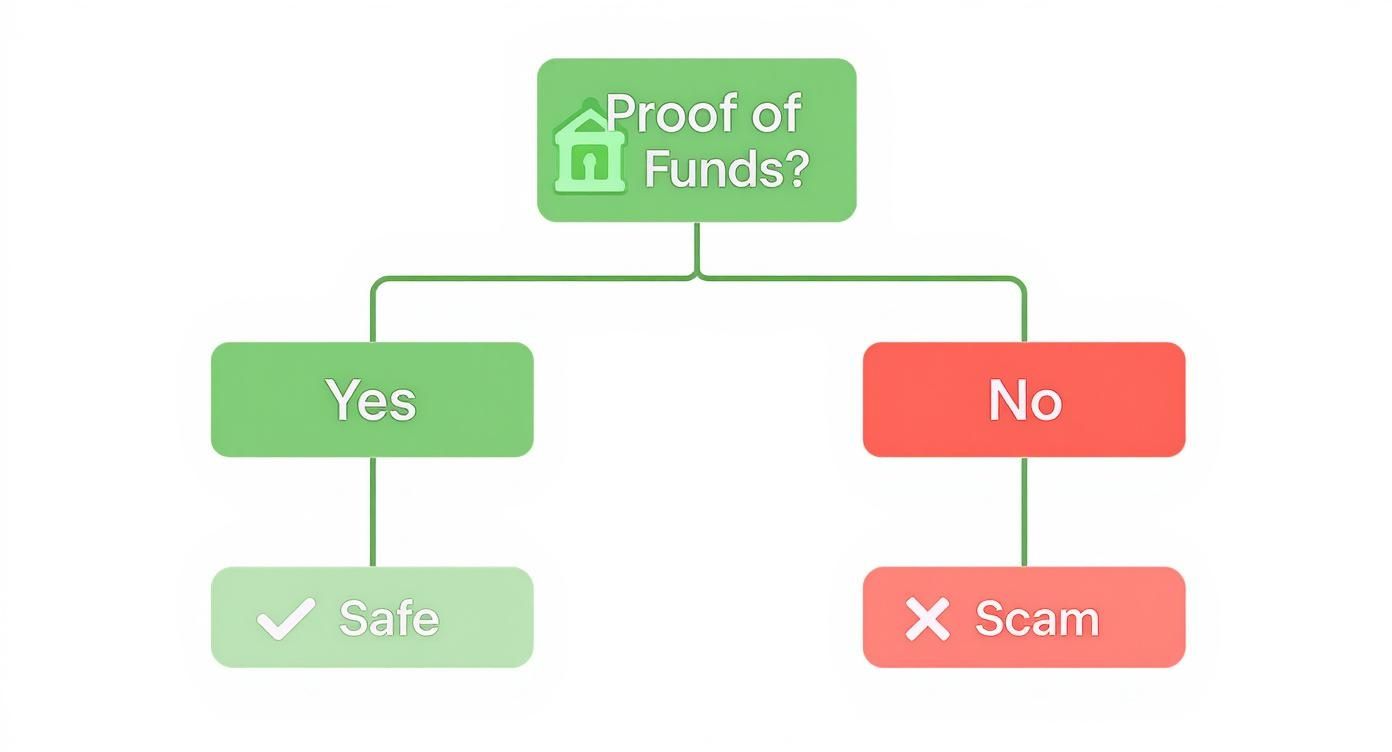
This decision tree really simplifies it. Any buyer who can't—or won't—show you verified funds right from the start is a massive red flag. Think of it as your first and most important filter.
Checking Company Credentials
First things first, do a quick background check. Head over to the Better Business Bureau website and look up their rating. This applies whether you're in Cleveland proper or suburbs like Parma or Euclid.
Next, confirm the company is actually registered to do business here. A quick search on the Ohio Secretary of State's website will tell you what you need to know. Finally, dig into online reviews from real sellers in your area—look for mentions of Lakewood, Maple Heights, or Bedford to see if they have a local track record.
- BBB Rating: You're looking for an A- or better. Anything less warrants a closer look.
- State Registration: Use the Ohio Secretary of State's business search to confirm they are a legitimate entity.
- Online Reviews: Look for multiple, detailed stories from local homeowners. A single glowing review is nice, but a pattern of positive experiences is better.
For those who want to be extra thorough, a detailed public record search can uncover any past lawsuits or formal complaints.
Asking the Right Questions
When you get a cash buyer on the phone, don't let them control the entire conversation. Come prepared with a list of questions that will separate the pros from the pretenders.
- Can you provide a proof of funds letter from a local Ohio bank?
- Which licensed Ohio title company do you typically work with for closing?
- Are you comfortable with my attorney reviewing the purchase agreement before I sign?
- Can you share references from a few sellers you've recently worked with in the Cleveland area?
“Always request references and documentation upfront. A real buyer won’t hesitate.” – Local Real Estate Attorney
Their willingness to answer these questions—and provide the documents to back them up—speaks volumes.
Verifying Proof of Funds Documents
A legitimate Proof of Funds (POF) letter isn't just a number on a piece of paper. It should look professional and be easily verifiable.
Look for official bank letterhead with a clear logo. The date should be recent, and it should include the bank's contact information so you or your attorney can confirm it's current.
- Bank Letterhead: Make sure it has the bank's logo and branch information.
- Account Balance: The document must clearly state a balance that is sufficient to cover your purchase price.
- Buyer Name: The name on the POF letter must match the buyer's name on the contract exactly.
Be on the lookout for typos, strange formatting, or anything that just feels off. Scammers often create fake documents that don't hold up under scrutiny.
Reviewing Contract Terms
Even if a buyer seems solid, the contract is where the real traps can be hidden. The fine print is everything.
Pay close attention to any clauses that give the buyer an easy way out or put you at a disadvantage.
- Assignment Clauses: These allow the buyer to sell your contract to another person. This isn't always bad, but you need to know who you might end up dealing with.
- Extended Inspection Periods: A long inspection window can be a tactic to lock up your property, find issues, and then try to renegotiate the price down.
- Hidden Fees: Scour the contract for any mention of "administrative," "processing," or other vague fees that might be deducted from your final payout.
Tip: Don’t let legal jargon bury the risks. If you don't understand a clause, ask for clarification or have an attorney review it. It's worth the peace of mind.
Cross-Checking Their Facts
Don't just take their word for it. Use public resources to verify the credentials and claims they've made.
- Check with the Ohio Department of Commerce for any licenses or complaints filed against them.
- Look up the property on your county auditor's website to see if there are any unexpected liens or judgments.
- Scan local real estate forums or community groups for any chatter or testimonials from other sellers.
Leveraging Local Market Data
A trustworthy buyer will always base their offer on real numbers, not just a random figure pulled from thin air. You can check their math yourself.
- Use your county auditor's website to look up recent sale prices in your neighborhood.
- Ask a Realtor for comps that account for your home's condition and location.
- Browse Zillow or the MLS for recent sales in places like Euclid or Lorain.
Even if you plan to sell your house as-is in Cleveland, these data points will help you understand if the offer you've received is in the right ballpark.
Comparing Multiple Offers
Never, ever jump on the first offer you receive. It's crucial to get at least two or three bids from different cash buyers.
This allows you to compare not just the final price, but all the other details: the proposed timeline, who pays for what fees, and any contingencies they've included.
- Offer Comparison: Create a simple chart to look at the net proceeds (offer price minus fees), the closing timeframe, and any conditions attached to each offer.
Confirming They Have a Local Presence
Scammers love to operate from behind a curtain of P.O. boxes and anonymous toll-free numbers. A real, committed local buyer will have a physical presence.
- Use Google Maps to verify their office address actually exists and isn't a mail drop.
- Call the number they provide. Does it have a local Cleveland area code?
- If you can, visit the office in person to meet the team. It’s hard to fake a real office with real people.
For a more structured way to vet any 'We Buy Houses' company, using a comprehensive due diligence checklist can help ensure you don't miss any critical steps before you sign anything.
You can learn even more about spotting real cash buyers in our detailed article: How to Spot a Legitimate Cash Home Buyer in Ohio.
Once you’ve confirmed their credentials and you're comfortable with the contract terms, you can finally move forward with confidence.
With a transparent, local company like Home Sweet Home Offers, closings in places like Parma, Bedford, or Euclid often happen within 14 to 30 days. This gives you the speed you need without sacrificing security, allowing you to plan your next move. Follow this process, and you can sell your home for cash confidently and safely.
Using Escrow and Title Companies to Protect Your Sale
If there's one non-negotiable step to protect yourself when selling your Cleveland home for cash, this is it. Pay close attention.
A scammer's entire game plan often hinges on convincing you to skip professional oversight. They'll frame it as a way to "save money" or "speed things up," but what they're really doing is trying to remove the very safeguards that protect your money and your property.
You absolutely must insist on using a reputable, third-party title and escrow company for any real estate transaction. This isn't just a suggestion; it's your most powerful defense against fraud. For homeowners in Parma, Garfield Heights, or anywhere in between, these professionals are the impartial referees who make sure everything is done by the book.
What Does a Title Company Do?
Think of a title company as your property's private investigator. Before any money changes hands, their first job is to perform a title search, digging deep into the public records tied to your home.
Their mission is to confirm you have a "clear title"—meaning you have the undisputed right to sell the property. They’re hunting for hidden issues that could completely derail a sale, things like:
- Unpaid property taxes to Cuyahoga County.
- Liens from contractors who were never paid for past work.
- Judgments from old debts or legal disputes.
- Surprise claims from a previous owner's long-lost heir.
Once they confirm the title is clear, they issue title insurance. This protects both you and the buyer from any unforeseen claims that might pop up down the road. Any legitimate buyer, including Home Sweet Home Offers, will always use a licensed Ohio title company and will never ask you to skip this critical step.
Understanding the Role of Escrow
While the title company verifies ownership, the escrow service—often handled by the same company or an attorney—acts as the secure middleman for the money. An escrow officer is a neutral third party who holds all the important documents and, most importantly, the buyer's funds.
Here’s how it works: the buyer wires their cash into a secure, protected escrow account. Those funds don't get released to you until every single condition in the purchase agreement has been met and all the paperwork is signed. This completely eliminates the risk of a buyer backing out after you've signed over the deed or, even worse, handing you a bad check.
Key Takeaway: Escrow ensures the buyer actually has the cash to close and that you get paid exactly what you were promised, when you were promised. A scammer avoids escrow like the plague because it exposes their inability to actually fund the deal.
The Growing Threat of Wire Fraud
Even when using a legitimate title company, you have to be vigilant about a particularly nasty scam called wire fraud. This is a huge issue in real estate, and sellers looking for a "quick home sale in Cleveland" are prime targets.
Wire fraud is an expensive and terrifyingly common problem. The real estate sector is projected to lose around $500 million every year to these schemes. Frighteningly, 25% of buyers and sellers report being targeted during closing, and 1 in 20 tragically become victims. You can read the full research on real estate scams at Kiplinger.com.
Here's how this scam plays out: a fraudster hacks into the email account of someone involved in the transaction—it could be the buyer, the title agent, or even your attorney. They then craft a fake email that looks identical to a real one and send you new, fraudulent wiring instructions for your closing proceeds. If you send your money to that account, it vanishes in an instant.
How to Protect Yourself from Wire Fraud
The good news is that preventing this scam is straightforward if you stay on your toes.
- Confirm All Instructions Verbally: Before you send or expect to receive a dime, always call the title company. Use a phone number you have independently verified from their official website or a document you received early in the process. Never, ever use a phone number listed in an email.
- Be Suspicious of Changes: Any last-minute change to wiring instructions is a massive red flag. Legitimate companies almost never change these details unexpectedly.
- Inspect Email Addresses Carefully: Scammers get tricky. They often use email addresses that are just one letter off from the real one (e.g.,
closing@tit1ecompany.cominstead ofclosing@titlecompany.com). Look closely.
This is another reason why working with a known, local buyer is so important. When we buy houses in Cleveland, we work with the same trusted local title partners time and time again. We already have established, secure communication channels that help protect everyone involved.
Having a trusted partner is also invaluable when navigating other local requirements, like point-of-sale inspections. If you're selling in University Heights, for example, our guide to POS inspections for homeowners can help you prepare.
Decoding the Cash Offer Contract for Hidden Traps
Getting that cash offer in hand can feel like the finish line, but honestly, it’s where you need to pay the most attention. This is where a scammer’s real intentions come to light. A purchase agreement that seems simple enough can be packed with fine print and loopholes designed to benefit the buyer, leaving you in a tough spot.
For homeowners in Cleveland, Parma, or Euclid, knowing how to spot these contractual traps is the key to avoiding a deal that goes south at the eleventh hour.
The paperwork is where a friendly verbal promise either becomes a solid legal commitment or shows its true colors as a clever trick. Legitimate buyers, like us at Home Sweet Home Offers, use straightforward, standard contracts designed to protect everyone involved. Scammers? They bank on confusing language to give themselves an escape route.
The Bait-and-Switch Inspection Period
One of the oldest tricks in the book is exploiting the "inspection" or "due diligence" period. Look, every buyer has a right to inspect a property. But scammers twist this process. They’ll lock you into a contract with a fantastic offer, then use a ridiculously long inspection window—sometimes 30 days or more—to "uncover" a laundry list of expensive and often overblown repair issues.
Right before their inspection period is up, they’ll come back to you with a dramatically lower offer. Their bet is that you're too far along in the process and too emotionally invested to back out now. It’s a classic bait-and-switch, preying on sellers who were already counting on that initial number.
Pro Tip: A serious cash buyer who knows what they're doing should only need a short inspection period, usually around 7 to 10 days. They're professionals; they can assess a property and make a final decision quickly. Anything longer than that is a huge red flag.
Understanding Assignment Clauses
You’ve seen the "we buy houses Cleveland" signs. A lot of those are put up by wholesalers, not the people who will actually buy your house. A wholesaler’s game is to get your home under contract with zero intention of buying it themselves. They use something called an assignment clause to sell the contract to a real investor, pocketing a fee in the middle.
While wholesaling itself isn't illegal, it throws a ton of uncertainty into your sale.
- Who is actually buying your house? You have no clue who the end-buyer will be or if they're even reliable.
- What if they can't find a buyer? If the wholesaler fails to find an investor to "assign" the contract to, they'll just use an escape clause to cancel the deal. You’re left high and dry, right back at square one.
You need to ask this question directly: "Are you the end-buyer, or will you be assigning this contract?" A transparent company will give you a straight answer. Home Sweet Home Offers is a direct buyer. When we make an offer, we're the ones closing the deal. Period.
Watch Out for Hidden Fees and Vague Language
A scammer's contract can be a minefield of vague terms that let them nickel-and-dime you at the closing table. Comb through that document for any mention of fuzzy costs like:
- "Marketing fees"
- "Administrative fees"
- "Processing charges"
- "Consulting costs"
These are almost always just clever ways to slice into your final payout. A legitimate cash offer should be clean and simple. It will clearly state who pays for standard closing costs (like title insurance and transfer taxes) without any last-minute surprise deductions.
The rise of digital deals has, unfortunately, opened the door for more scams. Reports of mortgage-related fraud have shot up by a staggering 407% since 2022, and that trend spills over into cash sales, too. Scammers exploit the speed and tech loopholes of modern real estate. You can learn more about these rising real estate fraud statistics to see just how important it is to be careful.
The Importance of an Attorney Review Clause
Finally, make sure your contract includes an attorney review clause. This is a non-negotiable. It gives you the right to have your own lawyer look over everything before it becomes binding. Any honest buyer will have absolutely no problem with this.
If a buyer gets defensive, tries to rush you, or says an attorney isn't necessary, walk away. That’s the clearest sign of all that they have something to hide.
Selling your house as-is in Cleveland shouldn't mean you have to become a legal expert overnight. By partnering with a trusted local buyer like Home Sweet Home Offers, you can dodge these contractual nightmares and move toward a safe and successful closing.
A Better, Safer Way to Sell Your House for Cash in Cleveland
Selling your home for cash shouldn't feel like you're rolling the dice. Once you know the red flags to look for and understand the risks involved, what you really need is a secure, straightforward path forward. The key is to find a trusted, local company that gets your situation and knows the Cleveland housing market inside and out.
This is exactly where we come in. Home Sweet Home Offers is a reliable, safe alternative to the wild west of unvetted national buyers. We’re not wholesalers just looking to flip your contract to someone else for a quick buck; we are the actual buyers who will be there with you at the closing table.
We live and work right here, from Bedford to Euclid, and our reputation is everything. It’s built on doing right by our neighbors in Cleveland and beyond.
The Real Benefits of a Trusted Partner
When you work with a reputable local buyer, you get all the actual advantages of a cash sale without any of the predatory tactics. It’s all about helping you reach your goals, safely.
- Certainty That the Sale Will Close: We don’t just make promises. We provide verifiable proof of funds right from the start, so you have complete confidence that the deal is solid.
- Speed That Works for Your Timeline: Need to close in two weeks? No problem. Need a couple of months to get things in order? We can do that, too. We work around your schedule.
- The Relief of Selling As-Is: You can finally stop stressing about that leaky roof, the outdated kitchen, or those pesky code violations. We take the property exactly as it is, handling all the headaches so you don't have to.
Our entire process is built on being fair and transparent. We want you to walk away from the closing table with cash in hand and complete peace of mind, ready for your next chapter.
If you’re thinking about a quick home sale in the Cleveland area, let’s have a conversation. We can provide a fair, fast cash offer with zero pressure and zero obligation.
Got Questions About Selling for Cash? We’ve Got Answers.
When you’re thinking about selling your home for cash in Cleveland, a million questions can start running through your head. It’s a big decision, especially if you’re trying to move quickly or are feeling stressed about the process.
Let’s tackle some of the most common concerns we hear from homeowners. Think of this as your personal guide to navigating the process safely and confidently, drawing from our experience helping people all over town.
Do I Really Need a Real Estate Attorney?
This is a big one. While Ohio law doesn't force you to hire an attorney for a cash sale, it's something we almost always recommend. Why? Because a good real estate lawyer is your best defense against a bad deal.
They'll pore over the purchase agreement, looking for those tricky clauses and loopholes that could cost you thousands down the road. They’re trained to spot red flags you might miss, ensuring the whole process is buttoned up correctly from start to finish. A few hundred dollars for an attorney can save you from a major financial headache.
“A real estate attorney isn't an expense; it's an investment in your peace of mind. They make sure your interests are protected and can spot hidden traps before you sign anything.”
What Exactly Is a Proof of Funds Letter?
Think of a proof of funds (POF) letter as a buyer’s report card. It’s an official document straight from their bank that proves they actually have the cash to buy your house. Don't just take their word for it—always ask to see it.
When you get the POF, look closely. It needs to be on official bank letterhead, dated very recently, and show a balance that covers the full purchase price. Most importantly, make sure the name on the letter matches the name on your contract perfectly. No exceptions.
A legitimate buyer like Home Sweet Home Offers will have no problem providing this. If they hesitate, that's a huge red flag.
Wholesaler vs. Direct Buyer: What’s the Difference?
This is a crucial distinction that trips up a lot of sellers. A wholesaler isn’t actually buying your house. They get your property under contract with the sole intention of "assigning" or selling that contract to another investor for a fee.
The problem? It adds a layer of uncertainty. If they can’t find a buyer, your deal could fall apart at the last minute, leaving you back at square one.
A direct buyer, on the other hand, is the one who will actually be at the closing table. They use their own funds to purchase your home directly. This offers a much cleaner, more reliable path to closing.
| Feature | Wholesaler | Direct Buyer (like us) |
|---|---|---|
| Funding Source | Hopes to find an investor | Has their own verified funds |
| Contract Flow | Sells the contract to someone else | Buys the house themselves |
| Closing Certainty | Can be unpredictable | Much higher and more reliable |
Knowing who you’re dealing with helps you set clear expectations and avoid unnecessary risks. Any reputable cash home buyer will welcome questions, encourage you to get legal advice, and be completely transparent about who they are and how they operate.
We put this together specifically for homeowners in Cleveland neighborhoods like Parma, Lakewood, and Euclid, but the advice holds true for anyone.
If you have more questions or just want to chat about your options, our team is always here to help. No pressure, just honest advice.
Ready for a straightforward cash offer you can trust? Contact Home Sweet Home Offers for a free, no-obligation cash offer today.