
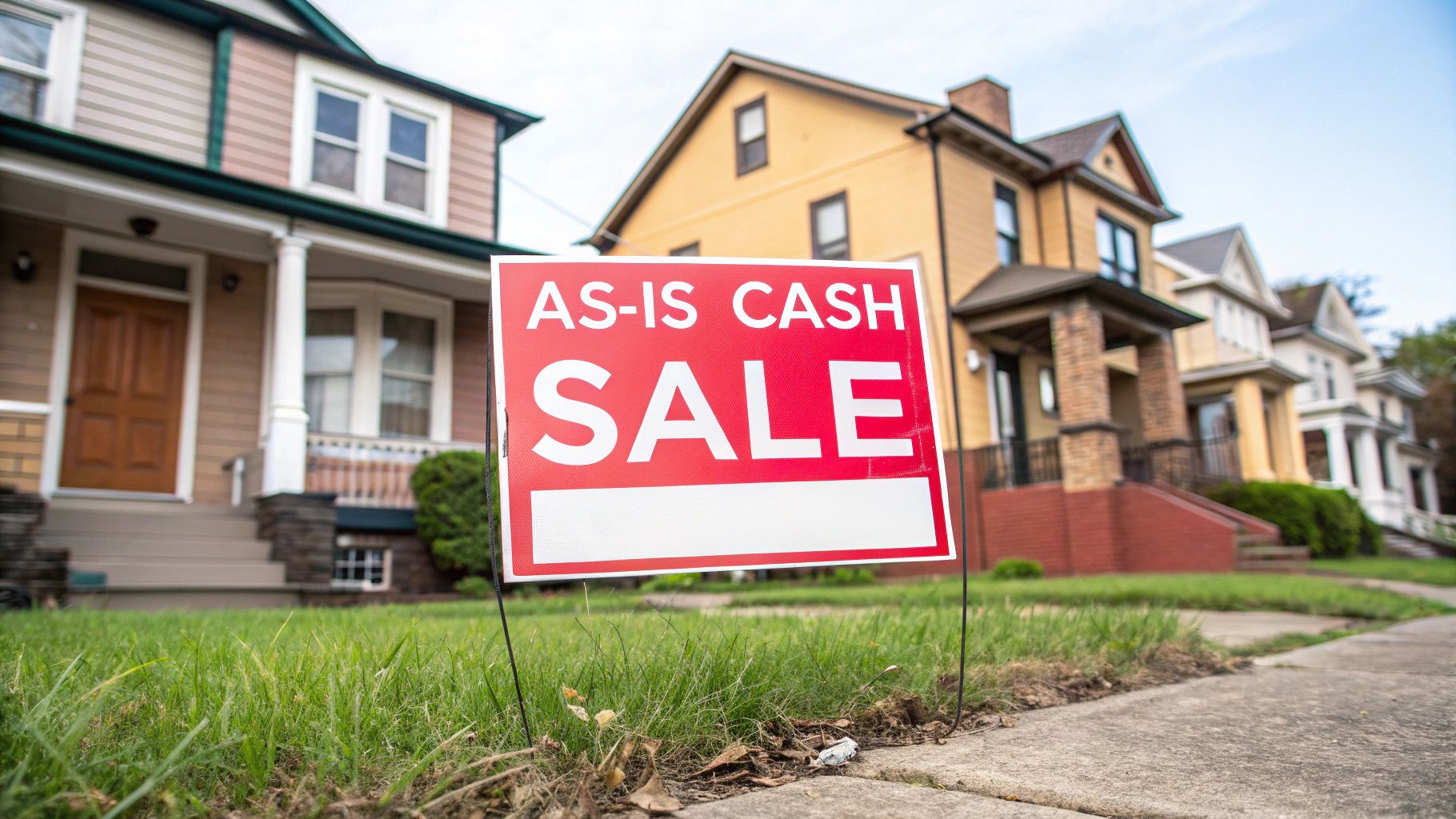
Discovering lead paint in your Cleveland home can feel overwhelming, especially if you're thinking about selling. If your house was built before 1978, it's almost a certainty that lead paint is present somewhere. We understand this discovery is concerning, particularly for families with young children or those who inherited an older home and don't know where to start.
The good news? Selling a house with lead paint in Cleveland is not only possible, it's a common situation we help homeowners navigate every week. This isn't a unique problem you're facing alone; it’s a shared reality across our city’s beautiful, historic neighborhoods. Whether you've had a buyer back out after an inspection or you simply can't afford the high cost of lead abatement, options exist that don't involve sinking thousands of dollars into your property before you sell.
With 2026 mortgage rates in the low 6s, buyers using FHA loans—especially first-time buyers with young children—face mandatory lead paint inspections and remediation requirements that can kill deals before they start. This guide will walk you through your responsibilities and your best strategies for a successful sale.
Whether you're dealing with known lead paint or own a pre-1978 home, Home Sweet Home Offers buys houses with lead paint as-is. Call or text 216-200-8010.
Understanding Lead Paint in Cleveland Homes
What Is Lead Paint?
Lead-based paint is simply paint that contains lead, an additive once prized for making paint more durable, vibrant, and quick-drying. It was used extensively in residential properties across the United States until the federal government banned its use in homes in 1978 due to its proven health risks. As a rule of thumb, any home built before 1978 is presumed to contain lead paint.
Why Do So Many Cleveland Homes Have Lead Paint?
Cleveland's housing stock tells the story. The city experienced a massive building boom from the 1920s through the 1960s, a period that perfectly coincided with the peak use of lead paint. The charming bungalows, colonials, and doubles that define our working-class neighborhoods were almost universally coated with it. It’s estimated that over 90% of Cleveland homes built before 1978 contain some level of lead paint, often buried under many newer layers.
Where Is Lead Paint Typically Found?
Lead paint can be on almost any painted surface in an older home, but it's most common on:
- Exterior surfaces like siding, porches, and trim
- Interior walls and ceilings (especially older layers)
- Window sills, frames, and sashes (high-friction areas)
- Door frames and jambs
- Railings, banisters, and baseboards
- Older kitchen and bathroom cabinets
When Is Lead Paint Dangerous?
The real danger comes from deteriorating paint. When lead paint starts chipping, peeling, or cracking, it creates invisible, toxic lead dust. This dust is easily inhaled or ingested, especially by young children. High-friction surfaces like old windows and doors are major culprits.
However, lead paint that is intact and in good condition, especially if it has been painted over (a process called encapsulation), is generally considered less hazardous. Many Cleveland homeowners have lived safely with lead paint for decades by keeping painted surfaces well-maintained and inaccessible to children. This is a common reality in many older Cleveland neighborhoods.
The Honest Truth About Health Risks
We can't understate the health risks, as this is the entire reason for the strict regulations. Lead exposure is a serious health concern, not just a selling issue.
- For Children Under 6: Exposure can cause irreversible damage to the developing brain and nervous system, leading to developmental delays, learning difficulties, behavioral problems, and a lower IQ.
- For Pregnant Women: Lead can pass to the fetus, posing significant risks.
- For Adults: Lead can cause high blood pressure, kidney problems, and reproductive issues.
Testing for Lead Paint & Identifying Hazards
While the federal government presumes lead paint is present in pre-1978 homes, there is no federal requirement for you, the seller, to test for it. However, you must disclose any knowledge you do have. Some buyers, particularly those using FHA loans, may require testing as a condition of their mortgage.
Who Can Perform Lead Paint Testing?
This is not a DIY job. Unreliable home test kits are not legally valid for real estate transactions. Testing must be performed by an EPA-certified lead paint inspector or risk assessor. In Ohio, these professionals are required to be certified by the EPA to ensure proper procedures and accurate results.
Types of Professional Testing
- Lead Paint Inspection: This determines the presence and location of lead paint on various surfaces throughout the home. A certified inspector uses an X-Ray Fluorescence (XRF) analyzer for instant, non-destructive results. A typical inspection for a Cleveland home costs between $400 and $800 and provides a detailed, room-by-room report.
- Lead Risk Assessment: This is more comprehensive. It not only identifies the presence of lead paint but also identifies actual lead hazards by testing dust and soil samples. This is often required before major remediation work and can cost $600 to $1,200.
The Disclosure Dilemma: To Test or Not to Test?
This is a critical strategic decision.
- When to Test: If you are planning a renovation, dealing with a buyer using an FHA loan, or see visible paint deterioration, testing may be necessary or required.
- When Not to Test: If you plan on Selling as-is to cash buyer, testing is often unnecessary. We assume it's present and factor that into our offer. Testing creates a legal obligation to disclose the specific results, which can sometimes complicate a traditional sale.
Many sellers of pre-1978 homes with intact paint opt not to test. Instead, they operate under the "presumed lead paint" approach. They simply disclose that the home was built before 1978 and that lead paint is likely present. This fulfills their legal duty without the cost and potential complications of a formal inspection report.
Your Legal Duties: Federal and Ohio Disclosure Requirements
Navigating the legal side of selling a house with lead paint is crucial for your protection. The primary law is the federal Residential Lead-Based Paint Hazard Reduction Act of 1996. Ohio’s laws align with this federal standard, so you only need to follow one set of rules. The most important thing to remember is that your duty is to disclose, not remediate.
What Sellers Are Required to Do
For any residential property built before 1978, you must complete the following steps before a buyer is obligated under a purchase contract:
- Provide the EPA Pamphlet: You must give every potential buyer the official EPA pamphlet, "Protect Your Family from Lead in Your Home."
- Disclose All Known Information: You must disclose any known presence of lead-based paint and/or lead-based paint hazards. This includes sharing the location of the paint and providing copies of any available records or reports.
- Include a Lead Warning Statement: Your purchase agreement must contain a specific "Lead Warning Statement," which confirms you have complied with all notification requirements.
- Offer a 10-Day Inspection Period: Buyers must be given a 10-day window to conduct their own lead paint inspection or risk assessment at their own expense. They can waive this right in writing, but the opportunity must be offered.
How to Disclose Properly in Ohio
On the Ohio Residential Property Disclosure Form, you will find a specific question about lead-based paint. If your home was built before 1978 and you have no reports, the safest and most honest approach is to write: "Home built [year], lead-based paint presumed present as typical for homes of this era. Seller has no reports or knowledge of specific locations. Recommend buyer conduct their own lead paint inspection." This simple statement protects you legally while being transparent.
What Happens If You Don’t Disclose?
Failing to disclose known lead paint is a serious federal offense. If a buyer discovers it after closing, they can sue you for fraud and non-disclosure. You could be liable for remediation costs, plus treble damages (three times the actual damages), and face penalties of over $10,000. It is never worth the risk.
The FHA Loan Deal-Killer
FHA loans, which are extremely common for first-time homebuyers in Cleveland, have very strict rules. An FHA appraiser must flag any and all chipping, peeling, or flaking paint. The loan cannot close until these surfaces are remediated according to EPA standards. This requirement is the single biggest reason why deals for pre-1978 Cleveland homes fall apart. In 2026, with mortgage rates in the low 6s, FHA and VA loans represent a larger percentage of buyers in the $150K-$300K range—the exact price point of most pre-1978 Cleveland homes with lead paint issues.
The Real Costs of Lead Paint Remediation and Abatement
Knowing your duties is one thing, but facing the actual cost of remediation is what causes the most stress for Cleveland homeowners. "Remediation" isn't one-size-fits-all; it's a spectrum of solutions with vastly different price tags. All work must be done by EPA-certified contractors to comply with safety regulations.
Cleveland Remediation Costs: A Breakdown
- Paint Stabilization (Minimum for FHA): This involves scraping and repainting only the deteriorating surfaces. It's a temporary fix to pass an FHA inspection. Cost: $2,000 – $6,000.
- Encapsulation: This involves covering the lead paint with a special sealant, effectively creating a barrier. It’s less expensive than full removal. Cost: $4,000 – $8,000.
- Enclosure: This means covering surfaces with new drywall or siding. It’s a permanent solution without the hazard of removal. Cost: $8,000 – $15,000.
- Full Abatement (Removal): This is the complete and permanent removal of all lead paint. It is the most expensive and disruptive option, often requiring temporary relocation. Cost: $8,000 – $25,000+ for a typical Cleveland home.
- Window Replacement: Old windows are a primary source of lead dust due to friction. Replacing all windows is a major project but solves both the lead and energy efficiency issues. Cost: $10,000 – $25,000.
- Exterior Remediation: Scraping and repainting the entire exterior of a home. Cost: $8,000 – $18,000.
The Financial Reality for Cleveland Sellers
Let's put those numbers in perspective. For a typical Cleveland home built in the 1950s or 60s, a necessary remediation project could easily cost $12,000 to $25,000.
- On a $180,000 home, that’s 7-14% of its value.
- On a $120,000 home, that can be 10-21% of your equity, gone before you even pay commissions.
In 2026, many Cleveland homeowners face a perfect storm: lead paint remediation costs have increased 15-20% since 2022 due to contractor shortages, while home values in some older neighborhoods haven't kept pace—making remediation economically unfeasible for many sellers.
Facing $10K-$25K in lead paint remediation you can't afford? Home Sweet Home Offers buys houses with lead paint as-is—no remediation required. Call or text 216-200-8010.
Challenges of a Traditional Sale with Lead Paint
Attempting to sell a pre-1978 home on the open market can be a frustrating and expensive journey when lead paint is involved. The issue creates significant hurdles with buyers, lenders, and inspectors that often lead to failed sales.
Buyer Fear and Financing Complications
The moment you disclose the potential for lead paint, many buyers—especially families with young children—will walk away. The health risks, even when managed, can be an emotional deal-breaker.
For those who stay, financing becomes the next roadblock:
- FHA Loans: As mentioned, this is the #1 deal-killer. An appraiser will flag any peeling paint, and the lender will halt the loan until remediation is complete. Since most Cleveland first-time buyers use FHA loans, this knocks out a huge portion of your potential market.
- VA Loans: Have similarly strict health and safety requirements, making them just as difficult to secure for homes with deteriorating paint.
- Conventional Loans: While more flexible, lenders can still be wary, and appraisals may note the presence of lead paint, causing concern for the buyer.
The Inspection Contingency Nightmare
Even with a willing buyer, the inspection period is where many deals fall apart. Federal law gives buyers a 10-day window for lead inspection. Here’s the typical cycle:
- A buyer makes an offer.
- Their inspector recommends a lead test due to the home's age.
- The test confirms lead paint is present (which was expected).
- The buyer gets spooked by the official report and either:
- Walks away from the deal entirely.
- Demands a massive credit of $15,000-$25,000 for full abatement.
- Insists you perform the costly remediation before closing.
- If you can't afford their demands, the deal collapses. You're forced to put your house back on the market, now with the stigma of a failed sale. After 6-12 months later, still unsold, the stress and costs mount.
With 2026 mortgage rates in the low 6s and home prices still elevated, buyers are stretching budgets to afford payments—they have zero appetite for $15K-$25K lead paint remediation on top of their down payment and closing costs.
Tired of buyers walking away when they discover lead paint? Home Sweet Home Offers buys houses with lead paint in any condition—no inspection contingencies, no buyer fear, no financing requirements. Call or text 216-200-8010.
The Solution: Selling Your House As-Is to a Cash Buyer
When the traditional sales process becomes a cycle of failed deals and expensive demands, selling your home as-is to a professional cash buyer offers a clear, simple, and effective solution. It allows you to sidestep the entire lead paint problem and move forward with certainty.
Why Cash Buyers Don't Fear Lead Paint
Unlike a typical homebuyer, an experienced cash home buyer like Home Sweet Home Offers sees lead paint not as a deal-killing hazard, but as a manageable part of a renovation project.
- We Are Experienced: We specialize in pre-1978 Cleveland homes and understand the costs and processes for dealing with lead paint safely and efficiently.
- No Lender Approval Needed: Our cash offers are not contingent on financing. This means no FHA appraisers, no bank requirements, and no risk of the deal falling through due to lending issues.
- We Have the Right Team: We have established relationships with EPA-certified contractors, allowing us to handle remediation at a lower cost than a typical homeowner would pay.
- It Becomes Our Problem: The moment you close, the lead paint is our responsibility. You walk away with cash in hand and no lingering liability.
How Our Simple, As-Is Process Works
- Contact Us: Call or text 216-200-8010 to provide basic details about your property. There’s no obligation.
- Property Evaluation: We’ll schedule a quick walkthrough to assess the home's overall condition, including any visible paint issues.
- Receive a Fair Cash Offer: Within 24 hours, you’ll get a transparent, no-obligation cash offer based on the home's as-is condition. We factor in the future cost of lead remediation on our end.
- Close on Your Schedule: If you accept, we can close in as little as 7-14 days. You get paid quickly, and we cover all closing costs.
The Math: Traditional Sale vs. Cash Sale
A side-by-side comparison often makes the choice clear.
Traditional Sale Attempt:
- List Price: $210,000 (after repairs)
- Less FHA Remediation: -$12,000
- Less Agent Commissions (6%): -$11,700
- Less Closing Costs: -$2,500
- Less Carrying Costs (7 months): -$5,000
- Net to You: $178,800 after 7-10 months of stress.
Cash Sale As-Is:
- Our Cash Offer: $180,000
- Less Remediation Cost: $0
- Less Commissions: $0
- Less Closing Costs: $0
- Less Carrying Costs (2 weeks): -$1,000
- Net to You: $179,000 in 2-3 weeks.
In this common scenario, selling as-is not only nets you more money but does so 9 months faster and without any of the headaches.
Ready to sell your Cleveland home with lead paint without the stress of remediation and uncertain buyer reactions? Home Sweet Home Offers buys houses as-is throughout Cleveland—we handle the lead paint after closing. Call or text 216-200-8010.
Special Situations Involving Lead Paint
The challenges of lead paint are often compounded by other life circumstances. We have experience helping homeowners in a wide variety of situations.
- Inherited Home with Lead Paint: You're inheriting 1950s-1960s parent's home and live out of state. You can't manage contractors and need to settle the estate without investing $15K into a property you don't want.
- Rental property with Lead Paint: You're a tired landlord dealing with peeling paint and the liability it brings. The low rents don't justify a $20K remediation project, and you're ready to exit the business due to Landlord burnout.
- House with Multiple Issues: Lead paint is just one item on a long list of needed repairs, including a bad roof and foundation problems. The total repair bill is overwhelming, and selling as-is is the only practical choice.
- Families with Young Children: You can't live in the home during a 2-4 week remediation due to toxic dust exposure. Selling as-is allows you to move directly to your new, safe home without the cost and stress of temporary relocation.
- Divorce situation: You and your ex-spouse need a quick, clean resolution. Neither party wants to invest in or manage a major remediation project. A cash sale provides an objective and fast solution.
- Facing foreclosure with Lead Paint: You have no funds for repairs and the bank won't wait for a lengthy traditional sale. A fast cash sale is often the only way to avoid foreclosure and salvage some equity.
Whatever your specific lead paint situation, Home Sweet Home Offers has handled it before. Call or text 216-200-8010 to discuss your property.
Living Safely with Lead Paint (If You're Not Selling)
If you decide not to sell right away, it's important to know that you can live safely with lead paint as long as it's managed properly. Many Cleveland families do this every day.
Best Practices for Lead Safety
- Maintain Painted Surfaces: The number one rule is to keep paint intact. Immediately repair any chipping or peeling areas (using an EPA-certified contractor).
- Clean Regularly: Use a wet mop on floors and a wet cloth on window sills and other surfaces to wipe up lead dust. A HEPA vacuum is also highly effective.
- Create Barriers: Keep children and pets away from any deteriorating paint.
- Promote Good Nutrition: Diets rich in iron and calcium can help a child's body absorb less lead.
- Get Children Tested: The Cuyahoga County Board of Health offers free lead testing. All children under age 6 should be tested annually.
- Avoid DIY Renovation: Never sand, scrape, or demolish surfaces with pre-1978 paint yourself. This creates dangerous levels of lead dust. Always hire EPA-certified professionals.
Frequently Asked Questions
Q: Does every house built before 1978 have lead paint?
A: The EPA presumes all homes built before 1978 contain some lead-based paint. While not 100% certain without testing, it's the safest assumption for legal and health purposes. It was used in approximately 90% of homes built during that era.
Q: Do I have to remove lead paint before selling in Ohio?
A: No. Neither federal nor Ohio law requires lead paint removal before selling. You must disclose its potential presence, but you can legally sell the home as-is with lead paint intact.
Q: How much does lead paint remediation cost in Cleveland?
A: Costs vary widely. Minimal paint stabilization for FHA can be $2K-$6K. Encapsulation can cost $4K-$8K. Full abatement often runs $8K-$25K or more. Whole-house projects can exceed $40,000.
Q: Will FHA buyers accept a house with lead paint?
A: Only if all deteriorating (chipping, peeling, or flaking) paint is remediated by a certified contractor before closing. This strict requirement is why so many FHA deals fail.
Q: What if I don't disclose lead paint and the buyer finds out later?
A: This is a serious violation of federal law. You can be sued for fraud, face penalties exceeding $10,000 per violation, and be held liable for remediation costs and health damages. Always disclose.
Q: Should I test for lead paint before selling?
A: It depends. If selling as-is to a cash buyer, testing is generally unnecessary as we assume it's present. If attempting a traditional sale, a buyer's lender may require it. Remember, once you test, you are legally obligated to disclose the specific findings of the report.
Q: Is lead paint really that dangerous?
A: Yes, especially for children under 6. The danger comes primarily from deteriorating paint that creates lead dust, which can cause irreversible developmental damage. However, intact, well-maintained paint poses a minimal risk.
Conclusion
Selling a house with lead paint in Cleveland doesn't have to be a nightmare. While it's present in nearly all homes built before 1978 and poses a serious health concern, federal law requires disclosure, not removal. The primary challenge is financial: remediation is expensive ($8K-$25K+), and buyers, especially those using FHA loans, often can't or won't take on the issue. In 2026's market with mortgage rates in the low 6s and FHA loans dominating the first-time buyer segment, lead paint in pre-1978 homes has become an even bigger obstacle to traditional sales.
The solution is to work with a professional cash buyer who understands the Cleveland market. We buy homes as-is, factoring remediation costs into our fair offer and handling the entire process after you've closed and moved on. This provides a fast, certain, and stress-free transaction, eliminating buyer fear, financing collapses, and costly repairs.
Dealing with lead paint in your Cleveland home doesn't have to mean expensive remediation or months of failed sales to FHA buyers. Home Sweet Home Offers buys houses with lead paint as-is throughout Cleveland and all surrounding suburbs—no remediation required, no buyer fear, no financing contingencies. We handle the lead paint after closing so you can move your family forward. Call or text 216-200-8010 for a fast, fair, no-obligation cash offer today.
Sources
- EPA Lead Paint Regulations and Guidelines
- HUD Lead Paint Disclosure Requirements
- Ohio Department of Health (Lead Poisoning Prevention)
- FHA Loan Requirements (Lead Paint)
- Cuyahoga County Board of Health (Lead Programs)
- Lead paint remediation contractor cost estimates (Cleveland market)
- Cleveland Division of Building and Housing