
Dealing with the loss of a loved one is incredibly difficult. When you’re also tasked with navigating the Ohio probate system, the dual burden of grieving while managing legal and financial responsibilities can feel overwhelming. If you’re a Cleveland homeowner responsible for an inherited property, please know you’re not alone in this. This guide is here to provide a clear, practical path forward.
Selling a house during probate in Cleveland is a common situation, but it has specific legal requirements that must be followed. Whether you inherited your parent's home in Parma, are an out-of-state heir trying to manage a property in Lakewood, or are one of several siblings trying to figure out what to do with a house in Garfield Heights that needs significant work, this process is navigable. This guide covers the probate laws specific to Cleveland and Cuyahoga County, explaining your options even if the home needs extensive repairs. With 2026 mortgage rates around 6.3%, retail buyers are especially picky about condition—a challenge when inherited homes often need $40K-$80K in deferred maintenance repairs. If you've inherited a Cleveland home that needs extensive repairs, understanding the probate process is your first step.
We will cover the probate process, court approval, property condition challenges, timelines, and your selling options. Whether you're just starting probate or ready to sell, Home Sweet Home Offers can help you navigate the process. Call or text 216-200-8010.
Understanding Probate in Ohio
What is Probate?
Probate is the legal process, supervised by a court, for transferring a person's property and assets after their death. In Cleveland, this process is handled by the Cuyahoga County Probate Court. Its purpose is to ensure that the deceased person's debts are paid and that their assets are distributed to the rightful heirs according to their will or Ohio law. When real estate is involved, the court’s oversight is crucial to ensure a legal and valid transfer of ownership.
When Probate is Required
For most Cleveland properties, probate is necessary if the house was titled solely in the deceased person's name. Specifically, probate is required when:
- The property was in the deceased's name only, without a joint owner.
- There was no "transfer-on-death" designation filed.
- The property was not held in a living trust.
- The total value of the estate exceeds $35,000, which is Ohio's threshold for a simplified "summary probate" process.
When Probate May Not Be Required
In some cases, you may be able to avoid the full probate process. This typically happens if:
- The property was held in joint tenancy with the right of survivorship.
- A valid transfer-on-death deed was filed with the county.
- The property was held within a revocable living trust.
- There is a surviving spouse, which may allow for a simplified process.
The Probate Timeline in Cleveland
One of the most challenging aspects of probate is the timeline, which can be lengthy due to legal requirements.
- Filing the Petition: Typically done within a reasonable time after death.
- Court Appoints Executor/Administrator: This usually takes 2-4 weeks.
- Creditor Notification Period: There is a mandatory 6-month period for creditors to make claims against the estate.
- Asset Inventory Filing: Must be filed within 3 months of being appointed.
- Full Probate Duration: A typical probate case in Cuyahoga County takes 9-18 months from start to finish.
- Real Estate Sales: A house can be sold during the probate process with court approval, long before the estate is formally closed.
Executor/Administrator Responsibilities
The person appointed by the will (Executor) or by the court if there is no will (Administrator) has a significant legal duty. You are required to:
- Manage all estate assets, including securing and maintaining the property.
- Pay the estate's debts and taxes.
- Distribute the remaining assets to the heirs.
- Act in the best interest of the estate. This is a fiduciary duty, meaning every decision must benefit the estate as a whole.
- Get court approval for major decisions, including the sale of real estate.
- You can be held personally liable if you mismanage the estate.
The Cuyahoga County Probate Court, located in downtown Cleveland, has its own local rules and procedures. Any sale of real estate requires court approval, often preceded by an appraisal and formal notice to all heirs.
The Probate Property Sale Process

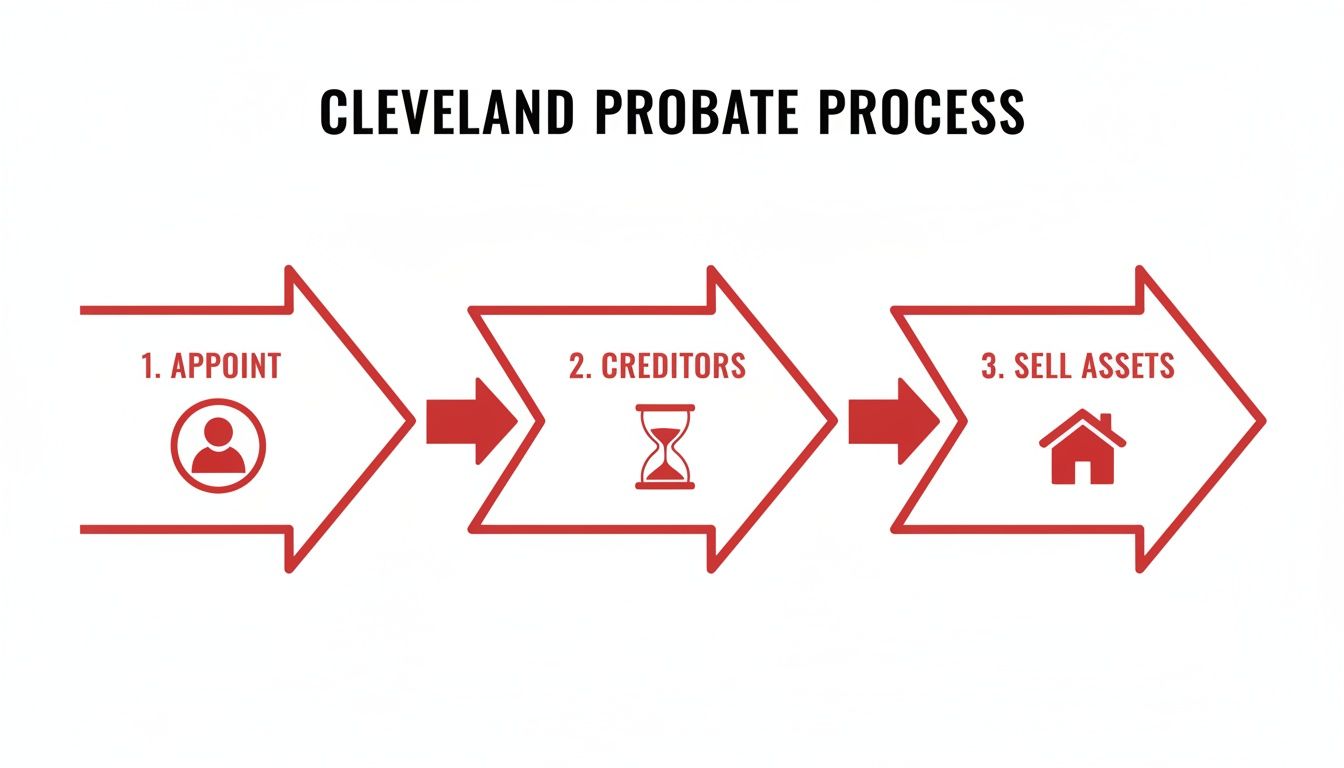
Selling a house during probate in Cleveland is a step-by-step legal procedure. Once you understand the sequence, it becomes much less intimidating. Here is the typical path you will follow.
Step 1: Get Appointed as Executor/Administrator
Your journey begins when the Cuyahoga County Probate Court officially appoints you as the executor or administrator. The court will issue a document called "Letters of Authority," which is your legal proof that you have the power to act on behalf of the estate. Without this document, you cannot legally sign any contracts to sell the property.
Step 2: Secure and Maintain the Property
Your first practical task is to take control of the house. This includes changing the locks, ensuring the property is insured, and arranging for basic maintenance like lawn care and keeping the heat on during Cleveland's cold winters. The estate is liable for anything that happens on the property, so this step is critical. If the home has been vacant for months and pipes have frozen, winter damage can add $10K-$30K in unexpected repair costs. Be aware that in 2026, homeowner's insurance companies are increasingly dropping vacant property policies or charging 2-3x premiums, adding financial pressure to sell quickly.
Step 3: Get the Property Appraised
The court needs to know the property's fair market value. You will need to hire a licensed appraiser to conduct a formal appraisal, which typically costs $400-$600 in the Cleveland area. This appraisal establishes the baseline value and is a key document for the court when you request permission to sell.
Step 4: Petition the Court for Authority to Sell
With the appraisal in hand, you (or your attorney) will file a motion with the probate court asking for permission to sell the house. This petition explains why the sale is necessary (e.g., to pay estate debts, to distribute assets to heirs) and includes the appraisal. All heirs must be formally notified of your intent to sell, giving them an opportunity to voice any objections at a court hearing.
Step 5: Obtain Court Approval
A hearing will be scheduled where a judge reviews your petition. If there are no objections from heirs and the request is reasonable, the court will grant you the authority to sell the property. The court may specify a minimum sale price, often around 90% of the appraised value, to protect the estate’s interests.
Step 6: Market and Sell the Property
With court approval, you can now sell the house. You have two main options: a traditional listing on the MLS or a direct sale to a cash buyer. A traditional sale can take 60-180+ days, especially if the home needs work. A cash sale can be completed in as little as 7-14 days once the court gives the green light.
Step 7: Return to Court for Sale Confirmation
After you accept an offer, you aren't done yet. You must go back to the court to file a motion to confirm the sale. This involves submitting the purchase agreement for the judge's final review. Once the judge gives final approval, the sale can close, and the proceeds are deposited into the estate's bank account.
From executor appointment to a completed sale, the timeline is typically 4-9 months, but it can be longer if heirs dispute the sale or a traditional buyer's financing falls through. The probate process is complex enough without dealing with property repairs and buyer financing falling through. Home Sweet Home Offers buys probate properties as-is for cash, simplifying the entire process. Call or text 216-200-8010.
Common Probate Property Challenges
Selling an inherited home during probate comes with a unique set of challenges that can add significant stress and cost to the process. Understanding these hurdles upfront can help you make a more informed decision for the estate.
Challenge 1: Property Condition Issues
This is often the biggest obstacle. Many inherited homes have been lived in for 30, 40, or even 50 years with little to no updating. You may be facing:
- Deferred Maintenance: Leaky roofs, old furnaces, and outdated electrical systems.
- Dated Cosmetics: 1970s kitchens, old carpeting, and wallpaper that needs to be removed.
- Major Repairs: Foundation issues, plumbing problems, or a failing HVAC system.
Cleveland homes from the 1960s-1970s often need $50K-$80K in updates—new roof, HVAC replacement, kitchen and bath renovations. As the executor, you face a dilemma: should you use the estate's limited funds to pay for these repairs, or sell the house as-is? The risk is that the cost of repairs may not be fully recovered in the final sale price. With buyers in 2026 facing 6.3% mortgage rates, they're extremely picky about condition and won't absorb ANY repair costs in their already-stretched budgets.
Challenge 2: Multiple Heirs with Different Opinions
When siblings or other family members inherit a property together, disagreements are common. One heir may want to sell quickly for cash, another may want to renovate to maximize the price, and a third may not want to sell at all due to emotional attachment. As executor, you are caught in the middle, trying to satisfy everyone while fulfilling your legal duty to the estate. These disputes can cause significant delays and increase costs.
Challenge 3: The Out-of-State Executor Burden
Managing a property sale from another state is incredibly difficult. You can't easily meet with contractors, real estate agents, or check on the vacant property. The time, travel costs, and stress add up quickly. If you're in Florida trying to manage a Cleveland rental property with tenants you've never met, the stress multiplies.
Challenge 4: Carrying Costs Eating into the Estate's Value
A vacant house is not free. Every month that passes, the estate is losing money to carrying costs:
- Property Taxes: $200-$500/month in the Cleveland area.
- Insurance: $100-$300/month (or more for a vacant property policy).
- Utilities: $150-$300/month to keep the heat on and prevent frozen pipes.
- Maintenance: $100-$200/month for lawn care and snow removal.
This totals $550 to $1,300 every month. A 9-month probate process plus a 6-month traditional sale could cost the estate over $15,000 in carrying costs alone.
Challenge 5: Property in a Declining Neighborhood
Some inherited homes in Cleveland are located in areas where property values are not appreciating. Properties in areas like Warrensville Heights where repair costs exceed what's financially justifiable need different solutions. In these situations, every month of delay could mean the property is worth less.
Challenge 6: Court Approval Delays
The probate court process itself can cause delays. Court hearings are scheduled weeks or months out, and if an heir contests the sale or the judge requires more information, the timeline gets pushed back even further.
Challenge 7: Buyer Financing Falls Through
In a traditional sale, you could be 60 days into a contract when the buyer's mortgage is denied. This is especially common for properties needing repairs that don't meet lender standards. When this happens, you are back at square one, having lost months of time and thousands in carrying costs.
These challenges compound quickly. Home Sweet Home Offers eliminates most of them: we buy as-is (no repair investment), we pay cash (no financing fall-through), and we close fast (minimize carrying costs). Call or text 216-200-8010.
Traditional Sale vs. Cash Sale During Probate
As an executor, you have two primary paths for selling a probate property in Cleveland: a traditional sale on the Multiple Listing Service (MLS) or a direct cash sale. The right choice depends entirely on the property's condition, the estate's financial situation, and the heirs' goals.
Traditional MLS Listing: When It Makes Sense
A traditional sale with a real estate agent can be a good option under specific circumstances:
- The property is in excellent, move-in-ready condition with recent updates.
- It's located in a highly desirable Cleveland suburb like Rocky River, Westlake, or Strongsville.
- All heirs are in agreement and are patient enough to wait for the right buyer.
- The estate has enough cash to cover 6-12 months of carrying costs and any necessary pre-sale repairs.
If you inherited a well-maintained home in Strongsville that's already updated, a traditional sale can maximize value. However, this is not the reality for most inherited properties.
The Math on a Traditional Sale
Let's look at a realistic example for a house that needs work:
- Estimated Sale Price (after updates): $280,000
- Cost of Repairs/Updates: -$50,000
- Realtor Commissions (6%): -$16,800
- Carrying Costs (9 months): -$10,800
- Net to Estate: $202,400 (after 9-15 months of work and uncertainty)
Cash Sale: When It Makes Sense
For the vast majority of probate situations, a cash sale is the more practical and logical choice. Consider a cash sale when:
- The property needs repairs, from minor cosmetic updates to major system replacements.
- The heirs want a quick, certain settlement without conflict.
- The executor lives out of state and cannot manage repairs or showings.
- The estate has limited cash for carrying costs or renovations.
- You want certainty and to avoid the risk of buyer financing falling through.

Cash Sale Advantages for Probate
- No Repairs Needed: We buy the property completely "as-is," saving the estate tens of thousands of dollars and months of work.
- Certainty of Closing: There is no financing contingency. Our cash offer is a guarantee to close.
- Fast Timeline: We can close in as little as 7-14 days after court approval, immediately stopping the bleed of carrying costs.
- Simplicity for Heirs: A firm cash offer provides an objective, third-party valuation that can resolve family disagreements about the property's worth.
- One Court Approval: You avoid the risk of having to go back to court multiple times if traditional buyers fall through.
Whether it's a South Euclid home with POS violations or a Brooklyn property needing $40K in work, cash buyers handle everything.
The Math on a Cash Sale
Using the same example house, sold as-is:
- Cash Offer: $195,000
- Cost of Repairs/Updates: -$0
- Realtor Commissions: -$0
- Carrying Costs (2 months): -$2,400
- Net to Estate: $192,600 (in 3-5 months with zero stress)
In this scenario, the traditional sale might net about $10,000 more, but it requires a $50,000 upfront investment from the estate, 6-10 months of additional time, and a huge amount of risk and stress for the executor. For most, the certainty and speed of a cash sale are far more valuable. With 2026 mortgage rates at 6.3%, buyer financing is less certain than in previous years—making cash offers more attractive for probate situations where certainty matters.
Probate is complicated enough. Home Sweet Home Offers simplifies the process: cash offer, as-is condition, fast closing once court approves. Call or text 216-200-8010.
Step-by-Step: Selling a Probate Property to a Cash Buyer
Selling to a cash buyer like Home Sweet Home Offers is designed to be the simplest, most straightforward path for an executor. We understand the probate process and work within its legal framework to provide a fast and certain outcome. Here’s what it looks like.
Step 1: Contact Home Sweet Home Offers
The first step is a simple, no-obligation phone call to 216-200-8010. You'll speak directly with one of our local Cleveland specialists. Explain that you are the executor of an estate and provide the property's address. We will listen to your situation with empathy and respect.
Step 2: Property Evaluation
We will schedule a brief walkthrough of the property at a time that is convenient for you. Don't worry about cleaning up or making repairs—we buy houses in absolutely any condition. Our goal is simply to assess the property's current state to formulate our best cash offer.
Step 3: Receive a No-Obligation Cash Offer
Within 24 hours of the walkthrough, you will receive a fair, written cash offer for the property as-is. Our offers are transparent, and we are happy to explain how we arrived at the price. There is never any pressure or obligation to accept.
Step 4: Petition the Court for Authority to Sell
Once you accept our offer, you (or your attorney) will submit our purchase agreement to the Cuyahoga County Probate Court as part of your "Petition for Authority to Sell." Because our offer is for cash and has no contingencies, it presents a clean, simple transaction for the judge to review.
Step 5: Obtain Court Approval
You or your attorney will attend the scheduled court hearing. The judge will review our offer to ensure it is in the best interest of the estate. Once the judge approves the sale, you are authorized to proceed with the closing.
Step 6: Fast, Simple Closing
Once we have the court's approval, we can close the sale in as little as 7-14 days, or we can work on a timeline that is best for the estate. The closing is handled by a reputable local title company, and we pay all the closing costs. The title company will wire the cash proceeds directly to the estate's bank account.
Step 7: Final Court Confirmation of Sale
After the closing, a final confirmation of the sale is filed with the court. This officially documents the transaction, allowing the probate process to move forward toward its conclusion.
From your first call to having cash in the estate's account, the entire process typically takes 60-90 days—a fraction of the time a traditional sale requires, with none of the uncertainty. This process eliminates the repair burden, minimizes carrying costs, reduces executor stress, and provides a certain, fast resolution for all heirs.
Working with Heirs and Family Dynamics
The role of an executor often feels like being a project manager, a grief counselor, and a mediator all at once. Navigating family dynamics during a probate sale is one of the most challenging aspects of the job.
Communication is Key
Your most powerful tool is clear and consistent communication. Keep all heirs informed about every step of the process. Explain the options—traditional sale versus cash sale—and show them the real math, including repair costs, commissions, and carrying costs. Gaining consensus is ideal, but keeping everyone in the loop is essential.
When Heirs Disagree
Disagreements are almost inevitable. A direct cash offer can be an invaluable tool to break a deadlock. It provides an objective, third-party valuation of the property in its current "as-is" condition. This removes emotion from the pricing debate and gives all heirs a concrete, realistic number to consider, often resolving conflicts faster.
Handling Emotional Attachments
Acknowledge the emotional weight of the situation. This wasn't just a house; it was a family home filled with memories. Be respectful and allow time for family members to go through the home and remove personal items and keepsakes. At Home Sweet Home Offers, we handle these situations with sensitivity and can offer flexibility on the closing timeline to accommodate the family's needs.
Supporting Out-of-State Heirs
For heirs living far from Cleveland, a cash sale is a lifeline. We can conduct virtual walkthroughs, handle all local logistics, and coordinate directly with the estate's attorney to make the process as hands-off as possible. Whether heirs are in California, Florida, or across the country, we've helped hundreds of families navigate selling an inherited Cleveland property from a distance.
When One Heir Wants to Keep or Buy the Property
This situation can significantly complicate and delay the probate process. The heir wanting to buy out the others must secure their own financing, which can be challenging. An agreement must be drafted and approved by all parties. Our cash offer can serve as a reliable backup plan if the family buyout arrangement falls through.
As the executor, you have a fiduciary duty to act in the best interest of the entire estate. A fast, certain cash sale is often the most defensible choice because it provides a clear market value, minimizes risk, and ensures the estate is settled efficiently for the benefit of all heirs.
Special Situations in Probate Sales
Inherited properties often come with unique and challenging circumstances. As experienced cash buyers in Cleveland, we have dealt with nearly every situation imaginable and can offer solutions where traditional sales might fail.
Probate Property with Tenants
Inheriting a rental property adds another layer of complexity. The tenants' lease and rights remain in effect even after the owner's death. Selling a rental property with tenants still inside requires understanding Ohio landlord-tenant law and probate requirements. We can purchase the property with the tenants in place, taking over the landlord responsibilities after the closing so the estate doesn't have to deal with evictions or lease negotiations.
Property with Liens or Judgments
It is common to discover that the deceased had debts, such as tax liens or court judgments, that have attached to the property. These liens must be paid off before the property can be legally transferred. Our team works with the title company to identify all encumbrances and ensure they are satisfied at closing using the sale proceeds.
Property in Foreclosure
A mortgage does not go away when the owner passes away. If payments stop, the bank will proceed with foreclosure. If the inherited property is facing foreclosure, time is critical—foreclosure doesn't pause for probate. A fast cash sale can stop the foreclosure process, preserve the estate's equity, and prevent a damaging auction sale.
Hoarder House Situations
Some executors are faced with the overwhelming task of dealing with a hoarder house. The cleanout can cost anywhere from $5,000 to over $30,000 and is an emotionally and physically draining process. Selling an inherited hoarder house in Cleveland requires specialized handling—we buy these properties as-is and handle all cleanout and disposal after the sale. You can simply walk away.
Property Needing Major Repairs
Major issues like a failing roof, foundation problems, or collapsed plumbing can make a property unsellable on the traditional market, as banks will not finance such homes. Foundation problems that would cost $20K-$40K to repair don't matter to cash buyers—we buy as-is and handle repairs after closing. The estate does not need to spend any money on repairs.
Multiple Properties in the Estate
If the estate includes several properties in the Cleveland area, we can provide a portfolio offer to purchase all of them in a single, streamlined transaction. This simplifies the process for the executor, allowing the estate to be settled much more quickly.
While 2026 property tax reassessments are hitting Cuyahoga County hard, inherited properties get a "stepped-up basis," which resets the property's cost basis to its market value at the time of death. This can significantly reduce or even eliminate capital gains tax on the sale.
Whatever special situation you're facing, Home Sweet Home Offers has likely handled it before. Call or text 216-200-8010 to discuss your specific probate property situation.
Costs and Fees in Probate Sales
Understanding the costs involved is crucial for an executor to make financially sound decisions for the estate. The expenses can add up quickly, especially in a prolonged traditional sale.
Probate Court Costs
These are the administrative fees required to process the estate through the court system.
- Filing Fees: $200 – $500
- Publication Costs (for legal notices): $100 – $300
- Appraisal Fee: $400 – $600
- Total Court Costs: Typically range from $1,000 to $2,000.
Attorney Fees
While not required, most executors hire a probate attorney to navigate the legal complexities.
- Typical Fees: Attorneys may charge a flat fee or a percentage of the estate's value. For a straightforward estate in Cleveland, expect fees between $3,000 and $8,000. This cost is well worth the protection against legal mistakes.
Property Carrying Costs
These are the monthly expenses that drain the estate's value while you wait to sell.
- Property Taxes: $200 – $500/month
- Insurance: $100 – $300/month
- Utilities: $150 – $300/month
- Maintenance: $100 – $300/month
- Total Per Month: $550 – $1,400. Over a 9-month period, this can exceed $12,000.
Real Estate Sale Costs: Traditional Listing
This is where the costs differ dramatically.
- Realtor Commission (6%): On a $250,000 sale, this is $15,000.
- Repairs & Updates: For an inherited home, this commonly costs $20,000 – $80,000.
- Title Insurance & Closing Costs: $1,000 – $2,000.
- Total Traditional Sale Costs: Easily $36,000 to over $97,000, plus carrying costs.
Real Estate Sale Costs: With a Cash Buyer
- Realtor Commission: $0
- Repairs & Updates: $0
- Closing Costs: $0 (we cover these)
- Minimal Carrying Costs: Because we close fast, these are often limited to 2-3 months.
- Total Cash Sale Costs: Around $2,000 – $4,000 in carrying costs.
The difference is stark. A traditional sale can cost the estate $40,000 to over $100,000, while a cash sale keeps those costs under $5,000. That is a massive saving of money and time for the heirs.
Cleveland Probate Sale FAQ
Q: How long does probate take in Cleveland?
A: A typical probate case in Cuyahoga County takes 9 to 18 months from start to finish. However, the sale of real estate can happen much earlier in the process with court approval, usually within a few months of being appointed executor.
Q: Can I sell the house before probate is complete?
A: Yes, absolutely. Once you are appointed executor and get court approval, you can sell the property. The proceeds from the sale are held in an estate bank account until the probate process is formally closed and all debts are paid.
Q: Do all heirs have to agree to sell?
A: Not necessarily. The executor has the legal duty to act in the best interest of the entire estate. If selling is the most prudent financial decision, you can petition the court for the authority to sell even if one or more heirs object. The court will hear their objections but will ultimately empower the executor to act.
Q: What if the house needs major repairs?
A: You have two choices: use the estate's money to fund potentially risky renovations for a traditional sale, or sell the property as-is to a cash buyer. If the property needs $50K-$80K in repairs, most executors choose to sell as-is rather than risk estate funds on uncertain returns.
Q: Can I sell an inherited house with a mortgage?
A: Yes. The outstanding mortgage is a debt of the estate. At closing, the sale proceeds are used to pay off the mortgage balance in full. The remaining equity goes directly to the estate.
Q: What if I live out of state?
A: Many executors manage probate from a distance. A local probate attorney is essential. Selling to a cash buyer dramatically simplifies the process for an out-of-state executor, as we handle all the local property-related tasks, requiring minimal involvement from you.
Q: How does the court determine the minimum sale price?
A: The court typically requires an independent appraisal and may set the minimum sale price at 90% of the appraised value. It is crucial that the appraisal reflects the home's "as-is" condition, which allows a fair cash offer to meet the court's requirements.
Q: Do I need a probate attorney?
A: While it's not legally mandatory, it is highly recommended. The probate process in Cleveland is complex. The fee for an attorney (typically $3,000-$8,000) is a worthwhile investment to ensure everything is handled correctly and to protect you from personal liability.
Q: How quickly can I sell to a cash buyer?
A: Once the court approves the sale, we can close in as little as 7-14 days. The total timeline, from filing the petition to sell to having the sale closed, is typically 60-90 days.
Your Path Forward During a Difficult Time
Selling a house during probate in Cleveland is a manageable process when you have the right guidance and support. It requires court approval and careful adherence to legal steps, but it does not have to be overwhelming. The two main paths are a traditional sale, which may work for a property in perfect condition, or a cash sale, which is the more practical solution for the vast majority of inherited properties facing challenges like needed repairs, heir disagreements, or an out-of-state executor.
In 2026's market with 6.3% mortgage rates and picky buyers, probate properties needing repairs are better suited for cash sales than traditional listings. A cash sale minimizes the costs, timeline, and stress, significantly reducing the burden on the executor and preserving the value of the estate for the heirs.
Handling probate is emotional enough without the stress of property repairs, buyer financing, and months of uncertainty. Home Sweet Home Offers buys probate properties as-is for cash throughout Cleveland and Cuyahoga County. We work with your timeline, handle all repairs after closing, and make the process as simple as possible during a difficult time. Call or text 216-200-8010 for a respectful, no-obligation evaluation.
Sources
- Cuyahoga County Probate Court
- Ohio Revised Code (Probate Law)
- Cleveland real estate market data
- Ohio State Bar Association (probate guidance)