

Going through a divorce in Cleveland is tough, and the question of the house is often the biggest weight on your shoulders. For homeowners in communities from Parma to Lakewood, it’s more than just a financial asset; it’s the place you built a life. We understand how overwhelming this part of the process can be, and our goal is to show you a clear, straightforward path forward.
First, let's break down the core issue. Home equity is simply what your house is worth on the market today, minus what you still owe on the mortgage. This value is a primary marital asset, and in Ohio, it must be divided fairly as part of your divorce settlement.
Understanding Home Equity in a Cleveland Divorce
Ohio’s Approach: "Equitable Distribution" Means Fair, Not 50/50
One of the biggest myths we hear from Cleveland homeowners is that everything gets split right down the middle in a divorce. That's not how Ohio law works. Our state follows the principle of equitable distribution, which means a judge will divide your assets fairly, but not necessarily equally.
When it comes to your home, a Cuyahoga County judge won’t just cut the equity in half. They'll look at the entire situation—how long you were married, each person's financial contributions, and whether one spouse has primary custody of the children. They might even consider if one person's actions drained the family's finances.
We always suggest getting familiar with Ohio's property division guidelines to understand what the court will review.
To give you a clearer idea, here's a breakdown of what a judge considers.
Key Factors in Ohio's Equitable Distribution Law
| Factor | How It Impacts Your Home Equity Split |
|---|---|
| Length of the Marriage | Longer marriages often lean toward a more equal split, as assets are more intertwined. |
| Assets and Liabilities | The court looks at the entire financial picture, not just the house in isolation. |
| Retirement Benefits | These are also marital assets and can be used to offset a share of the home equity. |
| Custody of Children | The parent with primary custody may be given preference to stay in the home. |
| Financial Contributions | This includes income, inheritances used for the home, and even "sweat equity." |
| Liquidity of the Property | The court considers how easily the home can be sold to divide its value. |
| Tax Consequences | How a sale or buyout will affect each person's taxes is taken into account. |
As you can see, "fair" can mean a lot of different things. It’s rarely a simple calculation.
Your family home is likely your largest shared asset. Understanding how its value will be divided under Ohio law is the first step toward a fair and manageable settlement.
The Three Main Paths Forward
When it comes to the house itself, you generally have three options. Each has its own financial and personal impact, and the right choice depends entirely on your specific circumstances.
- Sell the House: For many couples we work with in Garfield Heights and Euclid, this is the cleanest break. Selling turns your equity into cash, which you can then divide according to your divorce decree. It allows both of you to start fresh without being financially tied together.
- One Spouse Buys Out the Other: This is a popular option if one person wants to keep the home, often for the kids' stability. The spouse staying will need to refinance the mortgage into their name alone and pay the other spouse their share of the equity.
- Co-Own After the Divorce: This is the least common route because it requires a great deal of cooperation. You might agree to co-own until your youngest child graduates from high school, but it keeps you financially connected to your ex.
Getting a handle on these options gives you a roadmap for negotiations. And if the thought of repairs, showings, and waiting for a buyer feels like too much stress right now, remember that a cash home sale offers a quick, certain path to closure, letting you move on without the extra hassle.
Getting to Your Home's True Equity Number for the Divorce
Before you can talk about splitting anything, you need a solid, agreed-upon number for your home's equity. If you’re a homeowner in Cleveland or surrounding areas like Euclid or Parma, this means going deeper than a quick online search. Getting this wrong is one of the biggest points of conflict in a divorce. Let's get it right.
The basic formula is simple: Fair Market Value – Total Debt = Home Equity. But the details are where things get complicated, especially when emotions are high.
A Zillow Estimate Isn't Going to Cut It—You Need a Professional Appraisal
First, you need to determine your home's fair market value. It’s tempting to use an online calculator, but those estimates can be very inaccurate for specific Northeast Ohio homes.
A home’s true value depends on its condition, recent upgrades, and its specific neighborhood—whether it's a historic home in Lakewood or a brick ranch in Maple Heights. This is why a professional, licensed appraiser is so important.
An appraiser provides an unbiased, legally defensible valuation by inspecting the property and comparing it to recent, similar sales in your area. For a divorce, this is essential for a fair outcome. The best approach is for you and your spouse to agree on a single appraiser to avoid the cost and conflict of dueling reports.
A professional appraisal provides a concrete number that will hold up in a Cuyahoga County courtroom. It removes the guesswork and emotion from the valuation, paving the way for a smoother negotiation.
Tally Up Every Single Debt Tied to the Property
With a reliable market value, the next step is to subtract all debts secured by the house. This is often more than just your primary mortgage. Gather the most recent statements for everything:
- Primary Mortgage: The main loan used to buy the home.
- Second Mortgage: Any additional loan taken out against the property.
- Home Equity Line of Credit (HELOC): A revolving line of credit secured by your home.
- Other Liens: This could include things like judgments or tax liens filed against the property.
Forgetting a HELOC with a significant balance can completely derail the equity calculation and lead to major arguments later. Accuracy is key.
Don't Forget the Hidden Costs of Selling
Here’s a detail many people overlook: even if you don't plan to sell right away, Ohio courts often allow for the deduction of "hypothetical selling costs" when calculating a buyout amount. This reflects the reality that turning home equity into cash isn't free.
These costs can easily reduce the final equity figure by 6% to 10% and typically include:
- Realtor Commissions
- Closing Costs (title insurance, escrow fees, etc.)
- Potential Repair Credits for a Buyer
Factoring these in gives you a more realistic "net equity" number. Of course, there's a simpler way. Many divorcing homeowners choose to sell their house as-is, which eliminates arguments over repair costs and commissions.
By working with cash home buyers in Cleveland like Home Sweet Home Offers, you get a clear, net offer that bypasses these variables. This approach offers certainty and speed when you need it most, letting both of you see the exact amount you'll walk away with—a powerful tool for reaching a quick, peaceful agreement.
Once you’ve nailed down your home’s equity, the next big question looms: how do you actually split it? This is where things can get heated for divorcing couples in Cleveland, but laying out all the options on the table brings a sense of control back to a stressful situation.
You really have three main roads you can go down, and the right one depends entirely on your family's finances, timeline, and ability to cooperate.
This simple infographic breaks down the basic math. It’s always your home's current value minus what you still owe on the mortgage. That final number is your equity.
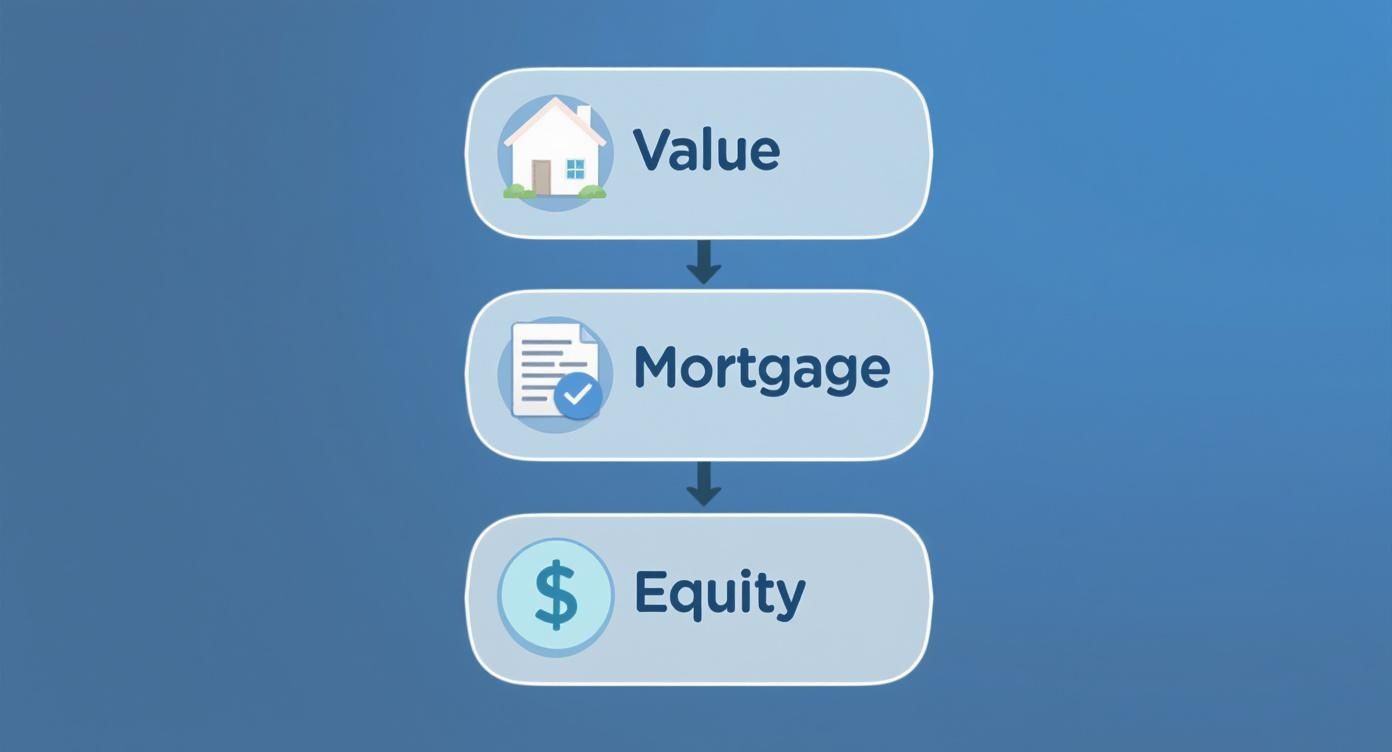
No matter which path you choose, everything starts with this number. It's the foundation for every negotiation that follows.
Option 1: The Buyout
A home buyout is one of the most common routes in Cleveland divorces. In this scenario, one spouse "buys out" the other's share of the home's equity.
Here’s an example: Your home is valued at $450,000, you owe $250,000 on the mortgage, leaving $200,000 in equity. The spouse keeping the house would need to secure new financing—usually a cash-out refinance—to pay the other spouse their share of that $200,000. The payout can be negotiated to account for potential selling costs. To ensure it's done fairly, it's wise to learn more about how to do a divorce buyout right.
This is a popular choice for families, as it provides stability for children by letting them stay in their home and school district, whether that’s in University Heights or Lakewood.
- Stability for Children: This is the biggest benefit. It minimizes disruption for the kids.
- Emotional Connection: If one spouse has a deep attachment to the home, this allows them to stay.
- Avoids Selling Hassles: You skip the process of staging, showings, and negotiating with buyers.
The major challenge, however, is financial. The spouse staying must qualify for a new, larger mortgage on their own, which can be a significant hurdle on a single, post-divorce income.
Option 2: Selling The Home
For many couples, selling the house is the cleanest break. It converts your largest asset into cash, which is much easier to divide according to your divorce decree. It provides a clear financial separation, allowing both of you to move on.
When you decide to sell, you have two very different options.
The Traditional Sale
This is the familiar path: hire a realtor, make repairs, list the property, and wait for a buyer. While you might get a higher price, it's also a slow, stressful, and unpredictable process. Trying to agree on a listing price, who pays for repairs, and how to handle showings can be incredibly difficult when you're already at odds.
The Fast Cash Sale
This is where Home Sweet Home Offers provides a solution. As cash home buyers in Cleveland, we give you a fair, no-obligation offer for your house exactly as it is. This route eliminates nearly all the headaches of a traditional sale.
Selling your home for cash provides certainty and speed during a time of immense uncertainty. It’s a direct path to closure, allowing both parties to receive their funds quickly and finalize the divorce without being tethered to a property.
With a fast cash sale, you skip:
- Repairs and Renovations: Stop arguing over who’s paying for the roof on your Bedford home. We buy houses as-is in Cleveland.
- Realtor Commissions: The typical 6% commission stays in your pocket, meaning more cash to divide.
- Showings and Open Houses: No need to have strangers walking through your home during an already difficult time.
- Buyer Financing Falling Through: A cash offer is a sure thing. You don't have to worry about a buyer's loan being denied at the last minute.
Option 3: Co-Ownership After Divorce
The third option—continuing to own the home together after the divorce—is the least common. It requires a tremendous amount of trust and is usually only a temporary solution for a specific reason.
For example, a couple might agree to co-own until their youngest child graduates high school, or until the housing market in a city like Elyria or Lorain improves. This requires a detailed legal agreement outlining who pays the mortgage, taxes, insurance, and for all repairs.
While it can offer short-term stability, it keeps you financially entangled with your ex and can complicate your ability to move on. For most people, a clean break is the best path to long-term peace.
Comparing Your Equity Splitting Options
Feeling overwhelmed? That's completely normal. Each of these options comes with trade-offs. What works for one divorcing couple in Cleveland might be a disaster for another. The key is to look at your specific situation—your finances, your relationship with your ex, and your goals for the future.
This table breaks down the pros and cons to help you see which path might be the best fit.
| Option | Best For | Potential Challenges | Speed |
|---|---|---|---|
| Buyout | Couples where one spouse can afford the home and wants to provide stability for children. | Qualifying for a refinance on a single income; potential for disputes over valuation. | Medium (depends on refinancing approval, 30-60 days) |
| Traditional Sale | Couples who can cooperate and want to maximize their sale price in a strong market. | Stress, delays, disagreements over repairs and pricing, agent commissions. | Slow (can take 3-6+ months) |
| Fast Cash Sale | Couples who need a quick, certain, and hassle-free sale to finalize their divorce. | The offer may be less than the top market value from a traditional sale. | Fast (can close in as little as 7-14 days) |
Ultimately, the goal is to untangle your finances so both of you can start fresh. Whether it’s through a buyout, a traditional sale, or a fast cash sale with Home Sweet Home Offers, choosing the right strategy is a critical step toward closing this chapter and moving forward.
Why a Fast Cash Sale Simplifies a Divorce

Divorce is already an emotional and financial marathon. The last thing you need is another complex, drawn-out process. For many Cleveland couples, a traditional home sale—with its showings, negotiations, and unexpected costs—becomes a major source of conflict that just prolongs the pain.
This is where selling your home for cash to Home Sweet Home Offers provides a powerful, simple solution. It's a process built for clarity and speed, allowing you and your ex-spouse to achieve a clean financial break and finally move on.
Sidestep the Most Common Points of Conflict
When communication is strained, every decision about selling the house can feel like a battle. Who picks the realtor? What's the right price? Who pays for the furnace repair the inspector found? These questions quickly become fuel for larger disagreements.
A fast cash sale takes these arguments off the table.
At Home Sweet Home Offers, we present a single, transparent cash offer for your property as-is. This means no debates over renovation budgets, no arguments about staging, and no need to coordinate your lives around open houses in your Maple Heights or Bedford home.
The biggest benefit of a cash sale during a divorce is certainty. You get a clear number and a definite closing date—two invaluable assets when you're trying to finalize a legal settlement and plan your future.
The Problem with Unpredictable Timelines
The traditional real estate market doesn't care about your divorce timeline. Your house could sit on the market for months, leaving you financially tied to your ex and unable to finalize your settlement.
Worse, a promising offer can collapse if the buyer's financing falls through, sending you right back to the beginning.
This uncertainty creates immense pressure. Mortgage payments, utilities, and property taxes for the home in Garfield Heights or University Heights continue to add up. One of the best ways to get a quick sale is to find cash buyers ready to purchase your property today. It guarantees a swift, reliable timeline.
Sell Your House As-Is No Matter the Condition
Agreeing on home repairs during a divorce is incredibly difficult. One person may not have the money, while the other doesn't want to invest more into a shared asset they're leaving. This often leads to a stalemate where necessary repairs are ignored, lowering the home's value.
When you sell your house as-is in Cleveland, you bypass this entire problem. We buy houses in any condition, whether it’s a home in Lorain with an old roof or a property in Elyria with an outdated kitchen.
- No Out-of-Pocket Costs: You don’t spend a dime on repairs, cleaning, or updates.
- No Negotiation Hassles: We factor the home’s condition into our fair cash offer, so there are no surprises or demands for repairs after an inspection.
- A Truly Simple Process: Just take what you want and leave the rest. We’ll handle the cleanout.
This "as-is" approach is a lifeline for couples who are already living apart and find it impossible to coordinate property maintenance.
The Financial Clarity of a Cash Offer
A traditional home sale comes with a long list of costs that chip away at your profit. In the end, these expenses can reduce your take-home equity by up to 10% of the sale price.
Here’s what you completely avoid with a cash sale from Home Sweet Home Offers:
- No Realtor Commissions: That’s typically 5-6% of the sale price that stays in your pocket.
- No Seller Concessions: You won't be asked to cover a buyer's closing costs.
- No Closing Costs: We often cover all traditional closing costs.
- No Holding Costs: By closing fast, you stop paying the mortgage, insurance, and utilities much sooner.
The offer we make is the amount you get. This clarity makes it much easier to calculate the final equity split for your settlement. It’s a clean transaction that aligns perfectly with the goal of an amicable separation.
You can also explore our guide on why cash home buyers can close faster to understand the mechanics behind our speed and simplicity. Selling your house fast for cash in Cleveland isn't just a transaction; it's a strategic decision that allows both of you to regain control and start new chapters without delay.
Navigating Financial and Legal Complexities in Ohio
https://www.youtube.com/embed/H08gr33zk_Q
Splitting home equity in a Cleveland divorce seems simple on the surface, but the financial and legal details can be tricky. Ohio law has specific rules about "marital property," and getting it wrong can lead to an unfair division of your home’s value, adding stress and cost to an already difficult process.
One of the first hurdles is the concept of separate property. This is anything one of you owned before getting married, or received as a personal gift or inheritance during the marriage.
For example, if one spouse used an inheritance for the down payment on your family home in Shaker Heights, they could argue they are entitled to that money back before the remaining equity is split. Proving this, however, requires clear documentation and often becomes a major point of conflict.
When Equity Isn't So Simple
Not every divorce involves splitting a profitable asset. Many couples in Northeast Ohio face more stressful financial situations that require a faster, more direct solution.
We often help homeowners navigate two major challenges that can turn a divorce into a financial crisis:
- Underwater Mortgages: This happens when you owe more on your mortgage than the house is worth. There is no profit to split—only debt. In a fluctuating market, this can leave you both feeling stuck, unsure how to get out from under the loan without taking a major financial hit.
- Foreclosure or Pre-Foreclosure: It is common for people to fall behind on mortgage payments during the turmoil of a divorce. Once you're facing foreclosure, the clock is ticking before the bank takes over. For families in places like Lorain or Elyria, a forced auction sale means losing any potential equity and all control over the situation.
In these high-stakes situations, a quick, guaranteed sale isn't just an option—it's often the smartest way out. It lets you settle the mortgage debt, sidestep the credit devastation of a foreclosure, and finally move on without being chained to a financial crisis.
Tackling Taxes and Titling
Beyond the equity split, you have to deal with the legal and tax consequences of the property transfer. It's not just about who gets what; you should understand how major life changes like divorce impact your tax situation, especially under Ohio’s specific rules.
A quitclaim deed is the legal document used to sign over one spouse’s ownership to the other in a buyout. It is crucial that this is filed correctly with Cuyahoga County to get the departing spouse's name off the title.
But here’s a critical point: a quitclaim deed does not remove their name from the mortgage. The spouse keeping the house must refinance the mortgage into their name alone to take full responsibility for the debt.
A guaranteed cash sale slices through these headaches. Instead of battling over separate property claims or living with the threat of foreclosure, you get a clean break. Take a look at what Cleveland sellers actually walk away with when they choose a cash sale over a traditional listing.
By working with a company like Home Sweet Home Offers, you get a firm cash offer right away, letting you bypass the legal and financial landmines that can derail a divorce settlement.
Common Questions About Splitting Home Equity
Working through the division of a home in a Cleveland divorce brings up a lot of tough questions. We know this process is loaded with uncertainty, and clear, direct answers can bring some much-needed peace of mind. Here are the questions we hear most often from homeowners in your situation.
What Happens If My Spouse Refuses to Sell the House in Our Cleveland Divorce?
This is an incredibly frustrating and common situation. If you cannot agree on selling, a Cuyahoga County judge can order the sale of the home as part of the final divorce decree. This forces the issue to ensure your marital assets are divided according to Ohio's equitable distribution laws.
However, a court-ordered sale should be a last resort, as it removes your control over the process, timeline, and sale price.
A powerful tool to break the deadlock is a fast, guaranteed cash offer. Bringing a concrete offer from a "we buy houses Cleveland" company like Home Sweet Home Offers to the table presents a quick, certain solution. For a reluctant spouse who wants to avoid a long court battle and just move on, that certainty can be very appealing.
Who Is Responsible for the Mortgage During the Divorce?
Until the divorce is finalized, both spouses are typically responsible for the mortgage payments if both names are on the loan. This is a critical detail that many people overlook during a separation.
Missing payments can damage both of your credit scores and even put the home at risk of foreclosure. It’s vital to create a temporary agreement on who will cover the payments while the divorce is ongoing.
If affording the mortgage becomes a problem, a quick home sale in Cleveland can act as a financial lifeline. Selling for cash allows you to pay off the mortgage debt completely, protecting your credit and eliminating a huge source of stress.
Can I Buy Out My Spouse If I Have Bad Credit?
A buyout requires you to refinance the entire mortgage into your name alone. Lenders will carefully review your income and credit score. If your credit is poor, getting approved for a new, larger mortgage on your own can be very difficult.
It’s a tough reality, but in this situation, selling the house often becomes the only practical way forward for both of you.
A buyout isn't an option for everyone. When that happens, selling the home provides the cleanest possible financial break. A cash sale bypasses all lender requirements and credit checks, making it a simple, direct way to split the equity without the stress of a failed refinancing attempt.
Do We Have to Sell Our House As-Is During a Divorce?
No, you don’t have to, but it's often the simplest and most conflict-free choice. When communication is already difficult, trying to coordinate and pay for home repairs can become a new battleground. Who picks the contractor? Who pays for the materials? These small decisions can easily reignite old arguments.
Deciding to sell your house as-is in Cleveland sidesteps this drama entirely.
You won't have to argue over fixing the leaky roof on your University Heights colonial or updating the kitchen in your Bedford bungalow. You simply sell the property in its current condition. This approach cuts through the complexity, allowing for a faster, cleaner split and letting both of you finally focus on moving forward.
Navigating a divorce is one of life’s most difficult chapters, and we understand that figuring out what to do with your home adds to the weight. If you're looking for a simple, certain, and fast way to handle your property, Home Sweet Home Offers is here to help. We provide fair, no-obligation cash offers that can help you and your ex-spouse achieve a clean break and start your next chapters.