

When you're navigating a divorce, the financial side of things can feel like a tangled mess, especially when it comes to your biggest shared asset: the house. We understand how overwhelming this is. The tax implications of selling your Cleveland marital home during divorce are a huge piece of this puzzle, and the decisions you make now can directly affect how much of your hard-earned equity you actually get to keep. Getting a handle on the rules around capital gains isn't just a good idea—it's essential for protecting your financial future as you move forward.
Your Guide to Cleveland Home Sale Taxes During Divorce

Going through a divorce in Cleveland, Parma, or Lakewood is draining enough without piling on financial stress. The pressure to make the right decisions can be immense, whether you're dealing with the emotional weight of a separation or time-sensitive deadlines from the court. When you add selling the house to the mix, a whole new layer of tax questions pops up that can feel impossible to sort out. This guide is here to be your clear, straightforward roadmap through it all.
We're going to break down the critical issues you're up against, from capital gains and property transfers to the specific Ohio rules that will hit your bottom line. Think of this as your first step toward making a smart, informed decision that protects what's yours as you start your next chapter.
The Foundation: Ohio's Equitable Distribution Rule
First things first: in Ohio, marital property isn't just chopped down the middle, 50/50. The courts here follow a principle of equitable distribution. The goal is a division that's fair, which isn't always the same as being perfectly equal. To get there, the court looks at a lot of different factors, like how long you were married and each person's financial standing.
The tax fallout from what you do with the house often plays a massive role in these decisions. In fact, it's estimated that 65% of divorcing couples in Ohio get hit with unexpected tax bills from their settlements, like a surprise invoice for capital gains.
To help you get ahead of this, here’s a quick overview of the key tax concepts you'll need to understand.
Key Tax Considerations When Selling Your Marital Home
| Tax Concept | What It Means For You | Potential Financial Impact |
|---|---|---|
| Capital Gains | Profit from selling your home. The IRS wants a cut of this profit if it's over a certain amount. | A significant tax bill that can eat into your net proceeds from the sale. |
| § 121 Exclusion | A tax break allowing you to exclude up to $250,000 (single) or $500,000 (married) of capital gains. | Potentially thousands of dollars in tax savings, but you must meet specific ownership and use tests. |
| Property Transfer | Moving the house title from one spouse to the other. | Generally tax-free during a divorce, but it can affect the future capital gains tax for the spouse who keeps the house. |
| Cost Basis | The original purchase price of your home plus the cost of improvements. It's used to calculate your capital gains. | A higher basis means lower taxable profit. A lower basis could mean a much larger tax bill down the road. |
Understanding these terms is the first step, but how you apply them is what really matters.
Why Timing and Strategy Matter
The choices you make right now will echo for years. For example, knowing how long it takes to sell a house in Cleveland could sway your decision to sell before or after the divorce is final—a choice with huge tax consequences. For a deeper look at managing these kinds of decisions, this guide on navigating real estate in divorce is a great resource.
Selling the marital home is often the single largest financial transaction during a divorce. A clear strategy that accounts for tax laws isn't just helpful—it's essential for preserving your equity and ensuring a fair outcome for both parties.
At Home Sweet Home Offers, we get the pressure you're under. We offer a clear, simple solution for homeowners who need to sell a house fast in Cleveland due to a divorce settlement. Our fast cash offer to sell your house as-is can cut through the complexity and give you the certainty you need to finally close this chapter and start fresh.
Understanding Capital Gains on Your Marital Home

Of all the financial surprises that can pop up during a divorce, the capital gains tax is often the biggest. It sounds intimidating, but the concept is actually pretty simple.
Think of "capital gains" as the profit you make when you sell your house. It’s the difference between your final sale price and what you really paid for it over the years, including major improvements.
Let's say you bought your family home in Garfield Heights years ago for $150,000. You put in a new roof and remodeled the kitchen, sinking another $20,000 into the property. If you turn around and sell it for $300,000, your profit—your capital gain—isn't just the sale price minus what you paid. The IRS wants to see the whole picture.
Getting a handle on this is essential for anyone dealing with the tax implications of selling your Cleveland marital home during divorce.
Calculating Your Home's Cost Basis
The secret to figuring out your potential tax bill lies in something called your home’s cost basis. This isn't just the number on your original purchase agreement. It’s a bigger, more accurate number that reflects your total investment.
Here’s what goes into it:
- The Original Purchase Price: What you paid for the house in the first place.
- Capital Improvements: Money spent on major upgrades that add real value. Think a new furnace, a finished basement, or a deck addition. Regular upkeep and minor repairs don't make the cut.
- Certain Closing Costs: Some of the fees you paid when you first bought the home can be added in, too.
Example: You bought a house in Elyria for $180,000. Over the years, you spent $30,000 on a gut kitchen renovation and paid $5,000 in eligible closing costs back when you bought it. Your adjusted cost basis is now $215,000 ($180,000 + $30,000 + $5,000).
Now, if you sell that house for $350,000, your taxable capital gain is $135,000 ($350,000 – $215,000). That’s the number the IRS is looking at.
Why This Matters in a Cleveland Divorce
Knowing your cost basis is just step one. Step two is realizing that this profit is taxable. Luckily, the IRS gives homeowners a pretty generous tax break, but—and this is a big but—your marital status when you sell completely changes the game.
For homeowners in University Heights, Lorain, or anywhere in Cuyahoga County, the timing of the sale is everything. Selling before the divorce is final versus after can be the difference of thousands of dollars in taxes. It determines whether you can pool your tax exemptions as a married couple or if you each have to take a smaller, individual exemption. This is where a stressful situation can quickly become a very expensive one if you don't plan ahead.
Trying to manage these financial details while going through the emotional toll of a divorce is a massive burden. If you just need a clean break and have to sell your house fast in Cleveland, Home Sweet Home Offers can give you a straightforward cash offer. We are cash home buyers in Cleveland who buy houses as-is, letting you sidestep the complications and move forward with your life.
How Divorce Changes Your Capital Gains Tax Exclusion
When you own a home, the IRS gives you a pretty sweet deal called the capital gains exclusion. It’s a powerful tax break that can save you a mountain of money at closing. While you’re married and filing your taxes together, you can often exclude up to a whopping $500,000 of profit from the sale of your home.
But a divorce completely changes the rules of the game.
Once the ink is dry on the divorce decree, you’re filing taxes as a single person. That generous $500,000 exclusion? It gets cut right in half. Suddenly, the tax implications of selling your Cleveland marital home during divorce get very real, with each of you now only able to exclude up to $250,000 of your share of the gain.
If your family home in a suburb like Euclid or Parma has shot up in value over the years, this reduction can be the difference between a tax-free sale and writing a painful check to the IRS. That's why you absolutely have to understand how to qualify for your piece of the pie.
The All-Important Ownership and Use Tests
To get your hands on that $250,000 exclusion, the IRS has two big hoops you need to jump through. They’re known as the "ownership and use tests."
- Ownership Test: You must have owned the home for at least two of the five years right before you sell it.
- Use Test: You must have actually lived in the home as your main residence for at least two of the five years leading up to the sale.
The good news is that these two years don't have to be consecutive. But you must meet both tests, and this is where divorcing couples in the Cleveland area often find themselves in a bind, especially once one person moves out.
Think about it: if one spouse moves out of the family home in Lakewood while the other stays put, a clock starts ticking. After three years of living somewhere else, the "out-spouse" no longer meets the two-out-of-five-year residency rule. Just like that, their entire tax exclusion could vanish.
Protecting Your Exclusion After Moving Out
Losing this incredible tax break isn't a foregone conclusion, though. A well-written divorce decree can be a lifesaver for the spouse who moved out. If the agreement specifically gives the "in-spouse" the right to keep living in the home, the IRS will often let the "out-spouse" count those years of residency as their own.
Timing is absolutely crucial here. Once you're divorced and filing as single individuals, you're each capped at that $250,000 maximum. Selling the home at just the right moment—when both of you can still meet the two-year residency requirement—is the key to keeping your tax bill as low as possible. You can dig deeper into Ohio's post-divorce tax rules in this helpful guide.
We understand that trying to navigate these deadlines during such a stressful period is tough. If you need to sell your Cleveland home quickly to settle assets cleanly and sidestep these tax traps, Home Sweet Home Offers can provide a certain and fast cash offer, letting you close on a timeline that works for you.
The Hidden Tax Trap When You Transfer a Home Title
During a divorce, one of the simplest-sounding solutions is for one spouse to just sign the house over to the other. On the surface, it feels like a clean break. Especially in places like Maple Heights or Bedford, the actual transfer of the title doesn't trigger any immediate taxes, which can feel like a huge relief.
But this is exactly where a nasty, and often completely overlooked, tax trap is lurking. It’s a concept called transferred basis, and it can have massive financial consequences for the person who keeps the house.
Here’s the deal: when your ex-spouse transfers their share of the home to you, they aren't just giving you the property. They're also handing you their half of the home's original, often very low, cost basis.
So, What Is Transferred Basis?
Think of it like getting a financial backpack along with the house keys. The person who keeps the house also has to carry the full weight of the home’s original purchase price for tax purposes.
Let's walk through an example. Say you and your spouse bought a home in Lorain a decade ago for $100,000. Fast forward to today, and it’s now worth $350,000. If your spouse signs their half over to you in the divorce, your new cost basis for the entire property stays at that original $100,000. It doesn't get "stepped up" to the current market value.
This means you are now solely responsible for the entire $250,000 in accumulated profit. When you eventually decide to sell, the IRS will calculate your capital gains tax based on that massive gain, not just on the appreciation that happened after the divorce was final.
This inherited basis is a critical, high-stakes negotiating point in any divorce settlement. If you don't account for this future tax liability, one spouse can walk away with what looks like a valuable asset, only to find out it comes with an incredibly expensive hidden tax bill.
Now, under Internal Revenue Code section 1041, these property transfers between divorcing spouses are indeed non-taxable events, so no tax is due right away. The rule is there to make asset division a little less painful during a tough time. But that very simplicity is what creates the "transferred basis" bomb for the spouse who keeps the home. To dig deeper into these rules, you can discover more insights on dividing assets when a marriage ends from The Tax Adviser.
The idea is a bit like what happens when beneficiaries inherit a house, though the tax rules are actually different in that scenario. For a closer look at that, you can learn about what Cleveland homeowners need to know about selling an inherited house.
Instead of saddling one person with a future tax nightmare, many Cleveland-area couples decide to take a much simpler path. Selling your house for cash to Home Sweet Home Offers lets you liquidate the asset, split the proceeds cleanly, and sidestep the transferred basis trap completely. It gives you a clear financial conclusion, allowing both of you to move on without any tax surprises haunting you down the road.
Strategies for Handling the Marital Home in a Divorce
Alright, you've got a handle on the tax rules. Now comes the hard part: figuring out what to actually do with the house. We know this isn't just about numbers on a spreadsheet. The path you choose for your Cleveland-area home will echo for years, both financially and emotionally. It's a huge decision, so let's walk through the options.
Each route has its own trade-offs, especially when it comes to the tax implications of selling your Cleveland marital home during divorce. The goal is to find the right balance between what makes sense for your wallet and what makes sense for your peace of mind.
Comparing Your Home Sale Options
For most divorcing couples in places like Bedford, Euclid, or Parma, it boils down to three main choices. Each one directly impacts your capital gains tax situation and adds its own layer of complexity to the settlement agreement.
To make it easier, we've broken down the pros, cons, and ideal situations for each approach.
Comparing Your Home Sale Options During Divorce
Here’s a quick overview of the three main ways you can handle the marital home during a divorce.
| Sale Option | Pros | Cons | Best For… |
|---|---|---|---|
| Sell Before the Divorce Is Final | You can file taxes jointly one last time and potentially use the full $500,000 capital gains exclusion. It's a clean break with a simple cash split. | Requires cooperation and agreement during a stressful time. The market can be unpredictable. | Couples who can still work together and want the simplest, most tax-advantaged financial separation. |
| One Spouse Buys Out the Other | Provides stability for one spouse (and kids, if any) by keeping them in the home. Avoids the hassle of moving immediately. | The spouse keeping the home inherits the original cost basis, setting them up for a potentially massive tax bill later on. Refinancing can be difficult. | Couples where one person is financially able to buy out the other and providing stability for children is the top priority. |
| Sell After the Divorce Is Final | Gives you time to sort things out without the pressure of an immediate sale. Each person can claim their own $250,000 exclusion. | The spouse who moves out risks losing their tax exclusion if they don't meet the "use test." Selling becomes a lingering financial tie. | Couples who need more time or when one spouse needs to remain in the home for a set period (e.g., until kids finish school). |
As you can see, there's no single "right" answer—it all depends on your unique circumstances. The key is to weigh the immediate benefits against the long-term consequences, especially those tricky tax traps.
This is especially true with a buyout. The decision tree below helps visualize how a title transfer—which seems simple enough—just kicks the tax can down the road.
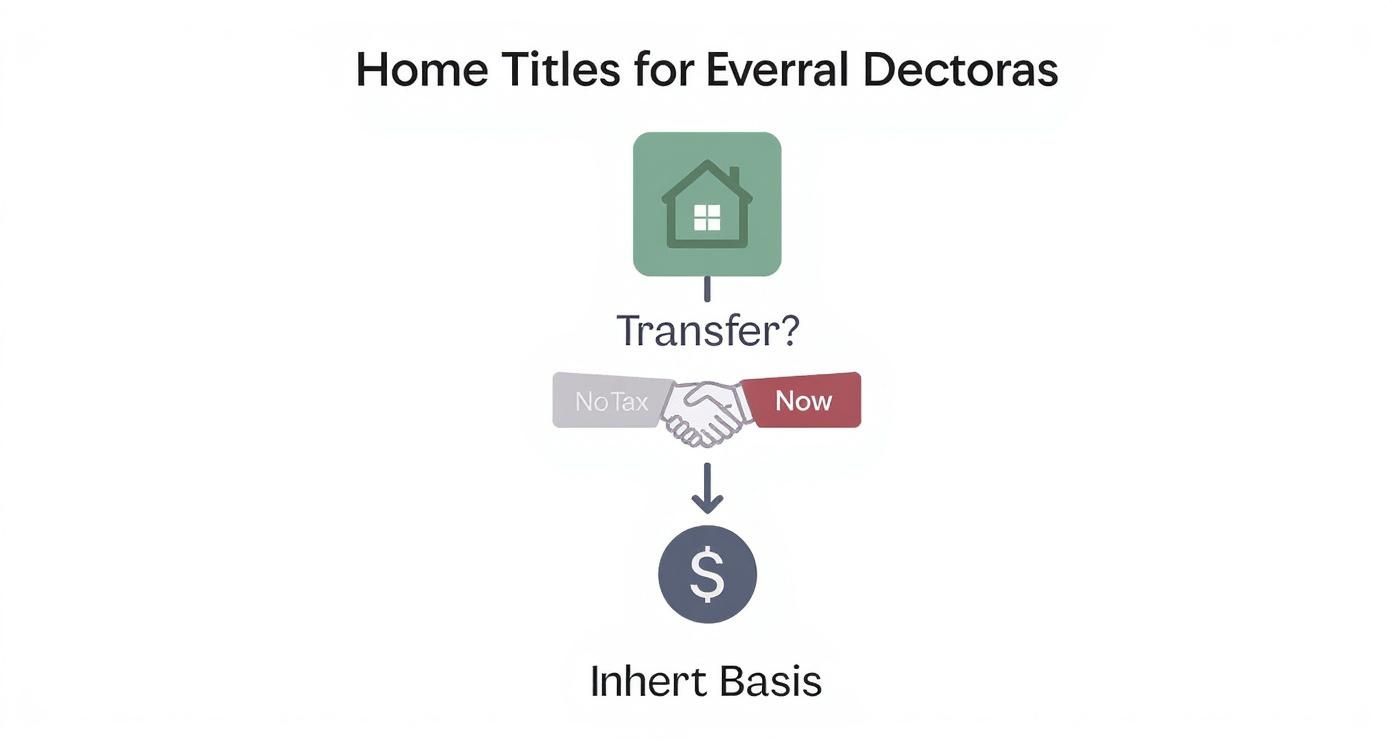
As the infographic makes clear, the transfer itself might be tax-free, but that original cost basis comes along for the ride, creating a tax bomb that's set to go off for the receiving spouse in the future.
The Advantage Of A Simple, Certain Solution
Let's be honest: trying to coordinate repairs, stage a house, and negotiate offers with your soon-to-be-ex is a recipe for disaster. This is where a direct, fast sale can feel like a godsend.
For many couples, the best move is the one that gives them certainty and a clean financial break.
Selling your house "as-is" for cash cuts through all the noise. You get a guaranteed sale price and a firm closing date. This lets both of you divide the money cleanly and move on without being financially tethered to each other or worrying about future tax surprises.
This approach means no realtor commissions, no arguments over who pays for a new roof, and no drawn-out haggling with buyers. It’s a pragmatic solution built for a quick, fair resolution. If you're curious, you can learn more about the pros and cons of selling to cash buyers in Cleveland.
Of course, the house is just one piece of a much larger puzzle. The strategy you choose might also need to align with bigger family decisions, like those found in comprehensive parenting plans.
If you’re in Cleveland or nearby communities like Maple Heights and University Heights and just want a straightforward way to liquidate your marital property, give Home Sweet Home Offers a call. We can give you a no-obligation cash offer, giving you the clarity and control you need to finally close this chapter.
Common Tax Questions When Selling a Cleveland Marital Home
When you're trying to untangle your finances during a divorce, the last thing you need is more confusion from complex tax rules. And let's be honest, even with a solid game plan, questions always pop up. It's completely normal.
To help clear things up, we've put together straightforward answers to the questions we hear most often from divorcing homeowners in Cleveland, Parma, and the surrounding areas. Our goal is to break down these key concepts so you can feel confident you're making the right financial moves.
What Happens if We Sell the House at a Loss?
Selling your primary home for less than you paid is a tough pill to swallow. Unfortunately, the IRS won't offer much sympathy—you can't deduct that loss on your tax return. It's considered a non-deductible personal loss.
It’s still crucial to accurately figure out your cost basis, which is the original purchase price plus what you've spent on major capital improvements (think a new kitchen or roof, not just a coat of paint). This calculation officially confirms whether you have a gain or a loss. While there's no tax break for taking a loss, the silver lining is you won't owe a dime in capital gains tax.
Who Pays Property Taxes During the Divorce?
This is a big one. Typically, who pays the property taxes on your home in a city like Garfield Heights or Euclid is decided by a temporary court order or just a mutual agreement between you and your soon-to-be-ex. Until the divorce is final and the house is officially sold or transferred, both names on the deed are still on the hook.
Most of the time, the spouse who stays in the home keeps making the payments. Whatever you decide, get it in writing in your separation agreement. You don't want missed payments to lead to a lien on the property, which can throw a major wrench in the works when you're trying to sell.
The great thing about a quick cash sale is that any unpaid property taxes are usually settled right at closing, paid directly from the sale proceeds. This takes the burden off both of you and ensures all the debts are cleared away cleanly.
Can My Ex-Spouse's Use of the Home Help Me?
Yes, it absolutely can. This is one of those IRS rules that's actually a huge help for divorced couples. If your divorce decree gives your ex-spouse (the "in-spouse") the right to live in the home, you (the "out-spouse") can often count their time there as your own.
This little provision is a lifesaver. It helps the out-spouse continue to meet the two-out-of-five-year "use test" required to claim their $250,000 capital gains exclusion when the house is finally sold. The key is that this arrangement must be explicitly spelled out in your divorce or separation agreement. Make sure you talk this over with your attorney to protect your tax benefits.
How Does a Cash Sale Affect My Taxes?
Selling your Cleveland house for cash to an investor like Home Sweet Home Offers doesn’t actually change the tax rules themselves. You're still looking at the same capital gains regulations and the same eligibility for exclusions. What it does change is the process and the timeline, which can be a massive advantage.
A fast, guaranteed sale lets you wrap everything up neatly within a specific tax year. This timing could be exactly what you need to file jointly one last time and claim the much larger $500,000 exclusion.
Plus, when you sell your house as-is for cash, you sidestep repair costs, which generally aren't deductible from your capital gains anyway. You also skip the realtor commissions, which means more net proceeds for you and your ex-spouse to divide. It’s a clean, certain, and often financially smarter way to close this chapter and move on.
Navigating the tax implications of selling your Cleveland marital home during divorce is a lot to handle, but you don't have to figure it all out on your own. If you need a simple, fast solution that gives you certainty and a clean financial break, Home Sweet Home Offers is here to help. We are local cash home buyers in Cleveland who understand your situation and can provide a fair, no-obligation offer to help you move forward.