
Selling your house in University Heights in 2025? If so, you’re likely facing the mandatory Point of Sale (POS) inspection. For many homeowners we talk to in Cleveland and surrounding suburbs, this process can feel overwhelming. It’s a critical step that can easily become a major headache if you’re not prepared for the costs, timelines, and potential repairs. The POS inspection in University Heights OH is required before you can hand over the keys, and the city needs to ensure your property meets local safety and housing standards.
You’re not alone if you're wondering what this inspection costs, how the process works, or what happens if the city finds violations. Whether you’re selling due to a job relocation, downsizing, or dealing with an inherited property, the last thing you need is another complication.
This guide is designed to cut through the confusion. We'll break down the entire process, from applying for the inspection to understanding your options for selling "as-is" without making a single repair. Whether you're aiming for a traditional sale or need a faster, less stressful solution, you’ll find the clarity needed to handle the University Heights POS requirements with confidence.
What Is a Point of Sale Inspection?
A Point of Sale (POS) inspection in University Heights is a mandatory housing inspection required before ownership transfer, ensuring properties meet city code and safety standards. The city’s main goal is to protect the health and safety of its residents while maintaining property values across the community.
This isn’t just about curb appeal. An inspector evaluates the home to ensure it meets minimum city codes, protecting new buyers from unknowingly purchasing a property with hazardous conditions or significant deterioration.
For you, the seller, this is a non-negotiable step. The inspection certificate is required before the title transfer can occur. Think of it as the city’s final check-up on your property before it changes hands. If violations are found, the process allows you or the buyer to decide who will handle the necessary repairs, giving you flexibility but adding a layer of complexity to the sale.
University Heights POS Inspection Requirements
Navigating the official POS process doesn't have to be a hurdle. When you understand the steps laid out by the city, you can avoid last-minute surprises that can frustrate you and your buyer. The best advice we give homeowners is to start early—the moment you decide to sell is the moment you should be thinking about this inspection.

Responsible Department
All POS inspections are managed by the City of University Heights Housing Department. They are your primary point of contact for applications, scheduling, and questions.
- Department: City of University Heights – Housing Department
- Address: 2300 Warrensville Center Road, University Heights, OH 44118
- Phone: (216) 932-7800
- Website: www.universityheights.com
- Office Hours: Monday–Friday, 8:00 AM–4:30 PM
When to Apply
Apply as soon as possible after deciding to sell. The city recommends scheduling early to avoid delays that could impact your closing date. A POS certificate is valid for one year from the date of the initial inspection. If the sale doesn’t happen within that timeframe, you will need to apply and pay for a new inspection.
Inspection Fees (Verified from City FAQ)
The seller is responsible for the inspection fee. Payment can be made with cash or a check. Applications can be submitted by mail or in person.
| Property Type | Fee |
|---|---|
| Single-family home | $250 |
| Two-family home | $300 |
Scheduling and Duration
Once your application and fee are processed, you can schedule the inspection.
- Appointments: Available Monday through Friday, from 8:30 AM to 3:00 PM.
- Duration: The inspection typically lasts between 1 and 2 hours.
- Attendance: The owner does not need to be present. An agent, relative, or any authorized adult (18+) can provide access for the inspector.
- Report: A typewritten report detailing any violations will be mailed or emailed to you within 10 business days.
If Violations Are Found
If the report lists violations, they must be corrected within 30 days of the report date. However, the city often grants extensions if you can show progress is being made.
Alternatively, the buyer may agree to assume responsibility for the repairs. To sell a house with outstanding violations, you must:
- Have the buyer sign a Violation Assumption Form.
- Deposit funds into an escrow account with the title company to cover repair costs.
- Once the city receives confirmation of the escrow funds and the signed form, it will issue a Transfer Release, allowing the sale to proceed.
Escrow Requirements
The escrow amount is based on contractor estimates for the required repairs. If estimates aren't available, the city’s Housing Inspector will determine the amount. It's important to note that these funds are held by the title company, not the city. The city simply requires a confirmation letter from the title company before it will release the property for transfer.
Reinspection and Certificates
After all violations have been corrected, you or the buyer must schedule a reinspection with the Housing Department. If all the work passes, the city will issue a Certificate of Compliance. This certificate is the final document you need to present at closing to finalize the title transfer.
Common Violations in University Heights
Inspectors in University Heights often flag similar issues across properties. Being aware of these can help you prepare.
- Cracked or uneven driveways and sidewalks
- Peeling exterior paint or rotted wood trim
- Broken or missing handrails on stairs and porches
- Roof or gutter deterioration
- Faulty plumbing fixtures, like leaks or running toilets
- Electrical hazards, such as exposed wiring or ungrounded outlets
- Chipped windows or missing screens
How POS Requirements Affect Home Sales
The University Heights POS process can significantly impact your sale, especially if you wait until the last minute. A report with violations can slow down your closing, as traditional lenders often won't approve a mortgage until a Certificate of Compliance is issued or a formal escrow agreement is in place.
This is where many sellers feel the squeeze, particularly those dealing with financial hardship, an inherited home, or a tight timeline for relocation. The stress of coordinating repairs on top of everything else can be immense.
This is also where cash buyers can provide a major advantage. Companies like Home Sweet Home Offers can purchase properties with open violations, often closing much faster because they don't rely on lender approvals.
How to Sell a Home With POS Violations
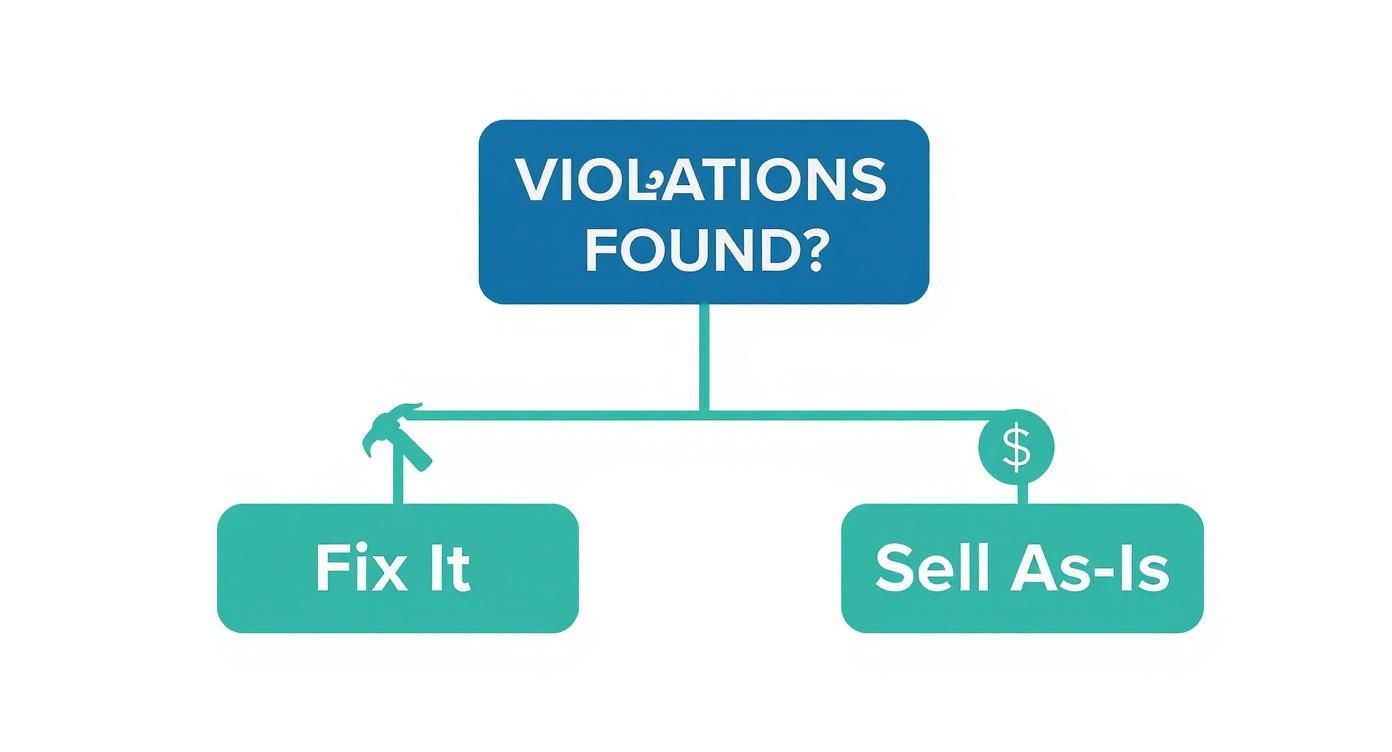
Getting a list of violations doesn’t mean your sale is doomed. It simply means you have a decision to make. You have three clear options for moving forward.
Option 1: Fix All Violations Before Sale
This is the traditional route. You hire contractors, manage the repairs, and pay for everything out-of-pocket. Once the work is done, you schedule a reinspection to get your Certificate of Compliance. This path leads to the smoothest closing for a traditional buyer but requires significant time, effort, and money upfront. It also requires you to act as a project manager, all while the clock is ticking.
Option 2: Sell As-Is With Escrow
If you can’t or don’t want to handle the repairs yourself, you can transfer the responsibility to the buyer through an escrow agreement. The buyer signs a form assuming the violations, and funds to cover the repair costs are held by the title company. This lets you sell without fronting the cash for repairs but can complicate negotiations and scare off some traditional buyers.
Option 3: Sell As-Is to a Cash Buyer (Fastest Option)
For homeowners who want a fast, simple, and stress-free solution, selling to a cash buyer is the most direct path. Home Sweet Home Offers buys homes in University Heights with open violations or failed inspections. We handle all the city requirements after the sale is complete.
This means you get:
- No Repairs: We buy your house exactly as it is today.
- No Escrow: Skip the complicated paperwork and funding requirements.
- No Reinspections: Your involvement ends at the closing table.
When you need to sell your house as-is in University Heights, working with experienced cash home buyers provides certainty and speed, allowing you to close in as little as 7 days.
FAQ Section
We understand you have questions. Here are answers to some of the most common ones we hear from University Heights homeowners.
Do I need a POS inspection for all properties in University Heights?
Yes, the POS inspection is required for all residential sales, including single-family and two-family homes.
How much does the inspection cost?
The fee is $250 for a single-family home and $300 for a two-family home.
Who pays for the inspection?
The seller is responsible for the inspection fee.
How long is the certificate valid?
The inspection report and any resulting Certificate of Compliance are valid for one year from the date of the initial inspection.
Can I sell a home that failed inspection?
Absolutely. You can either correct the violations, enter into an escrow agreement with the buyer, or sell the property as-is to a cash home buyer like Home Sweet Home Offers, who will assume all responsibility for the repairs.
Your Stress-Free Solution is One Call Away
The University Heights POS inspection process can feel complex, but it’s manageable when you know your options. Whether you’re facing foreclosure, managing a difficult inherited property, or simply want to move on without the hassle of repairs, you don't have to navigate it alone.
At Home Sweet Home Offers, we buy homes in University Heights as-is—even with open violations or escrow requirements. Skip repairs, skip reinspection, and close in as little as 7 days. We provide a fair cash offer so you can move forward with certainty and peace of mind.
Ready for a simple solution? Get your free, no-obligation cash offer today.
Sources
- City of University Heights – Point of Sale FAQ (2019)
- City of University Heights – Official Website
- City of University Heights Housing Department – POS Program Overview