

If you're thinking about selling your home in Cleveland Heights, you'll quickly run into something called the Point-of-Sale (POS) inspection. It’s a required step for most property sales in the city, and frankly, it can feel like a sudden, stressful hurdle. We understand that this is especially true if you need to sell quickly or don't have a budget for major, unexpected repairs.
Your Guide to Cleveland Heights POS Inspections
So, what exactly is this "Point-of-Sale" inspection? Think of it as a mandatory health checkup for your house, ordered by the city, that has to be done before you can hand the keys to a new owner. You'll find similar requirements in neighboring communities like University Heights and Lakewood, too.
The whole point is to catch and fix safety hazards or building code violations. This applies to almost every kind of sale, from single-family homes to condos. Before closing, the city requires sellers to provide buyers with a valid Certificate of Inspection, which is good for one year from the date it's issued.
For a lot of homeowners, this process is a huge source of anxiety. Maybe you inherited a property and live out of state. Or perhaps you're a tired landlord in a neighborhood like Bedford or Maple Heights, ready to get out of the rental game. If you're relocating for a job, you definitely don't have time for a long list of costly repairs. The fear of what the inspector might find can feel pretty overwhelming, especially when you're already under pressure.
Navigating the Inspection With Confidence
The best way to get through the POS inspection smoothly is to be prepared. Knowing what the city inspectors are looking for can save you a ton of time, money, and headaches down the road. It helps to have a solid understanding of what's covered in general home inspection services, as this gives you the ability to spot potential red flags before the city ever gets involved.
Here’s a quick overview of what to expect.
Cleveland Heights POS Inspection At a Glance
| Key Aspect | What You Need to Know |
|---|---|
| Who Needs It? | Nearly all sellers of residential properties in Cleveland Heights. |
| Purpose | To identify and ensure correction of safety hazards and code violations. |
| Outcome | A Certificate of Inspection, which is required to complete the sale. |
| Validity Period | The certificate is valid for one year after it is issued. |
| Common Violations | Faulty wiring, plumbing leaks, sidewalk issues, missing smoke detectors. |
| Your Options | You can make the repairs yourself or have the buyer assume responsibility. |
This table should give you a clear, at-a-glance summary of the process.
But let's be realistic—life doesn't always give you the time or money for extensive pre-sale home repairs. If you're in a position where you need to sell your house as-is in Cleveland Heights, a tough POS report doesn't have to kill the deal.
At Home Sweet Home Offers, this is exactly the kind of situation we specialize in. We buy homes directly from owners and take on all the required repairs ourselves. This means you can get a fast cash offer and move on without ever having to deal with contractors, permits, or stressful city re-inspections.
A Step-by-Step Walkthrough of the POS Inspection Process

When you're already juggling the stress of selling your home, the Point-of-Sale (POS) inspection can feel like one more complicated hurdle. We get it. The good news is that the process is predictable, and knowing what's coming can make a world of difference.
Let's break down the entire journey together, from the first application to deciphering the final report. Having a clear roadmap will help you feel much more in control.
Step 1: Applying for the Inspection
The first move is always yours: getting the inspection on the books. Most cities, including Cleveland Heights, have made this pretty straightforward. You'll usually just need to fill out an application online and pay a fee, which typically runs between $50 to $200 for a single-family home.
You’ll need basic information handy, like your property details and contact info. Pro tip: schedule this as early as you can in your selling process. Many buyers will want to see that POS report before they even think about making an offer, as it directly impacts the home's value and their own future costs.
Step 2: What to Expect on Inspection Day
When the city inspector arrives, they'll be doing a thorough review of your property, zeroing in on health, safety, and general maintenance standards. While every inspector has their own rhythm, they all follow a checklist covering key areas inside and out.
It’s always a good idea to be there during the inspection if you can swing it. Being present lets you ask questions on the spot and get immediate clarification, which can save you a lot of confusion down the road.
Common Interior Checkpoints:
- Electrical System: The inspector will be looking for obvious hazards like exposed wiring and outdated fuse boxes. They'll also check that outlets in kitchens and bathrooms have GFCI protection.
- Plumbing: This is a hunt for active leaks under sinks, slow drains, and a functional hot water tank.
- Smoke/CO Detectors: Functioning, correctly placed detectors are a non-negotiable safety requirement.
- Stairs and Railings: Any and all handrails must be secure. No wobbles allowed!
Common Exterior Checkpoints:
- Roof and Gutters: They’ll scan for significant damage, missing shingles, and make sure gutters are securely attached and not clogged with debris.
- Foundation and Siding: Any visible cracks in the foundation or damaged siding will definitely get noted.
- Sidewalks and Driveway: Severely cracked or uneven concrete is a classic violation because it’s a trip hazard.
- Paint and Wood Trim: Peeling paint on the house, garage, or trim is another common flag that needs to be addressed.
Step 3: Getting and Understanding the Report
Roughly 5 to 10 days after the inspector leaves, the official report will land in your hands. This document lays out all the findings and will point you toward one of two outcomes:
- Violation-Free Certificate: This is the best-case scenario! If the inspector finds no issues, you get a certificate that's valid for one year. You’re clear to sell.
- Report with Required Corrections: If violations are found, the report will list every single one. You'll then have a set timeframe, often 30 to 90 days, to make the necessary repairs.
If you get a report with a laundry list of violations, don't panic. You have options. But honestly, they often involve spending time and money you might not have planned for. For homeowners in Cleveland, Parma, or Euclid, this is where the stress really peaks.
This is exactly where a cash home buyer in Cleveland like Home Sweet Home Offers can be a lifesaver. We buy houses completely as-is, meaning we take over the responsibility for all those POS violations so you can walk away without lifting a finger.
Uncovering Common Violations Before the Inspector Does
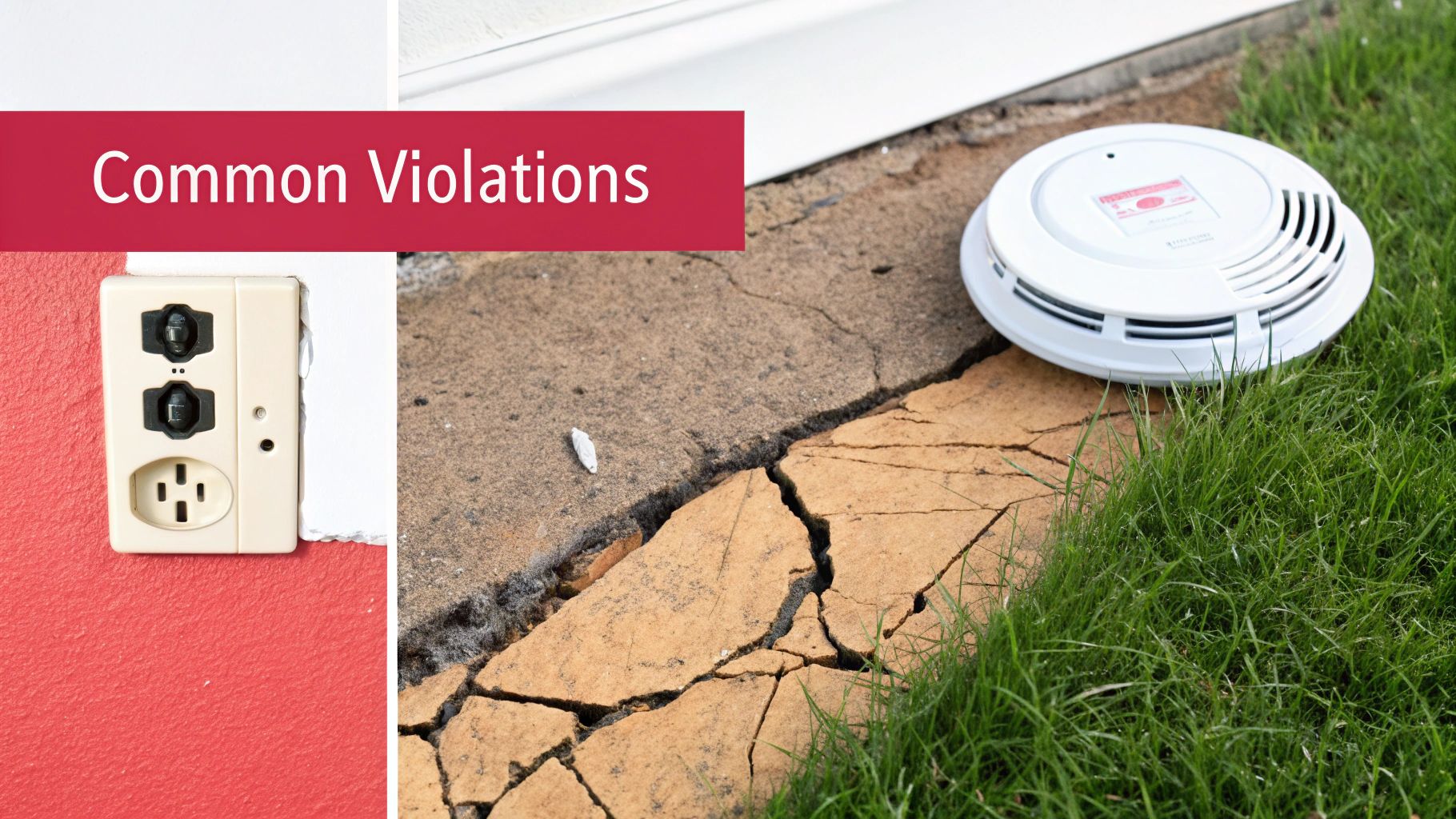
Knowing what a Cleveland Heights inspector is looking for is your secret weapon. It’s the best way to avoid a long, frustrating list of violations. When you get ahead of the game and fix common issues yourself, you dramatically increase your chances of passing the POS inspection on the first go.
Think of it as studying for a test when you’ve already been given the answer key. So many homes in our older suburbs—Cleveland Heights, University Heights, Bedford, you name it—share similar age-related quirks. Inspectors see the same problems day in and day out, and they know exactly where to look.
Your Pre-Inspection Hit List: Exterior Issues
Before you even step back inside your house, take a good, long walk around the property. The exterior is the inspector's first impression, and it can set the tone for the entire visit. These are some of the most common things that get flagged right away.
- Peeling or Chipping Paint: Any flaking paint on siding, trim, windows, or the garage is an automatic violation. It’s not just about looks; it’s a sign of neglect that can lead to wood rot and bigger problems down the road.
- Damaged Gutters and Downspouts: Inspectors will be checking for any loose, sagging, or disconnected gutters. Proper drainage is a huge deal, as it prevents water from seeping into your foundation.
- Cracked Concrete: This one’s a biggie. Significantly cracked or uneven sections of your driveway, front walkway, or even the public sidewalk are considered trip hazards and will need to be repaired.
- Roofing Problems: They won't get on a ladder and walk around, but they’ll give your roof a thorough look from the ground. They’re searching for obvious signs of trouble like missing shingles, curled edges, or any other visible damage.
These exterior fixes can feel like a mountain to climb, especially if you're dealing with a sudden job relocation or managing an inherited property from out of town. The time and money can add up fast, turning what should be a straightforward sale into a major project.
Common Interior Violations to Watch For
Once they come inside, the inspector’s focus shifts to safety and basic function. They’re checking the systems that directly impact the health and well-being of whoever lives in the home. The good news? Many of these issues are relatively cheap to fix but are just easy to overlook.
A great way to get your mind in the right place is to review a comprehensive plumbing inspection checklist to get a sense of the details inspectors care about.
Tackling these small but critical items can make a huge difference. A report with only a few minor issues is far less intimidating to a potential buyer than one filled with electrical and plumbing red flags.
Here are the key areas to double-check:
- Missing GFCI Outlets: Ground Fault Circuit Interrupter outlets are a must-have within six feet of any water source. Go check your kitchen counters, bathrooms, laundry room, and garage to make sure they’re installed and working.
- Smoke and Carbon Monoxide Detectors: You absolutely need working detectors on every level of the home and inside each bedroom. Don't just look at them—push the test button to make sure they're operational.
- Leaky Plumbing: Get down on your hands and knees and check under every sink in the kitchen and bathrooms. Even a slow, tiny drip is a guaranteed violation.
- Insecure Handrails: All stairways, both inside and out, must have sturdy, secure handrails. Give them a good, firm shake. If there's any wobble, they need to be reinforced.
- Exposed Electrical Wiring: This is a major safety hazard and an immediate fail. Look for any uncovered junction boxes or exposed wires in the basement, attic, or garage.
For many sellers in Cleveland, Garfield Heights, or Lorain, getting hit with a long list of violations feels like a dead end. If you don't have the cash for repairs or you simply need to sell your house fast in Cleveland without the runaround, you've got a better option. Home Sweet Home Offers buys properties as-is. We handle the entire POS repair list for you, so you can get a fair cash offer and close on your own timeline.
Understanding the True Cost of a POS Inspection
https://www.youtube.com/embed/_rDU2fZmX0I
When you're getting ready to sell your home in Cleveland Heights, the first cost you'll bump into is the Point-of-Sale inspection application fee. It's a straightforward charge, but honestly, it’s just the tip of the iceberg. The real cost of a POS inspection isn’t what you pay the city upfront; it’s the grand total of everything the inspector finds wrong.
We get how nerve-wracking that is. One minute you’re mapping out your move, the next you’re staring at a report that feels like a massive, unexpected bill. Those costs can snowball in a hurry, turning a simple requirement into a major financial headache.
The Direct and Indirect Financial Hits
The most obvious expenses are the direct ones—the price of materials and labor to fix whatever is on the violation list. A few missing GFCI outlets or a bit of peeling paint might only run you a few hundred dollars. Simple enough.
But what happens if the inspector flags a cracked driveway, a roof that’s seen better days, or an electrical panel that’s decades out of date?
Suddenly, you could be looking at repairs costing thousands, or even tens of thousands, of dollars. For a lot of homeowners in areas like University Heights or Maple Heights, that’s a non-starter. Especially if you've inherited a property, are trying to avoid foreclosure, or need to sell fast because of a job loss, those kinds of funds just aren't there.
And the financial strain doesn't stop with the repair bills. Think about all the time you'll spend chasing down contractors, pulling permits, and then waiting for re-inspections. That time has a cost, too, delaying your sale and piling on the stress.
The Hidden Market Impact on Your Sale Price
Beyond the direct cost of repairs, POS requirements can actually drag down your home's final sale price. It sounds counterintuitive, but mandatory inspections can create a ceiling on property values. In fact, a study from the Akron Cleveland Association of REALTORS® (ACAR) discovered that homes in cities with POS inspection mandates sold for an average of 13% less than similar homes in cities without them. You can read the full study on how these inspections impact homeownership to see the data for yourself.
That potential loss in equity is a huge deal. It means that on top of footing the bill for repairs, the mandate itself might shrink what a traditional buyer is willing to pay.
When you're caught in this financial squeeze, it’s natural to wonder if there’s a better way out. Selling your home "as-is" to a cash buyer offers a clear alternative. If you're weighing your options, our guide on the pros and cons of selling to cash buyers in Cleveland can help you get some clarity.
At Home Sweet Home Offers, we give you a fair cash offer that already accounts for the home's current condition. This lets you sidestep the entire repair process, avoid all the costs, and close the sale with certainty and peace of mind.
Your Options When Repairs Are Not Feasible
Getting a Point-of-Sale inspection report loaded with required repairs can feel like a gut punch. We see it all the time with homeowners in Cleveland Heights, University Heights, and Bedford. It's especially tough when you don't have the time, money, or frankly, the energy to take on a massive project.
Maybe you’re moving for a new job, dealing with an inherited property from out of state, or you just need the cash from your sale now—not months and thousands of dollars later. The good news? A difficult POS report doesn't have to kill your deal. You have options that don't involve you lifting a hammer.
The Escrow Account Option
One common route is to set up an escrow account. Think of it as a separate pot of money, funded by your sale proceeds, that’s held specifically for the POS repairs. You and your buyer agree on a cost estimate for the work, and that amount gets held back from your profit at closing.
The title company manages this fund. After you've closed and moved on, the new owner uses that money to get the repairs done and clear the violations with the city. While this lets you sell, it does mean a smaller check at closing and can sometimes lead to some back-and-forth negotiations over repair costs.
The Buyer Assumption Option
Your other main choice is a buyer assumption. This is exactly what it sounds like: the buyer legally agrees to take on the full responsibility for every single violation on that POS report. They'll sign an assumption agreement directly with the city, and just like that, you're off the hook.
This is by far the simplest path for a seller who just wants a clean break.
A buyer assumption is the key that unlocks a true "as-is" sale in cities with POS requirements. It shifts the entire headache of repairs and city compliance from your shoulders to the new owner's, allowing you to walk away without any strings attached.
Comparing Your Paths Forward
So, which path makes the most sense for you? Let's break it down to help you decide between these two common approaches for handling POS violations.
Repair Options Comparison: Escrow vs. Buyer Assumption
| Feature | Escrow Account | Buyer Assumption |
|---|---|---|
| Seller's Upfront Cost | None, but funds are held from your sale proceeds. | None. |
| Responsibility | The buyer manages repairs, but you negotiate the cost upfront. | The buyer takes on all repair and compliance responsibility. |
| Complexity | Can involve detailed cost estimates and negotiations. | Simpler for the seller; requires a buyer willing to assume liability. |
| Best For | Sellers with traditional buyers who need funds secured for repairs. | Sellers who need a fast, simple, as-is sale with no strings attached. |
For many homeowners, the thought of dealing with either escrow negotiations or finding a traditional buyer willing to assume violations is just too much. If you're looking for a way to bypass all these complexities, our guide on the easiest way to sell a house with code violations in Cleveland dives deeper into this.
At Home Sweet Home Offers, we are cash home buyers who specialize in this exact situation. As a trusted "we buy houses Cleveland" company, we assume all POS violations, giving you a guaranteed, stress-free way to sell your property and move on.
Selling As-Is for a Simpler Path Forward

Let's be honest. For many homeowners in Cleveland Heights, University Heights, and the surrounding neighborhoods, the whole Point-of-Sale process is just too much. It can feel like you're stuck in a never-ending loop of inspections, eye-watering repair quotes, coordinating contractors, and waiting for the city to come back out. All this while you're just trying to move on with your life.
This cycle is especially tough if you're managing an inherited property from out of state, scrambling to relocate for a new job, or simply don't have the cash on hand for major repairs. The good news? There's a much more direct, stress-free alternative.
A Path That Bypasses the Hassle
Selling your house "as-is" for cash to a trusted local buyer like Home Sweet Home Offers lets you completely sidestep the entire POS repair headache. We're cash home buyers in Cleveland who buy properties in their current condition, meaning we take on full responsibility for every single violation on that inspection report.
This means you get to skip:
- The endless calls and meetings trying to hire and manage contractors.
- The back-and-forth negotiations over who pays for which repairs.
- The waiting game for city re-inspections to clear your property.
- Dealing with complicated and confusing escrow holds.
We know that homeowners sell for many reasons. Whether you're a tired landlord in Euclid, downsizing in Lakewood, or need a quick home sale in Parma due to a divorce or financial hardship, the last thing you need is more complexity.
Selling as-is offers one thing you can't get from the traditional process: certainty. You get a fair cash offer and a firm closing date you can actually plan your life around. It allows you to sell your house and move forward without the heavy burden of repairs.
Whether your property is in Garfield Heights, Elyria, or Lorain, this option puts the control back in your hands. We're here to give you a fast cash offer and a simple solution to what can be a very complicated problem, letting you close this chapter and start your next one.
Common Questions About Cleveland Heights POS Inspections
Navigating the world of Point-of-Sale inspections in Cleveland Heights can feel a little confusing, especially when you're trying to sell your home. We get it. Let's walk through some of the most common questions homeowners have to clear things up.
How Long Is a Cleveland Heights POS Certificate Good For?
Once you have that Certificate of Inspection in hand, it's valid for exactly one full year from the issue date.
Life happens, and sometimes a sale doesn't close within that window. If your home is still on the market after that year is up, you'll need to go through the process again—that means scheduling and paying for a new inspection before the property title can officially be transferred.
What If the Buyer and I Can't Agree on Who Pays for Repairs?
This is where things can get tricky. If you and the buyer are at a standstill over who's covering the repair costs for POS violations, it all comes down to negotiation.
You might offer to knock a little off the sale price or give the buyer a credit at closing to cover the work. But if you can't find a middle ground, the buyer could walk away from the deal, depending on the terms of their contract.
This is exactly the kind of headache you avoid by selling as-is. When you work with cash home buyers in Cleveland like us, you skip these stressful, last-minute negotiations altogether. We handle it all.
Can I Sell My House If It Has Existing POS Violations?
Yes, you absolutely can sell a home with outstanding POS violations. You’ve got a few options here.
You could fix the issues yourself before closing, which is the most straightforward path. Another option is to have the buyer formally assume responsibility for the repairs in writing. Some sellers also set up an escrow account with funds dedicated to completing the required work after the sale.
Of course, the simplest route is to sell your house as-is in Cleveland directly to a cash home buyer like Home Sweet Home Offers. We buy the property from you, and then it's on us to deal with all the violations after you've closed and moved on.
Facing a long list of POS violations or simply want to sell without the stress? At Home Sweet Home Offers, we provide a fair cash offer and handle all the repairs so you can close quickly and confidently. Get your no-obligation cash offer today at https://www.homesweethomeoffers.com.